
Use AI for government RFP analysis to build strategic compliance matrices, parse complex FAR/DFARS clauses, and scale your federal proposal development.
Yes. AI can analyze a federal RFP and build a compliance matrix that organizes requirements for your proposal team. AI for government RFP analysis can also help identify FAR and DFARS clauses, connect requirements to approved knowledge, and prepare relevant draft answers. These tools can support your work, but your team’s review remains essential.
Federal solicitations can span hundreds of pages, combining technical, contractual, and submission requirements. AI can help organize the material for review, while your team interprets context, confirms clause applicability, and validates response accuracy.
AI can structure compliance information, support clause analysis, and draft content from approved materials. Human oversight, information controls, and final review remain essential parts of a disciplined proposal process.
Key Takeaways
- Use AI to organize solicitation requirements into a matrix that assigns each item for tracking and review.
- Analyze FAR and DFARS clauses in context, flagging provisions that need careful interpretation and follow-up.
- Ground draft answers in approved proposal materials, then have subject matter experts review them for accuracy and relevance.
- Assess permissions, information handling, and audit trails as part of adopting AI for federal proposal work.
- Align proposal development with a clear compliance process; professional Proposal Writing support can help when your team needs additional capacity.
AI-assisted drafting and content generation
The price generally reflects platform scope, integrations, and support; smaller organizations responding to fewer than 10 RFPs per year may not need an enterprise-grade platform.
A strong workflow for AI for government RFP analysis retrieves approved company content before generating proposal responses. The system can draw from past proposals, capability statements, project examples, and approved technical descriptions. Retrieval-augmented generation connects generated text to these sources, rather than relying only on general model knowledge. This approach can reduce hallucination rates by more than 40%.
For example, a team responding to a cybersecurity contract could ask AI to draft an answer using approved security procedures and relevant past performance. The team should check every claim against its source, confirm that cited experience applies, and remove unsupported statements. Government contractors report spending more than seven hours developing a first proposal draft, so targeted drafting can address a substantial manual task.
Measure draft usefulness before expanding AI across the procurement lifecycle. Test the system with 20 to 30 real questions from a recent proposal, then classify each response as usable, needing revision, or unusable. A usable draft rate above 60% signals strong knowledge connectivity; a rate below 40% usually indicates that valuable content sources are missing or poorly indexed.
- Select representative questions: Include technical, management, past-performance, and compliance prompts from one recent RFP.
- Record source coverage: Track whether each answer cites approved material and whether the cited version remains current.
- Score review effort: Note whether subject matter experts make minor edits, substantial revisions, or complete rewrites.
- Estimate operational value: Compare review and drafting hours before and after the pilot, using the same proposal work categories.
This is a scenario, not a guaranteed outcome. Actual value depends on proposal volume, source quality, review time, and implementation effort.
AI-generated responses still require human validation. Subject matter experts should review technical accuracy, context, and feasibility before submission. A 45% confidence score, for example, can signal that reviewers should rewrite an answer rather than rely on generated language. AI can accelerate drafting; accountable proposal owners remain responsible for a clear, accurate response aligned with the contract.
Can AI RFP software build a compliance matrix for federal proposals?
Yes. AI can extract solicitation requirements and organize them in a compliance matrix, linking each item to a response owner, proposal section, and review status. A proposal team must still validate the extraction against the complete solicitation.
Requirement Extraction and Tracking
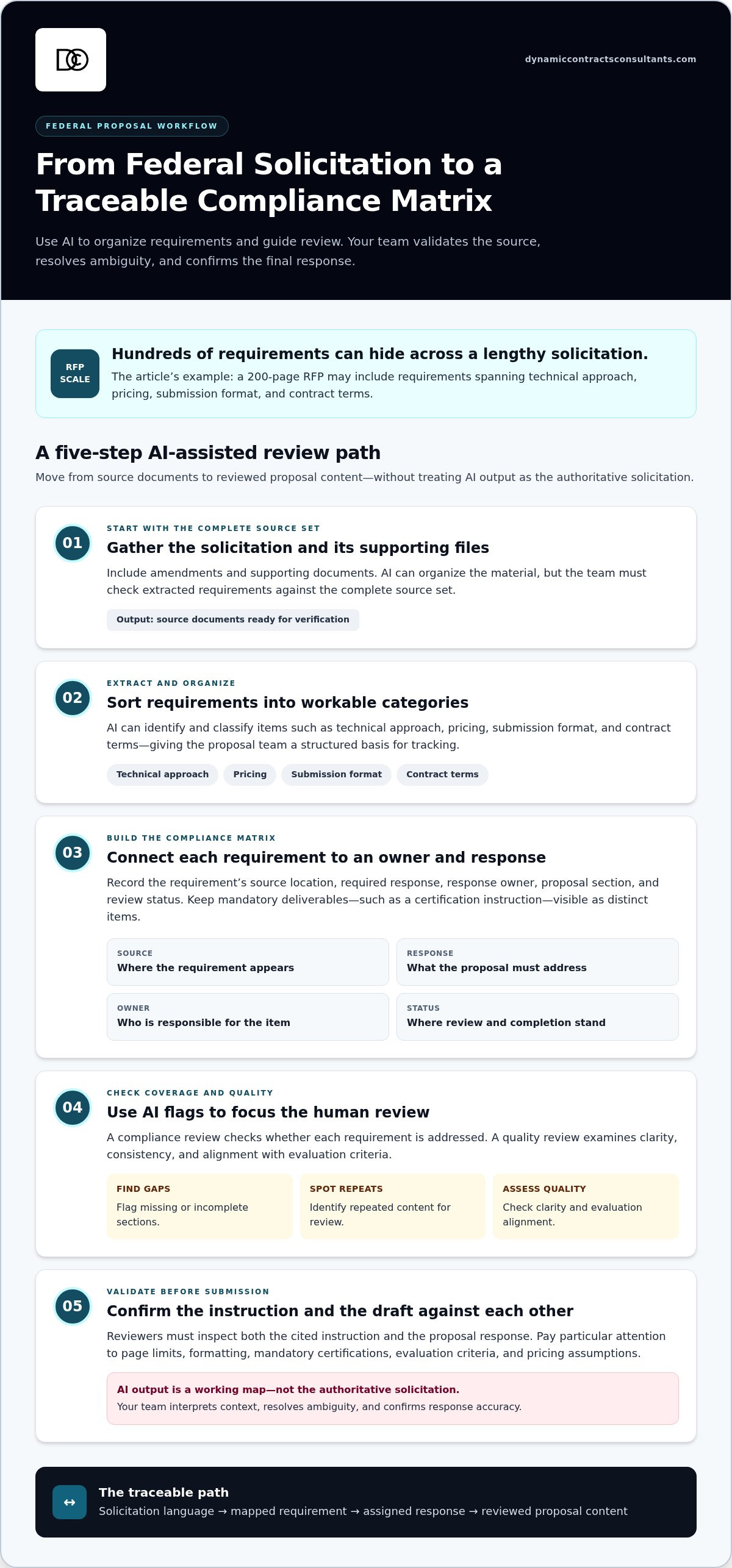
Requirement extraction identifies solicitation instructions and maps them to corresponding proposal responses. For a 200-page RFP with hundreds of requirements, AI can sort items by topic, such as technical approach, pricing, submission format, and contract terms. This gives the proposal team a structured basis for assigning work and tracking completion.
A useful matrix records each requirement’s source location, required response, owner, and status. The team can compare it with the original documents and flag items that need interpretation. For example, a mandatory certification instruction should remain visible as a distinct deliverable, rather than being buried in a broader compliance category.
Proposal Compliance and Quality Reviews
A compliance review checks whether the draft addresses each requirement; a quality review assesses clarity, consistency, and alignment with evaluation criteria. AI can compare response text with extracted requirements and flag gaps, repeated content, or incomplete sections. These checks help reviewers focus on specific issues before the proposal team prepares its final submission.
Manual review can miss page limits, formatting instructions, mandatory certifications, or responses that fail to address evaluation criteria. AI flags can guide review, but the team must inspect both the cited instruction and the draft. Pricing tables, for example, require careful comparison with solicitation instructions and the proposal’s stated assumptions.
AI Tools, Manual Review, and Proposal Software
AI RFP tools extract and classify information across documents, while manual review depends on people reading and recording requirements. Traditional proposal software often supports collaboration and document control; AI adds automated analysis and mapping. The functions can work together: AI organizes the review, and people resolve ambiguity before submission.
For a small business assessing federal opportunities, AI can summarize the solicitation, extract key requirements, and highlight deadlines or scope complexity. The business can then compare those findings with its capabilities, proposal resources, and strategic fit before deciding whether to pursue the opportunity.
Treat AI outputs as a working map, not the authoritative solicitation. Check each extracted requirement against its source document, including amendments and supporting files, then record the response location and review status. This creates a traceable path from solicitation language to proposal content and helps reviewers find omissions before submission.
AI-generated proposal answers grounded in approved knowledge
AI-generated proposal answers are most useful when the system retrieves approved company material before drafting. For a federal response, that material might include validated past-performance narratives, technical descriptions, staffing approaches, and previously approved language. The model can produce a tailored draft, but proposal staff must ensure every claim reflects current capabilities and the opportunity’s requirements.
Which AI platforms specialize in government RFP analysis? Look for platforms designed to interpret federal solicitation documents and connect answers to a controlled library of company content. Useful capabilities include semantic search, source references, version handling, and workflows that support human review, not just content generation.
A searchable knowledge library helps teams find relevant language without copying entire past proposals. For example, an AEC contractor pursuing a facilities project could search approved narratives about project controls, engineering methods, or comparable work. The team should confirm that each example fits the new scope, reflects current information, and does not carry forward outdated commitments.
Content quality depends on how knowledge is organized. Three well-connected sources can outperform 15 poorly indexed ones. A centralized library should therefore prioritize approved, clearly labeled material over document volume. Teams can classify content by capability, customer, contract type, technical theme, and approval status. That structure helps AI tools retrieve relevant passages and gives reviewers a route back to the source.
Proposal automation can support government and AEC workflows beyond drafting. During capture, teams may use AI to summarize opportunity information, organize agency research, and develop themes for later responses. During proposal development, the same knowledge base can help draft initial content, adapt approved language to evaluation criteria, and identify where evidence is needed.
- Capture planning: Organize agency context, incumbent information, and strategic-fit considerations before proposal work begins.
- Response development: Retrieve approved examples and tailor their language to the solicitation’s requirements.
- Review preparation: Trace generated statements to sources so subject matter experts can validate accuracy and relevance.
Centralized proposal knowledge management also supports continuity when contributors change between opportunities. A proposal manager can preserve approved themes, source documents, and revision history in one governed library. Before AI uses the content, designate authoritative materials, assign owners for updates, and separate approved statements from drafts or superseded language.
For example, a past project description may support a technical answer without proving performance under a different contract structure. Reviewers should check the underlying project record, validate the connection, and revise the draft where context differs. This disciplined workflow lets AI accelerate retrieval and drafting while accountable subject matter experts retain proposal judgment.
Security, permissions, and audit trails
Evaluate security controls alongside an AI platform’s proposal capabilities, because RFP files can contain sensitive business and contract information. Before uploading documents, identify the data categories involved, who may access them, and how the tool stores and processes them. For example, a team handling controlled unclassified information (CUI) needs permissions and handling practices appropriate to that environment.
Encryption is one part of the review. Assess whether data is encrypted in transit using TLS/SSL and at rest using AES-256 or equivalent. Also consider whether the platform has SOC 2 Type II certification and how its stated controls fit your organization’s security requirements. FedRAMP, FISMA, ITAR, SOC 2, and ISO 27001 are frameworks or standards that may be relevant to government procurement platforms; their relevance depends on the system and data involved.
Permissions should reflect proposal roles, rather than giving every contributor unrestricted access. Role-based access can distinguish writers, reviewers, administrators, and subject matter experts. Controlled workspaces can separate an RFP’s technical sections from pricing material, while review workflows can align comments with color team cycles. Activity logs help teams track who accessed or changed a compliance matrix, draft answer, or source document.
Audit trails also support accountability. A useful record can show which source supported a generated response, who edited the language, and when the change occurred. For example, if a reviewer revises a past-performance statement, the team should be able to trace the edit and its approval. This record helps distinguish approved writing from draft content during later reviews.
Review data privacy practices, including model-training procedures. Determine how uploaded documents, prompts, and generated responses are handled, and whether your organization can control their use. Set internal rules for permitted data, approved users, and retention before bringing an AI tool into proposal workflows. These controls help prevent team members from putting sensitive contract information into an unapproved system.
- Access: Assign permissions by role, project, and document sensitivity.
- Protection: Evaluate encryption, security documentation, and relevant standards against your requirements.
- Traceability: Retain activity logs for source access, edits, reviews, and approvals.
- Governance: Set clear rules for data handling and model use before uploading proposal materials.
Security is not a single platform feature. A controlled workspace, documented permissions, and traceable writing reviews work together to protect proposal information. For a federal contractor, evaluating these safeguards before adopting AI connects operational efficiency with strategic compliance.
FAR and DFARS clause analysis
AI can help proposal teams locate and organize FAR and DFARS clauses, then connect them to response planning. It can flag clause families, summarize language, and identify provisions that warrant closer review. It cannot determine clause applicability or replace informed interpretation of the solicitation and contract context.
Federal, state, and local procurement requirements depend on jurisdiction, solicitation, and applicable agency policies. For a federal opportunity, review the FAR and any DFARS clauses included in the solicitation; state and local opportunities may use different procurement terms and policies. AI should identify relevant text for review, not declare that one universal rule applies to every procurement.
Start clause analysis with the complete solicitation package. Proposal teams can direct an AI tool to extract clause references, preserve their document locations, and group related provisions for review. The reviewer then compares each result with the underlying text, related instructions, amendments, and proposed work. This process helps surface obligations without treating a generated summary as authoritative.
Context matters. A clause’s significance can depend on the solicitation language, contract structure, agency, and proposed work. For example, a clause affecting subcontractor obligations may require the team to consider flow-down implications. AI can flag the clause family and prompt a review, while contracting and compliance professionals assess how it applies to the opportunity.
Clause mapping can also connect findings to proposal decisions. A team might record the provision, source location, responsible reviewer, response implications, and any open interpretation question. Linking these fields to proposal sections helps writers address relevant requirements and keeps important issues from being isolated in a separate clause list.
Use AI outputs to produce reviewable information, not unsupported conclusions. A practical sequence is to identify the clause, verify its text in the solicitation, assess its relevance to the work, and document the resulting proposal action. If the language is ambiguous or materially affects the offer, route it to an appropriate contracting or legal professional for interpretation.
Dates and procurement channels can also affect analysis. Beginning October 1, 2026, Department of War contracting officers must publish unclassified solicitations and receive offers through the PIEE Solicitation Module unless an exception applies. Proposal teams should account for such solicitation-specific instructions when organizing opportunities and submission workflows.
Clause-aware proposal development requires coordination between document analysis, compliance review, and response drafting. For help connecting contract requirements with clear proposal content, turn to expert proposal-writing support.
Dynamic Contracts Consultants LLC: Proposal Writing
Dynamic Contracts Consultants LLC provides Proposal Writing support to government contractors bringing solicitation requirements, clause analysis, and response development together in a coherent submission. This service can help your team turn its compliance review and approved content into clear, requirement-focused proposal sections.
Turn to Proposal Writing support when your team needs help structuring responses, aligning technical content with evaluation criteria, or coordinating a complex federal proposal. It complements AI analysis: automation can organize information, while proposal expertise shapes it into an accurate response.
Contact Dynamic Contracts Consultants LLC to discuss your government proposal needs.
Turn RFP intelligence into a repeatable capability
The next step is to make AI for government RFP analysis part of a governed proposal practice, not an isolated experiment. Establish clear ownership of source materials, review decisions, and updates so each opportunity can inform stronger workflows. Your team can then scale automation while preserving accountability for the final submission.
When additional expertise can help put this approach into practice, Dynamic Contracts Consultants LLC offers Proposal Writing, Grant Writing, and DCAA Compliance Consulting. These services support organizations preparing proposals, pursuing grant opportunities, or addressing DCAA-related compliance needs.
Contact Dynamic Contracts Consultants LLC to discuss the support that fits your next opportunity. With a deliberate process and the right expertise, your team can build a more consistent foundation for future growth.
Frequently Asked Questions
How can AI help government contractors save time?
AI can reduce repetitive document work, giving proposal staff more time for analysis and decision-making. For example, it can organize solicitation content, draft reusable text from approved materials, and identify sections needing specialist review. Teams can assess practical value by comparing time spent on equivalent tasks before and after adoption, including correction time. Savings depend on how well the system fits existing workflows and how much review its outputs require.
How fast can a team realistically adopt AI RFP software?
Adoption speed depends on content readiness, security review, user permissions, and integration with proposal workflows. A team can begin with a bounded pilot using selected solicitation documents and approved materials, then assess output quality and review effort before expanding use. Preparing a searchable, current knowledge library and defining who approves AI-generated content are foundational tasks. These decisions, not software installation alone, shape the rollout schedule.
What is an AI RFP software platform?
An AI RFP software platform applies artificial intelligence to solicitation and proposal work. Depending on its capabilities, it may read procurement documents, identify requirements, organize responses, search company materials, or support draft generation. It can connect analysis with collaboration features, such as assigning review tasks and maintaining document versions. It supports the work, but is not the authoritative source for solicitation terms or a substitute for proposal-team decisions.
Will AI RFP software put CUI or proprietary pricing at risk?
Uploading CUI or proprietary pricing creates exposure if access, storage, or model-use controls do not meet your organization’s requirements. Before using a platform, determine what data it receives, who can access it, how it is retained, and whether submitted information is used for model training. For example, teams can restrict pricing files to authorized reviewers and keep sensitive documents out of workflows without appropriate safeguards.
What can AI tools do to analyze government RFPs and solicitations?
AI tools can identify solicitation sections, summarize scope, extract deadlines, classify requirements, and flag clauses or instructions for review. A proposal manager might use the system to locate submission-format language, then assign that instruction to the document-production lead. Tools can also support opportunity qualification by organizing scope and evaluation information. Use source references to connect findings with the original solicitation text.
How accurate are AI tools at extracting RFP requirements and deadlines?
Accuracy varies with document quality, formatting, tables, scanned pages, and how clearly each requirement is expressed. A deadline embedded in an amendment or table may be harder to interpret than a clearly labeled date in the main instructions. Reviewers should compare extracted items with their source passages, paying particular attention to amendments, submission instructions, and requirements spread across multiple documents.
How can agencies or contractors use AI to summarize and evaluate an RFP?
Use AI to create an initial summary organized around scope, deliverables, evaluation factors, submission instructions, and open questions. Then compare it with the solicitation and assess the opportunity against organizational capabilities, staffing, schedule, and strategic priorities. For example, a contractor can identify a technical requirement that depends on a capability it plans to provide through a teammate, then account for that dependency in its pursuit decision.
What security and compliance certifications should government RFP AI tools have?
Assess SOC 2 Type II certification and consider whether FedRAMP, FISMA, ITAR, or ISO 27001 is relevant to your data and use case. These names do not represent interchangeable assurances, and one credential does not establish suitability for every environment. Review the platform’s encryption, access controls, audit records, and CUI handling alongside any certification. Your security requirements and information types determine which safeguards matter for adoption.
Have a question this article didn’t answer?
Talk it through with a certified contracting professional. The first 30 minutes are free.