
See how proposal manager roles and responsibilities align teams, manage compliance and reviews, and deliver strategic, on-time responses to complex bids.
A bid can have strong technical content and a sound strategy yet lose coherence when no one owns the response from planning through submission. Proposal manager roles and responsibilities center on coordinating that process: interpreting the solicitation, organizing contributors and reviews, managing the schedule, and keeping the response aligned with requirements and strategy. The proposal manager is accountable for the proposal itself, while related roles may lead the broader pursuit.
That distinction matters when business development, capture, pricing, technical, and writing teams all contribute under deadline. A proposal manager brings their work into one controlled response, clarifying responsibilities, decisions, and review points while keeping compliance and delivery on track.
This article explains what proposal managers do, how they coordinate cross-functional teams, and where process failures can occur. It also compares the role with bid, capture, and RFP management positions, clarifying where proposal ownership begins and ends and what support can help an organization prepare a more disciplined response.
Key Takeaways
- Use a compliance matrix and an integrated schedule to keep solicitation requirements, owners, reviews, and submission tasks visible.
- Coordinate subject matter experts, pricing, capture, and reviewers around shared customer requirements and proposal strategy.
- Recognize how missed inputs, late reviews, and production constraints can put a compliant, on-time submission at risk.
- Distinguish ownership of the proposal response from leadership of the wider bid pursuit and related capture activities.
- Identify when structured proposal writing or capture management support can strengthen your response process.
What Is a Proposal Manager?
A proposal manager directs a response from opportunity review through submission. The role combines project leadership, content coordination, and quality control. In federal contracting, proposal managers organize work around solicitation requirements while contributors develop technical and business content. Understanding proposal manager roles and responsibilities helps organizations define where coordination and accountability sit.
Proposal Lifecycle Stages
The proposal lifecycle is the sequence of work that turns an opportunity into a submitted response. Its stages show how clear ownership helps organizations coordinate decisions and manage dependencies.
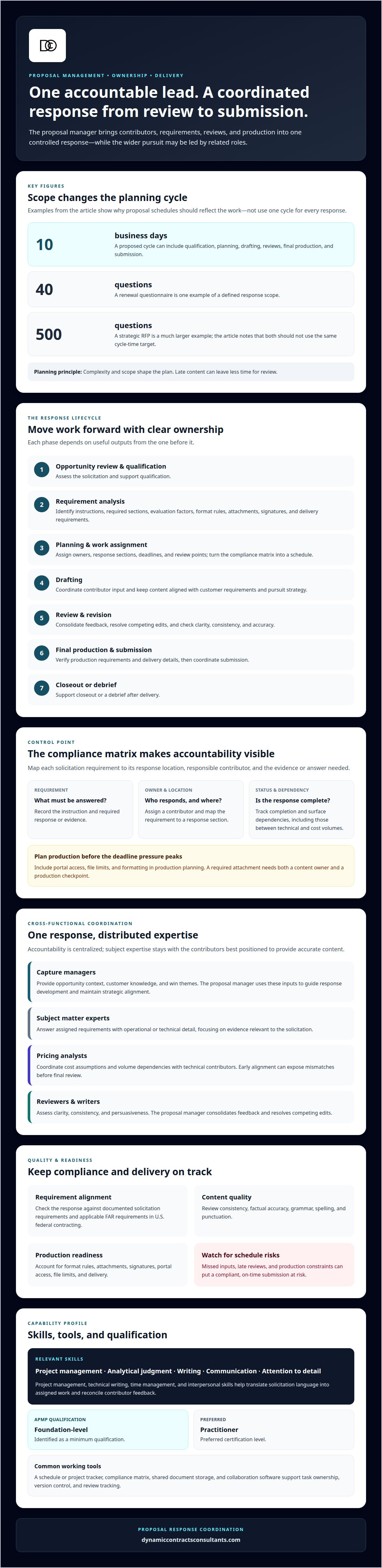
At opportunity review, the manager assesses the solicitation and supports qualification. During planning, they assign owners, sections, and deadlines. They coordinate drafting, reviews, revisions, production, and submission, then support closeout or a debrief. A proposed 10-business-day cycle can include qualification, planning, drafting, reviews, final production, and submission. We track progress across the process so a delayed technical input is visible before final production.
From opportunity review to submission, the steps include qualification, requirement analysis, work assignment, drafting, review, final production, and delivery. Each phase relies on useful outputs from the one before it. Late content can leave less time for review, so managing dependencies is essential.
Solicitation and FAR Compliance
Solicitation compliance means aligning every response element with the agency’s instructions and evaluation factors. In U.S. federal contracting, proposal managers also account for applicable FAR requirements. This alignment is essential because even a persuasive answer can miss a required instruction or deliverable.
The manager analyzes the solicitation, identifies required sections, and records rules for format, attachments, signatures, and delivery. They assign each requirement to an owner and verify that the response addresses it. For example, a required attachment needs both a content owner and a production checkpoint.
Quality assurance checks the response against documented requirements. Reviewers assess consistency, factual accuracy, grammar, spelling, and punctuation. Include portal access, file limits, and formatting in production planning instead of leaving them for last-minute troubleshooting.
Compliance Matrices and Response Planning
A compliance matrix maps solicitation requirements to response sections, owners, and completion status. This makes accountability visible and helps teams identify unanswered instructions before submission.
For each requirement, the manager records its location, responsible contributor, and the evidence or answer needed. Subject matter experts can draft to assigned instructions, while reviewers trace each response back to its requirement. The matrix can also reveal dependencies between technical and cost volumes.
Planning turns the matrix into a schedule covering drafting, review, approval, and production. A 40-question renewal questionnaire and a 500-question strategic RFP should not use the same cycle-time target; complexity and scope shape the plan.
Proposal Management Skills and Tools
Proposal managers combine project management, analytical judgment, writing, communication, and attention to detail. APMP Foundation-level certification is identified as a minimum qualification, with Practitioner preferred.
These capabilities help managers turn solicitation language into assigned work and reconcile feedback from technical and business contributors. Project management, technical writing, time management, and interpersonal skills are all relevant to the role.
Common tools include a schedule or project tracker, compliance matrix, shared document storage, and collaboration software. They support task ownership, version control, and review tracking. A clear understanding of proposal manager roles and responsibilities helps organizations decide who maintains each tool and acts on its information.
Cross-functional team coordination
A proposal manager connects contributors whose work must come together as one credible response. Sales, capture, technical, pricing, and writing teams bring different priorities. The manager aligns their input with the pursuit strategy and customer requirements, giving each contributor a clear purpose and helping prevent conflicting messages across sections.
Accountability is centralized, but expertise remains distributed. The proposal manager assigns work to the people best positioned to provide accurate content, then coordinates how their contributions fit together. For example, a technical lead explains the solution while a pricing analyst develops the cost volume. The manager aligns both with the customer’s stated needs and the organization’s strategy.
- Capture managers provide opportunity context, customer knowledge, and win themes. The proposal manager uses those inputs to guide response development and maintain strategic alignment.
- Subject matter experts answer assigned requirements with operational or technical detail. Clear section ownership helps them focus on evidence relevant to the solicitation.
- Pricing analysts coordinate cost assumptions and volume dependencies with technical contributors. Early alignment can expose mismatches before final review.
- Reviewers and writers assess clarity, consistency, and persuasiveness. The proposal manager consolidates their feedback and resolves competing edits.
Sequence matters. The manager communicates deadlines and dependencies so contributors understand when their work affects another section. If the technical approach changes, pricing may need to revisit its assumptions. If a subject matter expert submits content late, the writer may have less time to integrate it. Tracking these handoffs makes development more controlled and keeps schedule decisions visible.
Meetings should serve specific coordination purposes, not just report progress. A strategy session aligns the team on customer priorities and differentiators. A risk review identifies weaknesses that need evidence or mitigation. A technical review tests whether the proposed approach is clear and supportable. The manager records decisions, owners, and follow-up actions so discussion leads to useful changes.
Disagreement can improve a response when the team resolves it against the solicitation and strategy. A technical lead may favor detail, while a writer may recommend greater brevity. The proposal manager weighs the requirement, evaluator relevance, and available space, then guides the team toward a focused answer. This helps preserve accurate meaning without letting individual preferences fragment the narrative.
Visual contributors also need coordination. A graphic should clarify a process, architecture, or differentiator, not simply decorate a page. The manager connects its purpose to the surrounding text and checks that labels and claims are consistent. When review feedback is integrated systematically, the final response makes one coherent case rather than presenting disconnected departmental submissions, supporting a more disciplined path to revenue opportunities.
Common proposal management pitfalls
Proposal performance metrics should track delivery, compliance, accuracy, and pursuit outcomes. Useful KPIs include on-time, fully compliant submissions; compliance or factual errors; and win-and-loss pursuit metrics.
One common failure is proceeding without a clear qualification decision. A team may invest heavily in a solicitation that no longer fits its strategy, capacity, or customer priorities. For example, a changed requirement may weaken the original rationale for pursuing the opportunity. Revisit the decision when material information changes, and document why the response remains viable.
Another pitfall is treating solicitation criteria as broad themes rather than specific obligations. A response can discuss the right subject yet miss a requested deliverable, format, or evaluation point. Before drafting, map each criterion to a planned answer and an accountable owner. During review, confirm that each section answers its instruction directly, rather than merely mentioning related capabilities.
Pricing and technical content can diverge when developed in isolation. A technical approach may describe staffing or materials that the pricing volume does not account for. Compare assumptions across both volumes before approval, and resolve discrepancies with the responsible contributors. This protects the proposal’s credibility and helps reviewers assess one consistent offer.
- Late content: A subject matter expert’s delayed input can leave insufficient time for review. Escalate missing dependencies early and distinguish essential content from material that can be removed.
- Uncontrolled revisions: Multiple versions can introduce conflicting figures or outdated language. Assign a controlled working file and reconcile edits before final production.
- Weak review closure: Review comments add little value if no one records a decision. Assign each material comment an owner and disposition, such as accept, revise, or reject.
Production errors create another avoidable risk. A complete response may still have missing attachments, incorrect file names, absent signatures, or portal upload problems. Use the solicitation’s submission instructions as a final production checklist, including file limits and formatting. Leave time to inspect the assembled files, not just the individual sections.
AI-assisted drafting can introduce unsupported claims or factual inconsistencies. Treat generated text as draft material, then validate each assertion against approved evidence and the solicitation. A useful quality measure is zero compliance or factual errors in AI-assisted content submitted to clients. Human review remains essential because fluent wording alone does not establish accuracy.
Metrics need context. On-time delivery and compliance indicate process control, while win-and-loss results reflect the broader pursuit. Review both across comparable opportunities, and examine causes rather than treating one outcome as proof of performance. A missed criterion, pricing mismatch, or late approval calls for a different corrective action. This diagnosis turns KPI tracking into a practical improvement process.
Proposal manager, RFP manager, and bid manager role differences
These titles can describe overlapping work, but they signal different areas of ownership. A proposal manager focuses on the response; a bid manager may lead the wider pursuit. An RFP manager title often indicates responsibility for an RFP response. Because organizations use titles differently, compare decision authority and deliverables, not labels alone.
A proposal manager owns the proposal document and its development through submission. The role connects customer requirements with the organization’s bid strategy by coordinating contributors, writing, reviews, and final production. For example, the manager ensures the technical narrative supports the chosen win themes and remains consistent across sections. The focus is a complete, compelling response that meets the solicitation’s criteria.
An RFP manager commonly performs proposal management functions under a title centered on the request for proposal. In some organizations, the RFP manager and proposal manager are the same role. In others, an RFP manager may focus specifically on organizing an RFP response, while proposal management covers other response formats too. The title alone does not establish a universal distinction.
A bid manager typically owns more of the pursuit than the proposal document. That wider scope can include capture, presentations, and negotiation, alongside oversight of bid strategy and pursuit outcomes. For example, the bid manager may direct the opportunity, while a proposal manager organizes how that strategy appears in the written response. The roles complement each other when responsibilities are clearly assigned.
The distinction matters at key decision points. During opportunity assessment, a bid manager may lead the broader pursuit decision. Once the organization proceeds, the proposal manager can direct response development, coordinate inputs, and manage delivery. During a presentation or negotiation, the bid manager’s wider remit may continue beyond the document. Agree on these boundaries early, especially when one person holds multiple titles.
- Proposal manager: Owns the response document, its coordination, and submission readiness.
- RFP manager: Often manages an RFP response; the title may be interchangeable with proposal manager.
- Bid manager: Leads the wider pursuit, which can extend into capture, presentations, and negotiation.
Industry terminology adds nuance. A contract proposal manager role tends to emphasize completing a compliant response on time more than a permanent role does. This describes a tendency, not a fixed job boundary. In either arrangement, the organization benefits from identifying who owns strategy, writing, approvals, and final delivery.
To compare roles, ask three questions: who directs the pursuit, who owns the written response, and who leads customer-facing stages beyond submission? The answers help a team assign accountability without duplicating effort. Clear boundaries connect bid strategy to the proposal while allowing each role to focus on defined outcomes.
Proposal manager versus related roles
Related roles contribute to proposal success, but their ownership differs. A proposal manager governs the response; other roles shape the opportunity, content, or decisions around it. Comparing deliverables and decision authority clarifies who directs each stage, prevents duplicated work, and keeps progress visible.
Capture Manager
A capture manager develops the pursuit strategy before and during response development, bringing customer context, opportunity positioning, and win themes into proposal planning. The proposal manager translates that direction into a structured written response. For example, capture may identify a differentiator, while proposal management ensures the relevant section explains it clearly and supports it with evidence.
The two roles work closely, but their primary outputs differ. Capture focuses on shaping the opportunity and strengthening the organization’s position. Proposal management focuses on expressing the chosen strategy in a complete submission. If the capture strategy changes, the proposal manager coordinates updates across affected sections.
Proposal Writer and Coordinator
A proposal writer develops and edits content, often focusing on assigned sections or the overall narrative. The proposal manager oversees how that writing fits the requirements, schedule, and response strategy. For example, a writer may refine a technical explanation while the manager checks its alignment with the solicitation and other volumes.
A proposal coordinator typically supports administrative control, such as document tracking, meeting logistics, or version management. The proposal manager remains accountable for integrating those activities into the response process. In a smaller team, one person may perform both functions, but the responsibilities remain distinct.
Sales and Subject Matter Experts
Sales professionals manage customer relationships and help identify opportunities. Their customer knowledge can inform positioning, while proposal management turns relevant insights into coordinated response content. For instance, sales may explain a customer priority, and the proposal manager ensures the response addresses it consistently.
Subject matter experts contribute technical, operational, or past-performance knowledge. They provide the substance; the proposal manager organizes it into evaluator-focused content. An expert may describe a solution, while the manager determines where that explanation belongs and coordinates revisions if it conflicts with another section.
Pricing and Executive Decision-Makers
Pricing analysts develop cost inputs and assumptions; proposal managers coordinate consistency between pricing and technical content. If the technical approach describes a resource that is absent from the pricing assumptions, the teams must resolve the discrepancy before approval.
Executives make strategic decisions, including whether to pursue an opportunity or approve the final response. The proposal manager provides schedule, compliance, and progress information to support those decisions, then implements approved direction. The practical distinction is clear: executives decide, specialists contribute, and proposal managers control response integration. This division helps teams assign accountability and address errors without confusing content ownership with pursuit authority.
Dynamic Contracts Consultants: Proposal Writing
Dynamic Contracts Consultants LLC provides Proposal Writing for organizations developing solicitation responses. We support proposal development with AI-assisted writing and customized templates, incorporating AI-driven automation into the drafting workflow while keeping your requirements and approved strategy central.
When your priority is operational efficiency or scalable intelligence across proposal work, our support can complement your internal expertise. Capture Management can help shape opportunity positioning, while Grant Writing and DCAA Compliance Consulting address distinct organizational needs.
Contact Dynamic Contracts Consultants LLC to discuss Proposal Writing or another relevant service.
Build a More Deliberate Pursuit Process
A clear understanding of proposal manager roles and responsibilities can help your organization make accountability part of its operating model, rather than leaving it as an expectation for individual contributors. For your next opportunity, identify who owns the response, where strategic decisions sit, and how contributors will resolve competing priorities. These decisions create a practical foundation for consistent execution and informed improvement across future pursuits.
When internal capacity or specialized expertise is a constraint, Dynamic Contracts Consultants LLC offers Proposal Writing, Grant Writing, and DCAA Compliance Consulting. These services address different needs, from developing a written response to supporting grant submissions or DCAA compliance. Choose support based on the work your team needs to advance, while keeping your organization’s pursuit decisions and priorities clear.
Contact Dynamic Contracts Consultants LLC to discuss your proposal needs, and take a considered next step toward a more disciplined pursuit process.
Frequently Asked Questions
What are the core roles and responsibilities of a proposal manager?
A proposal manager is accountable for turning an approved pursuit into a controlled, customer-ready response. Beyond coordinating production, the role clarifies decision rights, documents open issues, and escalates changes that affect scope or delivery. For example, if leadership changes the proposed solution, the manager identifies impacted content owners and routes the revision for approval. This governance keeps contributors working from current decisions rather than assumptions.
How does a proposal manager differ from a bid manager or capture manager?
A proposal manager directs response development, while a bid manager oversees the broader pursuit and a capture manager shapes opportunity positioning. In practice, the capture lead may recommend an approach to the customer before drafting begins; the proposal manager then translates approved direction into the response. The bid manager can retain responsibility for pursuit decisions beyond the document. In smaller organizations, one person may cover multiple functions, so explicit decision authority matters more than title.
Who does a proposal manager work with, and how are proposal teams structured?
Proposal managers work with leaders and specialists across functions, often through a matrix team rather than a single reporting line. A practical structure names one accountable lead for each workstream, identifies who approves content, and establishes an escalation path for unresolved decisions. For example, a technical lead can own solution accuracy while an executive approver resolves a strategic tradeoff. This lets contributors retain their functional expertise while working toward one response.
What challenges and risks do proposal managers face, and how can they be mitigated?
Proposal managers face shifting assumptions, competing priorities, and content with no identifiable source. A change-control record can capture what changed, who approved it, and which response elements need revision. For example, if a solution assumption changes, trace its effects through the narrative, supporting evidence, and related attachments. A separate issue log helps distinguish decisions requiring leadership attention from routine edits, reducing the chance that unresolved questions reach final approval.
Have a question this article didn’t answer?
Talk it through with a certified contracting professional. The first 30 minutes are free.