
Discover what contracting officers look for in a proposal. We help you align pricing, past performance, and strategic compliance to win high-value awards.
A technically strong proposal can still miss the mark if it does not address the agency’s actual need. When considering what contracting officers look for in a proposal, focus on a direct response to the solicitation’s evaluation criteria, relevant qualifications, responsibility, well-supported pricing, and complete submission materials. Make your approach easy to understand and assess.
Pricing and technical capability matter, but they are only part of the evaluation. Your proposal must connect your solution to the agency’s problem, explain the plan clearly, and meet the solicitation’s requirements.
This article explains how qualifications, responsibility, pricing, compliance, and communication shape proposal evaluations. You’ll learn how to make your approach specific, present pricing clearly, and keep your response focused on the agency’s needs.
Key Takeaways
- Connect relevant past performance to the agency’s specific needs, using concrete examples that show how your team approaches delivery.
- Demonstrate responsibility by presenting a credible picture of your organization’s capacity, experience, and performance record.
- Make pricing clear and supportable, with costs aligned to the work and the solicitation’s requirements.
- Use the solicitation’s evaluation criteria as your response framework, and confirm every required section and submission item is addressed.
- Keep communication concise and direct so evaluators can understand your solution, risks, and proposed approach without searching through unnecessary detail.
1. Demonstrating qualifications and past performance
Connect your technical capability to the agency’s requirement with evidence, not broad claims. Choose project examples that demonstrate comparable scope, methods, outcomes, and delivery conditions. For each example, identify your role, the work performed, and how the result addressed the customer’s need. This gives evaluators a basis for judging how relevant your experience is to the current requirement.
Past projects are most useful when they document successful delivery against schedule and budget. To better understand how proposal pricing and compliance are evaluated, watch this overview:
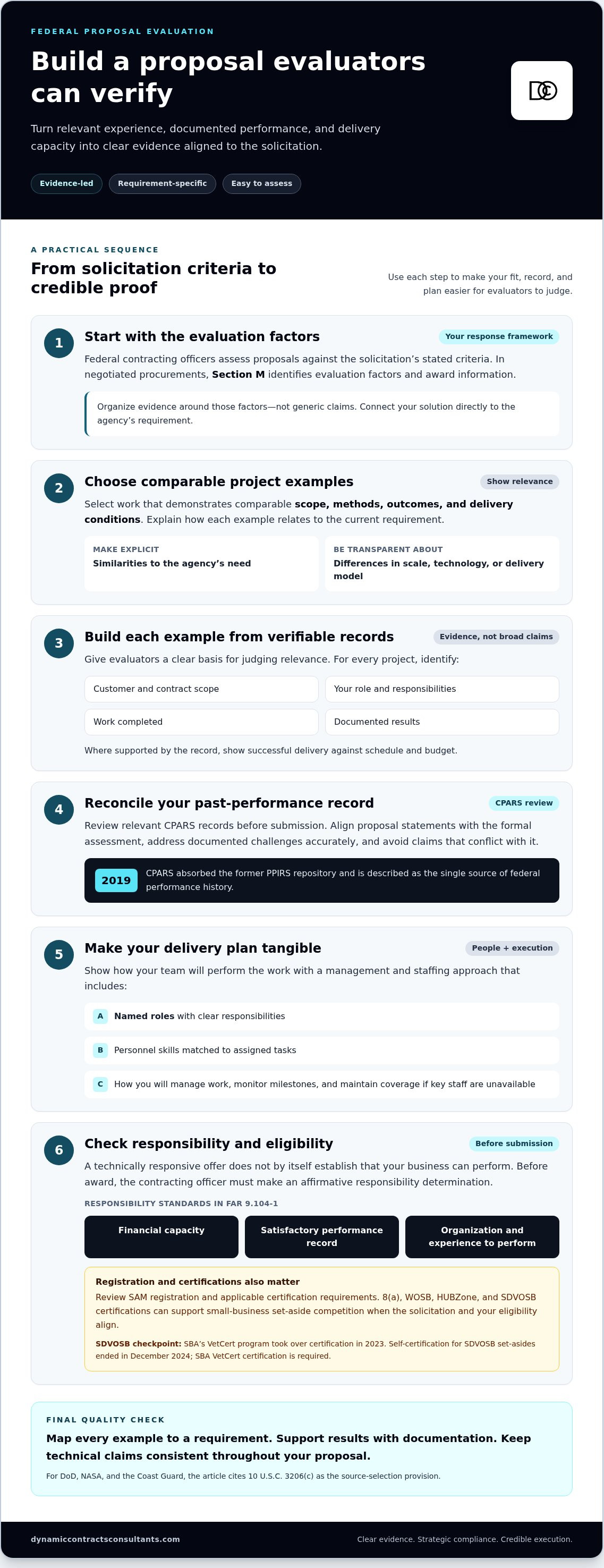
Federal contracting officers assess proposals against the solicitation’s stated evaluation criteria. In negotiated procurements, Section M identifies evaluation factors and award information. Organize your evidence around those factors rather than relying on generic claims.
Build each past-performance narrative from verifiable records: the customer, contract scope, your responsibilities, work completed, and documented results. Explain how each example relates to the current requirement, then point out differences in scale, technology, or delivery model. Make the comparison explicit so evaluators can assess relevance without assuming the projects were identical.
The Contractor Performance Assessment Reporting System absorbed the former PPIRS repository in 2019 and is described as the single source of federal performance history. Review your relevant CPARS records before submission. Align proposal statements with those records, address documented performance challenges accurately, and avoid claims that conflict with the formal assessment.
For your management plan and staffing approach, contracting officers look for named roles, clear responsibilities, and personnel whose skills match assigned tasks. Show how your team will manage work, monitor milestones, and maintain coverage if a key staff member becomes unavailable. We recommend linking each role to the work it will perform.
Small businesses can demonstrate capability through relevant work, qualified personnel, and a practical execution approach. If your federal past performance is limited, use other comparable projects where the solicitation permits, and clearly state your role and why the work is relevant.
Past-performance evaluation is not a résumé contest. Map each example to a requirement, support results with documentation, and keep technical claims consistent throughout your proposal. For DoD, NASA, and the Coast Guard, the cited source-selection provision is 10 U.S.C. 3206(c).
2. Federal contractor responsibility and award eligibility
A technically responsive offer does not, by itself, establish that your business can perform. Under FAR 9.103, a federal contracting officer must make an affirmative responsibility determination before awarding a contract. FAR 9.104-1 identifies financial capacity, a satisfactory performance record, and the organization and experience to perform as responsibility standards. We recommend assessing your records against each standard before shaping your submission.
Before drafting, review your business records against the solicitation’s responsibility standards. Financial statements and relevant capacity information can help explain how your organization will support the work. Keep performance documentation consistent with the record you present. An organizational chart, key-role descriptions, and evidence of relevant experience can show how your team will execute the requirement.
Registration and certifications also affect eligibility for particular opportunities. Contractors are advised to register in the System for Award Management and meet applicable certification requirements. The 8(a), WOSB, HUBZone, and SDVOSB certifications can support competition for small-business set-asides, but only when the solicitation and your eligibility align. We suggest treating certification status as part of your opportunity planning.
Certification requirements change over time. The U.S. Small Business Administration took over SDVOSB certification from the Department of Veterans Affairs in 2023 through its VetCert program. Self-certification for SDVOSB set-asides ended in December 2024, and certification through SBA’s VetCert program is required. SBA’s Small Business Search directory replaced the Dynamic Small Business Search in 2025. The 8(a) Business Development Program also underwent significant eligibility and processing changes since 2024, including new documentation requirements for participants.
Federal Acquisition Regulation requirements vary with the procurement and its stated terms. Read the solicitation closely and identify applicable representations, submission requirements, and performance conditions. Map each requirement to the responsible team member and supporting record. A missed requirement can affect eligibility even when your technical solution is strong.
Research and development contracts require careful interpretation of the agency’s objective. FAR 35 states that their primary purpose is to advance scientific and technical knowledge and apply it as needed to achieve agency and national goals. Unlike supply and service contracts, most R&D contracts concern objectives whose work or methods cannot be precisely described in advance. Explain your proposed research method, decision points, and how the work supports the stated objective.
Federal source selection follows the solicitation’s evaluation approach. Under FAR 15.101, negotiated contracts use a best-value continuum, allowing the government to weigh factors beyond price as specified in the solicitation. Review the evaluation criteria, agency mission, scope, and performance risks before deciding whether an opportunity fits. For agencies with extramural research budgets exceeding $100 million, a percentage is reserved for SBIR contracts or grants to small businesses.
Research the agency’s underlying problem, not just the contract title. Use that research to determine whether your eligibility evidence and proposed approach fit the actual requirement. A focused opportunity assessment helps you direct bid resources toward a credible pursuit.
3. Price analysis and fair-and-reasonable pricing
A competitive price is not simply the lowest figure on a spreadsheet. The agency needs pricing that is understandable, consistent with the technical approach, and supportable against the work required. Under FAR Part 15.4, contract pricing is addressed within the negotiated-contract framework; FAR Part 15.405 addresses price negotiation. A practical way to understand what contracting officers look for in a proposal is to examine whether the proposed price has a clear connection to the work.
Start with the solicitation’s pricing instructions, then build your estimate from the proposed effort. Connect labor categories and hours to assigned tasks, and explain the assumptions behind each estimate. If the technical approach requires specialized work, show that effort in the pricing. An unexplained mismatch between scope and price can make your offer difficult to assess.
Price analysis considers whether the proposed amount is reasonable, not merely whether it appears low. The workbook identifies FAR Part 15.403 as addressing obtaining cost or pricing data for negotiated contracts. These references make accurate, traceable estimates important. Keep calculations, narrative explanations, and supporting assumptions consistent throughout the submission.
For example, if a proposal assigns senior technical personnel to a demanding task, explain the labor mix and the work those roles perform. If subcontractors contribute, identify their scope and integrate their costs coherently into the overall price. Under FAR Part 15, a prime contractor must provide specified subcontract certified cost or pricing data and analysis when the subcontract or purchase order is $20 million or more, according to the Federal Acquisition Regulatory Council.
Sealed-bid pricing has distinct references. FAR Part 14.201-8 addresses price-related factors in sealed-bid contracts, and FAR Part 14.408-2 addresses the reasonableness of a responsible bidder’s price. Keep the bid aligned with the solicitation’s stated pricing factors and format. A clear cost breakdown can help the agency compare the offer against its stated basis for award.
Past performance can put the proposed effort in context, but it does not replace a supported price. Use prior work to explain relevant delivery experience, then show how the current scope differs. For example, reflect a new staffing requirement or delivery method in the proposed approach and cost assumptions, rather than relying on a previous project to justify it.
Understanding what contracting officers look for in a proposal also means making the price traceable from assumptions to totals. Before submission, reconcile each pricing schedule with the technical narrative and check the arithmetic. Confirm that quantities, labor assumptions, subcontract amounts, and stated totals agree. Remove unsupported contingencies and explain material assumptions plainly. This consistency check helps the agency evaluate pricing and negotiate from an informed position.
4. Proposal compliance with solicitation requirements
A solicitation is the evaluation framework, not simply a request for a polished document. Contracting officers assess proposals against its stated criteria, required content, and submission instructions. For a federal RFP, which results in a negotiated contract, organize your response around the solicitation’s structure and answer each requirement directly.
Evaluation criteria differ between lowest-price technically acceptable and best-value procurements. In an LPTA approach, the proposal must meet the stated technical acceptability requirements, with price central to selection; under FAR Part 15.101, negotiated contracts use a best-value continuum that can weigh non-price factors through stated tradeoffs. Section 880 of the John S. McCain National Defense Authorization Act for Fiscal Year 2019 is a cited restriction on LPTA source selection.
Common causes of rejection or low scores include noncompliance, uncompetitive pricing, incomplete submissions, and insufficient relevant experience. A missed attachment, unanswered requirement, or generic response can weaken an otherwise capable offer. The solicitation sets the requirements, so do not assume a previous proposal’s format or content will satisfy a new program’s instructions.
Review the complete RFP before drafting, then create a compliance matrix mapping each instruction and evaluation factor to a response location. Record page limits, formatting rules, required forms, and the submission method. For example, if the solicitation requests a staffing plan and a risk approach, assign each to a clear section and verify both appear in the final version.
Section M of the uniform contract format lists evaluation factors and award information. Use those factors to prioritize your explanation while addressing every other mandatory instruction. Keep the response concise and avoid unrequested material unless it presents an applicable improvement. A competitive proposal makes the connection between each requirement, your response, and its supporting evidence easy to follow.
Before submitting, conduct separate reviews for compliance, technical accuracy, and production quality. A compliance reviewer can confirm that every required item is included; a technical reviewer can check whether the approach addresses the agency’s needs. A final production review can catch inconsistent page references, missing attachments, and formatting errors that make required information harder to find.
- Requirement: Quote or summarize the solicitation instruction precisely.
- Response location: Identify the proposal section and page.
- Evidence: Confirm the response includes required support or documentation.
- Final check: Verify the item is complete in the submission copy.
For sealed-bid contracts, FAR Part 14.3 covers submission of bids, while FAR Part 14.408 covers award. The procedures differ from negotiated RFPs, so identify the procurement type first and follow its stated instructions. That distinction helps keep the response aligned with the correct evaluation and submission process.
5. Clear communication with contracting officers
Clear communication gives evaluators a direct view of your capabilities, proposed approach, and delivery risks. In government contracting, concise writing does not replace substance; it helps the agency find and assess it efficiently. Connect each stated requirement to a specific action, responsible role, or supporting fact.
Under FAR Part 15, contracting officers control exchanges with offerors after receiving proposals in accordance with section 15.306, according to the Federal Acquisition Regulatory Council. That means post-submission communication follows the procurement’s established process. Prepare designated team members to respond accurately, keep answers consistent with the submitted offer, and route questions through the appropriate company lead.
Before submission, make the proposal easy to navigate. Use headings that reflect the solicitation’s terminology, define specialized terms, and place evidence beside the claim it supports. For example, pair a proposed quality-control method with its review steps, accountable role, and reporting output. This structure reduces ambiguity without adding material unrelated to the evaluation.
Communicate risks with the same discipline. Identify a material delivery concern, explain its potential effect, and describe a practical mitigation. For instance, address a staffing shortage through the proposed staffing approach and a documented coverage plan. Do not claim a risk is eliminated when the plan only reduces its impact. A credible explanation gives contracting officers a clearer basis for assessing your approach.
After award, regular project updates can support transparency by tying progress reports to milestones and deliverables. State what is complete, what comes next, and whether an issue affects the agreed plan. If a milestone faces delay, explain the cause, corrective action, and decision or information needed. This keeps communication factual and actionable.
For proposal questions or clarifications, distinguish confirmed facts from assumptions. Identify the solicitation provision or proposal section at issue, state the point precisely, and avoid claims that conflict with the submitted response. Internally, maintain a record of questions, answers, owners, and resulting actions. This helps your team provide consistent information throughout the procurement.
- Be specific: Connect each statement to a requirement, capability, milestone, or risk.
- Be consistent: Align answers with the submitted proposal and authorized company positions.
- Be concise: Put the conclusion first, then provide the evidence or explanation.
- Be transparent: Report progress and issues with clear next steps.
The practical advantage is clarity: evaluators can understand your offer, and your team can act on performance information. Clear communication supports a coherent view of the work, from proposed capabilities through project updates, while respecting the formal exchange process.
Dynamic Contracts Consultants LLC: Proposal Writing
Dynamic Contracts Consultants LLC supports government contractors with Proposal Writing when an opportunity requires a clear, compliant response aligned with the solicitation’s evaluation criteria. This support can help you organize technical content, connect qualifications to agency needs, and present pricing and supporting evidence consistently.
When assessing which opportunities to pursue, Capture Management can support your strategy before proposal development begins. DCAA Compliance Consulting can help address accounting-system compliance considerations relevant to your contracting operations.
If you’re preparing a federal submission, contact Dynamic Contracts Consultants LLC to discuss your proposal requirements.
Build a More Deliberate Pursuit Strategy
A proposal process becomes more valuable when each pursuit strengthens the next. Treat every submission as an opportunity to learn: record which assumptions held, where reviews exposed gaps, and how your team can make decisions earlier. This turns individual bid effort into organizational capability and helps your approach mature over time.
Understanding what contracting officers look for in a proposal can guide that learning, but the strategic question is how your organization will apply it consistently. Establish clear ownership for opportunity decisions, proposal development, and final quality review. Use lessons from each procurement to refine templates, evidence libraries, and internal coordination, while ensuring the process supports rather than replaces sound judgment.
If you’re preparing for a pursuit or strengthening your proposal strategy, contact Dynamic Contracts Consultants LLC to discuss your goals and next steps. A disciplined approach can help your team move forward with greater clarity and purpose.
Frequently Asked Questions
What Problem is the Agency seeking to Resolve?
The agency is seeking to address the operational need described in the solicitation, not simply acquire a product or service. Look for the mission outcome, existing constraint, and intended result behind the requested work. For example, a requirement for upgraded data support may reflect a deeper need for more reliable reporting. Use the solicitation’s background and objectives to explain how your approach addresses that underlying need.
What Sets Top Contractors Apart?
Strong contractors make their proposed solution easy to assess and credible to execute. They connect the agency’s objective to a specific approach, assign clear ownership, and support claims with relevant evidence. They also make deliberate pursuit decisions instead of treating every opportunity as a fit. For example, a contractor might decline a bid if its available team cannot credibly support a central requirement, preserving resources for better-aligned work.
What is a Government Proposal?
A government proposal is a contractor’s formal response to a government solicitation. It explains the offered solution and may describe technical capabilities, proposed pricing, relevant past performance, and intended regulatory compliance. The required format and content depend on the solicitation and procurement method. Think of it as a structured offer: it must explain what the contractor will do and provide the information the agency requests for evaluation.
How do contracting officers evaluate technical approach and understanding of requirements?
Contracting officers compare the proposed technical approach with the solicitation’s requirements and evaluation criteria. A strong response explains how the work will proceed, how key tasks relate, and how the approach addresses the agency’s stated objective. For example, a software implementation proposal could explain how requirements move through configuration, testing, and deployment. Make assumptions visible and avoid claiming capabilities the proposed team or method cannot support.
How are past performance and relevant experience evaluated in government proposals?
Evaluators consider whether prior work helps demonstrate the contractor’s ability to perform the current requirement. Explain the project’s scope, your organization’s role, the work delivered, and why the experience is relevant. For example, if a prior project involved similar technical work in a different customer environment, clarify both the comparable elements and the differences. This context helps evaluators assess the evidence without treating unrelated work as equivalent.
How do price and cost realism affect proposal evaluation?
Price evaluation considers whether the proposed amount is reasonable under the solicitation’s stated approach. When cost realism analysis applies, it examines whether proposed costs appear consistent with the described work and resources. For example, a labor estimate should correspond with the staffing plan and task distribution. Follow the solicitation’s pricing instructions, explain material assumptions, and ensure the technical narrative and cost schedules tell a consistent story.
What makes a proposal compliant with an RFP’s instructions and submission requirements?
A compliant proposal follows the RFP’s instructions for content, format, required documents, and submission. Create a response matrix that assigns each instruction to a proposal section, then use a final review to confirm completion. For example, if the RFP requests a signed form and a separate pricing file, verify both are included in the correct submission location. Check file versions and attachments before sending the final package.
What proposal evaluation rules apply under the Federal Acquisition Regulation?
The applicable FAR evaluation framework depends on the procurement method and solicitation. FAR 15.101 addresses the best-value continuum for negotiated contracts, while FAR Part 14 covers sealed bidding, including bid submission under FAR 14.3 and award under FAR 14.408. The solicitation identifies the evaluation factors for the specific procurement. Read those provisions alongside the stated instructions, because the evaluation method determines how the agency compares responsive offers.
Have a question this article didn’t answer?
Talk it through with a certified contracting professional. The first 30 minutes are free.