
Discover how to write a sources sought response that wins. Learn our expert strategies to showcase capabilities across the federal procurement lifecycle.
A Sources Sought Notice can shape a procurement before an agency issues a solicitation. It is a type of Request for Information used for market research, including to assess whether two or more small businesses can perform a planned requirement and whether a small-business set-aside may be appropriate. Knowing how to write a sources sought response means addressing the notice’s specific requirements with clear evidence of your company’s capabilities and capacity.
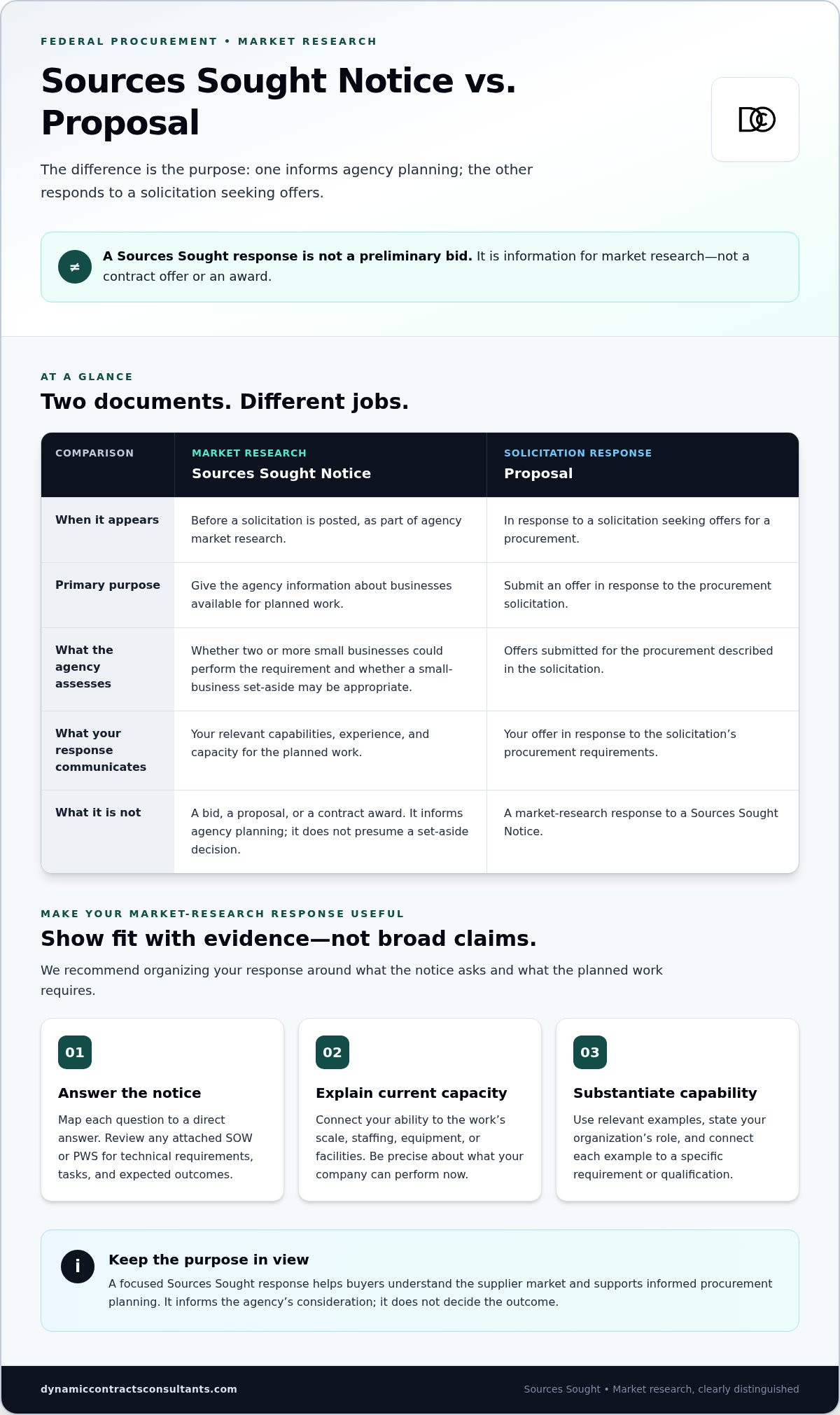
It’s easy to mistake a Sources Sought Notice for a preliminary bid, but its purpose is different: the agency is gathering information, not requesting a proposal for award. Your response should help the agency understand what your business can do, how your experience relates to the work, and whether your capacity fits.
This guide explains how agencies use responses, how to select a notice worth pursuing, and how to organize relevant examples to substantiate your claims. It also covers common mistakes, practical guidance on length and timing, and ways to align your content with the notice and any attached statement of work. An evidence-based response makes your capabilities easier for government buyers to evaluate.
Key Takeaways
- Understand how agencies use market research responses to assess the available small-business landscape before a solicitation.
- Match relevant past performance and technical capabilities to the notice’s requirements, using specific evidence rather than broad claims.
- Choose notices that align with your company’s capabilities and capacity, then organize your response around the agency’s requested information.
- Plan your submission around the notice’s deadline and page instructions, keeping the content focused and easy to evaluate.
- Identify common response pitfalls and use a structured review to improve clarity, relevance, and compliance before submission.
1. How agencies use responses for market research
A Sources Sought Notice gives federal agencies information about businesses available for planned work. It is a type of Request for Information (RFI) used for market research before a solicitation is posted. Agencies can use responses to assess whether two or more small businesses could perform the requirement and whether a small-business set-aside may be appropriate. Treat the notice as a planning opportunity, not a request for a contract offer.
The distinction matters. An RFI gathers information, and a Sources Sought Notice is one form of RFI. A proposal responds to a solicitation seeking offers for a procurement. The Federal Acquisition Regulatory Council discusses the small-business Rule of Two for federal acquisitions under FAR 19.502-2. A Sources Sought response informs agency planning, but it is not itself a contract award.
For an overview of how to respond to these notices, watch this video:
To support useful market research, buyers need responses that address the notice rather than rely on general marketing claims. Start by mapping each question to a direct answer. Then review any attached Statement of Work (SOW) or Performance Work Statement (PWS) to identify technical requirements, tasks, and expected outcomes. This makes clear what information the agency is seeking.
Explain your relevant technical ability and capacity. Describe how your company would meet the requirements in the SOW or PWS, including the task’s scale, required equipment or facilities, and staffing. For example, if responding about a facilities project, connect your resources and experience to the work described instead of simply claiming to have qualified staff.
Agencies use these details to assess whether the supplier market can support the planned requirement. When reviewing an attached performance work statement, use a spreadsheet to evaluate your knowledge of the work and related past performance. Record each requirement, its supporting evidence, and any capability gaps. This gives you a structured way to decide what your response can tell the agency.
For the Port Hueneme Division/Corona Division criteria, potential capability may support technical ability and capacity, but the contractor must demonstrate existing capability to manage. This distinction helps companies describe what they can perform now without overstating readiness. A precise response gives buyers a more reliable picture of market capacity and supports informed procurement planning.
A Sources Sought Notice is a type of Request for Information used to support market research and decisions about whether to create a small-business set-aside. Let that purpose guide your response’s scope and tone. Keep information relevant to the planned work, and make clear which details address the agency’s research questions. A focused account of current capabilities can inform planning without sounding like an offer or assuming a set-aside decision has already been made. The notice is an opportunity to inform the agency’s consideration, not presume its outcome.
2. Providing relevant examples
Choose examples that directly connect your company’s experience to the notice. Describe the work performed, your organization’s role, and the capability the experience demonstrates. A claim such as “we have extensive experience” is difficult to evaluate on its own. A concise account of a comparable project gives the agency concrete evidence to assess.
For a past-performance section, include 2-3 relevant contracts when the notice requests or allows examples. Select records that closely match the planned work in scope, technical demands, or operating conditions. For each contract, identify the customer, summarize the work, and explain your company’s role. Follow any notice instructions about identifying customers or sharing contract details.
Connect each example to a specific requirement instead of presenting unrelated achievements. If the agency seeks experience with recurring maintenance, describe comparable work and the tasks your team completed. Then explain how that experience relates to the requirement. This makes the connection clear and avoids claims the reviewer has to interpret.
Use supporting details to substantiate your qualifications. Explain which skills, experience, or resources your example demonstrates, and distinguish your company’s work from a teammate’s contribution. If a contract involved several partners, accurately describe your organization’s responsibilities. We encourage this precision because an unclear role can make even relevant experience harder to evaluate.
Some notices request specific information beyond past performance. Some notices may request information beyond past performance, so answer any explicit requests directly. When a notice includes a request like this, answer it directly and place the relevant information where reviewers can find it. Don’t assume a general capability statement addresses a separate, explicit request.
If your company lacks a directly comparable contract, use related experience and describe a credible readiness plan. Identify capabilities you already have, explain what remains to be developed, and state how you would prepare before performance begins. Separate current qualifications from planned actions. This keeps your response accurate while giving the agency useful context.
Before submitting, we recommend checking each example against these points:
- It relates to a stated requirement or requested qualification.
- Your company’s role and contribution are accurately described.
- Supporting details substantiate the capability being claimed.
- Any development plan is clearly separate from existing experience.
Remove examples that do not strengthen your response. A focused set of relevant contracts gives the agency clearer evidence than a longer list with weak connections. Follow the notice’s requested format and ensure each example explains why your company’s experience matters to the planned work.
3. Avoiding common response mistakes
A Sources Sought response loses value when it misses the notice’s questions. Read the notice and attachments together before drafting. Build your outline around the requested topics, then answer each one directly. If the agency asks about staffing, for example, describe the workforce relevant to the requirement rather than your general growth plans.
Treat market research differently from a proposal submission. A response is not an offer for award, so avoid adding pricing or unsupported promises unless the notice requests them. Government requests for information are typically freeform, often submitted as white papers, and are not compensated. Follow the format and submission method specified in the notice.
Broad capability statements can obscure relevant evidence. Replace claims such as “we deliver high-quality service” with details showing which requirement your company can perform and how. If the notice describes a technical task, connect your experience to it. Separate established capabilities from plans to develop missing ones; don’t present future readiness as current performance.
Make the connection between qualifications and requirements explicit. If the notice asks about capacity, address the task’s scale, relevant equipment or facilities, and staffing. If it asks about technical ability, explain how your approach meets the stated requirement. “We have qualified personnel” alone does not show how those people relate to the work.
Submission errors can undermine otherwise useful content. Follow the notice’s stated deadline, file instructions, and submission channel. Confirm that attachments open, requested fields are complete, and your document follows the specified format. Don’t reuse instructions from an older notice without checking the current one; requirements can differ between opportunities.
- Check coverage: Match every requested topic to a clear answer before submitting.
- Remove generic claims: Keep statements that explain a relevant capability or support an answer.
- Use evidence carefully: Distinguish demonstrated experience from planned capability development.
- Review submission details: Confirm the current notice’s deadline, format, and delivery instructions.
Finally, we recommend tailoring each response to the agency’s current requirement instead of sending the same unchanged document. A response prepared for one SOW or PWS may not address another notice’s priorities. Adjust your terminology and supporting information to fit the opportunity, while keeping company details accurate. A final review against the notice can catch unanswered prompts, mismatched examples, and claims your supporting material does not substantiate.
4. Response length and timing
Sources Sought Notices may set page limits, formatting rules, and submission methods, so follow the specific notice. Responses are often freeform and may take the form of a white paper. If the notice provides a page allowance or template, treat those instructions as controlling.
There is no single length that fits every request. A practical target is 5-10 pages unless the notice requests more. A one-page cover letter and a 1-2-page capability summary can help organize a longer response. If the notice gives a four-page allowance, use the available space for relevant evidence rather than submitting an incomplete presentation.
Keep attachments distinct from the response body when instructions require separate files. A Capability Statement is usually limited to two 8.5-by-11-inch pages, with a font no smaller than 10 point. This guidance applies to the Capability Statement, not automatically to every Sources Sought response. Check whether the notice sets different requirements.
For a readable document, organize the content in the same order as the notice and its SOW or PWS. Use clear, bold subtitles to identify each requirement, then put the corresponding answer beneath it. This helps agency reviewers locate technical, capacity, and past-performance details without searching through unrelated sections.
Submission deadlines vary by notice. Sources Sought response windows are typically 15-30 days, while a notice may give businesses 10 days to respond. Use the deadline in the specific notice, including its stated time zone, as the operative date. The submission method may also vary, so follow the listed portal, email, or other delivery instructions.
Plan backward from the deadline. Allow time to identify the right notice, collect contract examples, draft answers, review attachments, and complete a final compliance check. For instance, assign an internal reviewer to compare every response section with the notice before submission. Don’t leave file preparation until the final hours.
After submitting, allow the government 10 days to review before following up. A Sources Sought response does not establish when a solicitation will appear. The timeline from a notice to an RFP can range from 30 days to 18+ months, so use the response to inform capture planning without treating it as a procurement schedule.
A final review of timing and length should confirm that the response fits the notice, is easy to evaluate, and reaches the agency through the required channel. Page count alone does not make a response effective. Prioritize complete answers, relevant details, and compliance with the stated deadline and formatting instructions.
5. Selecting the correct source type
On SAM.gov, search Contract Opportunities for notices that match your company’s work. Use relevant keywords, then review each notice’s title, description, attachments, response deadline, and submission instructions. A promising title alone does not mean the requirement fits your capabilities.
Choose a Sources Sought Notice when the agency is collecting market information about a planned requirement. Compare its scope with your actual services, technical experience, and available capacity. If an attached SOW or PWS describes work your company cannot credibly support, prioritize a better-aligned opportunity rather than stretching your qualifications.
Read the full notice before deciding how to respond. Look for the agency’s stated purpose, requested business information, response format, and questions about small-business participation. An RFI may gather market input, while a solicitation requests offers through its stated procurement process. The notice’s label and instructions help determine the appropriate response.
Review NAICS codes in context. Compare the code shown in the notice with the work described, then provide the codes and business details requested. Don’t treat a code as proof of your ability to perform; explain your relevant work, expertise, and capacity separately. A related code, for example, does not replace evidence tied to the SOW’s tasks.
Address small-business status precisely. State your company’s status using the categories and information requested in the notice, and ensure your response represents the business accurately. If the notice asks about a specific small-business category, answer that prompt rather than relying on a general description. Agencies use responses to understand which businesses may be able to perform.
A capability statement should reinforce, not replace, the answers requested in the notice. Identify core capabilities, relevant experience, and contact information, then connect them to the agency’s requirement. If the notice includes questions or a response template, provide the requested information in that structure. A polished general statement cannot make up for unanswered prompts.
Use this review sequence before committing drafting time:
- Confirm that the notice describes work your company can perform.
- Compare the SOW or PWS with your technical experience and capacity.
- Identify the requested NAICS and small-business information.
- Check the response format, deadline, and submission instructions.
- Decide whether your evidence supports a focused, accurate response.
This screening process aligns your opportunity pipeline with your actual capabilities. Record the notice’s agency, scope, response requirements, and deadline in your capture process. Then make a deliberate bid-or-no-bid decision based on fit and evidence, not simply because a Sources Sought Notice appears on SAM.gov.
Dynamic Contracts Consultants: Proposal Writing
Dynamic Contracts Consultants LLC provides Proposal Writing to help you turn relevant capabilities and past performance into clear, well-structured submissions. When a Sources Sought response needs close alignment with agency questions, this support can help organize your evidence, address the notice’s requirements, and present your qualifications precisely.
Our Proposal Writing support is useful when your team needs a disciplined drafting process for government opportunities, particularly when technical content and compliance considerations must work together. The goal is a response that communicates your experience accurately and makes each answer straightforward to evaluate.
Build a More Deliberate Opportunity Strategy
A Sources Sought response can inform capture planning, but its value also depends on how well your team carries that discipline into future opportunities. Knowing how to write a sources sought response is one part of building a repeatable process: connect each opportunity to your capabilities, assign clear review responsibilities, and retain useful evidence for future submissions.
Dynamic Contracts Consultants supports organizations through Proposal Writing, Grant Writing, and DCAA Compliance Consulting. These services address distinct needs, from developing a clear government proposal to preparing grant applications or managing compliance requirements. Consider expert support when internal capacity is constrained or your team needs a structured approach to its next submission.
Contact Dynamic Contracts Consultants to discuss support for your government contracting priorities. With a deliberate process and focused preparation, your team can approach upcoming opportunities with greater clarity.
Frequently Asked Questions
What Is a Sources Sought Notice?
A Sources Sought Notice is a government request for information that helps agencies understand which businesses may be able to perform planned work. When learning how to write a sources sought response, answer the notice’s requests with accurate company information rather than treating it as a formal offer. For example, an agency exploring facility maintenance may use responses to understand the services available in the market.
What is a sources sought notice in government contracting?
In government contracting, a Sources Sought Notice is an early market-research step, not a contract award or binding offer. To understand how to write a sources sought response, distinguish the agency’s information request from a solicitation and keep statements specific to the requested details. You can use the notice to assess opportunity fit, but responding does not guarantee an invitation to compete.
How can a sources sought response influence a future solicitation or set-aside decision?
Responses can help an agency assess whether two or more small businesses appear capable of performing a planned requirement. The Federal Acquisition Regulatory Council discusses the small-business Rule of Two for federal acquisitions under FAR 19.502-2. Market information may inform set-aside planning or help refine the agency’s understanding of the work. A response contributes evidence to that assessment, but does not determine the final procurement decision.
What common mistakes should businesses avoid when responding to a sources sought notice?
Don’t present a teammate’s experience as your company’s own or describe proposed resources as already available. Distinguish your firm’s completed work from a partner’s past performance, and accurately describe planned teaming arrangements. Also compare business identifiers and status statements across your response and capability materials. Consistent, precise information helps agencies interpret your submission and reduces confusion during market research.
Have a question this article didn’t answer?
Talk it through with a certified contracting professional. The first 30 minutes are free.