
Explore the cost of hiring a government proposal writer, including how scope, expertise, proposal complexity, and pricing models shape your total investment.
The hourly rate is only one part of the cost of hiring a government proposal writer. In the United States, your total depends on the response’s scope and complexity, the writer’s experience and specialization, and whether the engagement is hourly, fixed-fee, or ongoing. We’ll explain how proposal writers analyze solicitation requirements, coordinate subject matter experts, and develop sections aligned with evaluation criteria.
It’s understandable to focus first on the rate, especially when comparing a freelancer with a firm or an in-house hire. But the rate reflects only part of the work: a concise response and a complex federal submission can require very different levels of analysis, coordination, and review.
Government proposal writers interpret solicitation requirements and help develop a compliant, persuasive response. Hiring arrangements, experience, specialization, and fee structures all affect cost. Understanding how scope and schedule shape the total helps you decide what support fits your pursuit and internal capacity.
Key Takeaways
- Understand how proposal writers support solicitation analysis, compliance, drafting, and coordination with your internal experts.
- Compare freelance, agency, retained, and in-house arrangements by the scope of work and level of ongoing support each requires.
- Assess how federal, state, and local requirements can affect proposal complexity and the work involved.
- See why specialized federal experience, capture expertise, and technical subject matter knowledge influence writer rates.
- Learn how hourly, fixed-fee, and success-based structures differ, and which considerations matter when evaluating the engagement.
What Does a Government Proposal Writer Do?
A proposal writer turns solicitation requirements into a clear, compliant bid narrative. The work can include analyzing procurement documents, identifying evaluation criteria, coordinating subject matter experts, and drafting technical approaches, staffing plans, and management plans. Writers may also coordinate with proposal managers, capture teams, and reviewers before submission.
Federal proposals require familiarity with the Federal Acquisition Regulation (FAR), Section L instructions, and Section M evaluation criteria. Section L sets out submission instructions; Section M explains how the proposal will be evaluated. Use that analysis to build a compliance matrix and outline, then shape a narrative that addresses the agency’s stated requirements.
These responsibilities shape project fees because scope extends beyond writing. A short commercial proposal might be a two-page quote, while a federal submission can reach 150 pages. Federal work may require technical, management, past-performance, and pricing narratives, alongside coordination across finance and technical teams. Each additional volume adds analysis, drafting, review, and integration work.
State and local RFPs may require a narrower response than a complex federal solicitation, but page count alone does not determine effort. For example, a response under 30 pages may still require detailed compliance mapping, information from several departments, and careful revision. Commercial RFPs also vary: a focused response differs from one needing custom technical content and extensive stakeholder input.
A fixed fee generally covers a defined scope and set of deliverables. Monthly arrangements provide continuing proposal support and may suit organizations pursuing recurring opportunities. Graphics and layout, pricing narratives, color reviews, and final production may be billed separately. Before comparing arrangements, identify which activities each engagement includes.
Government proposal-writing fees are not automatically reimbursable or allowable as contract costs. Treatment depends on contract terms and applicable cost rules, so don’t assume a proposal expense is reimbursable by default.
Writers help communicate the value of your offer by aligning the narrative with the agency’s mission, linking differentiators to evaluation criteria, and presenting subject matter input consistently. For example, the staffing plan should support the technical approach rather than read like an unrelated section.
After drafting, a writer may coordinate revisions and address clarifications or requested changes. We can help you consider how the work may involve organizing source material, resolving inconsistencies, and checking final sections against solicitation instructions. A defined review schedule helps your team identify missing content before submission deadlines.
Fees for fixed-fee or monthly services vary with scope, deliverables, and continuing support. A fixed fee covers an agreed proposal effort; monthly services provide ongoing capacity, with responsibilities set out for the engagement.
In-house versus outsourced proposal writing
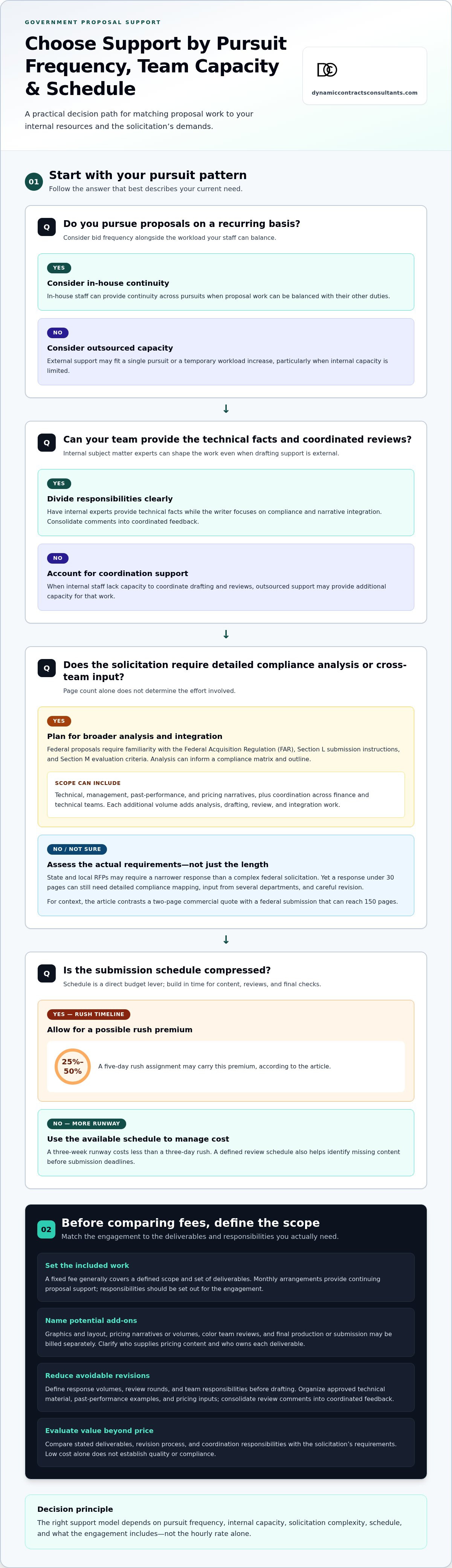
In-house staff provide continuity across pursuits, while outsourced support adds capacity for specific opportunities. Compare the options based on bid frequency, internal workload, and the services included.
Scope and Add-On Services
Proposal scope defines the work and deliverables included in an engagement. Add-on services cover tasks outside that agreed scope.
Separate charges may apply for graphics and layout, pricing volumes, color team reviews, and final production or submission. Before work begins, assign each deliverable to a responsible team member. For example, clarify whether the writer drafts pricing narratives or your finance team supplies that content.
Risks of Low-Cost Services
Low-cost proposal services can create risk if a limited fee also means limited scope, insufficient review, or weak coordination. A draft might omit requested volumes or fail to integrate subject matter input, leaving your team extra work before submission. Assess value against the actual deliverables and review responsibilities, not price alone.
Price alone does not establish quality or compliance. Before assessing value, compare the stated deliverables, revision process, and coordination responsibilities with the solicitation’s requirements.
In-house capacity can make sense when proposals recur and staff can balance bid work with other duties. Outsourcing may better fit a single pursuit or a temporary workload increase, particularly when internal staff lack capacity to coordinate drafting and reviews.
Those packages can cover broader support, so we recommend comparing scope rather than hourly rates alone. A five-day rush assignment may carry a 25% to 50% premium. A three-week runway costs less than a three-day rush, making schedule a direct budget lever.
Control costs by defining response volumes, review rounds, and team responsibilities before drafting starts. Provide approved technical material, past-performance examples, and pricing inputs in an organized format to reduce avoidable research and revisions. Specify whether graphics, pricing support, and production are inside or outside the scope.
To reduce spend, assign internal experts to provide technical facts while the writer focuses on compliance and narrative integration. Set a review calendar and consolidate comments into coordinated feedback rather than separate, conflicting edits. If your team needs defined external drafting support, our government proposal writing services can help structure proposal support around a pursuit.
Contingency and success-fee arrangements
A contingency arrangement makes some or all payment depend on a defined outcome, such as winning an award. A success fee may use similar outcome-based terms, so the contract language matters. For proposal support, distinguish payment for completed writing work from payment triggered by an award. That distinction affects budgeting, performance expectations, and the arrangement’s compliance review.
Contingency fees are generally prohibited on federal work under contingent-fee rules. An award-dependent payment structure is therefore a serious concern for federal pursuits. A fee called a success bonus also warrants careful review if payment depends on obtaining the contract. The label alone does not determine how the arrangement operates.
For example, a company might propose paying a writer only if an agency selects its bid. That ties compensation to the award outcome rather than defined deliverables. Another agreement could instead identify solicitation analysis, drafting, revisions, and final delivery as paid work. Make the payment basis explicit before the writer begins.
Outcome-based compensation can complicate project control. A writer may contribute to narrative quality, but the final evaluation reflects the complete submission and the agency’s decision. Other factors, including the technical solution, pricing, eligibility, and competition, are beyond the writer’s drafting responsibilities. Separating those responsibilities from payment terms makes expectations clearer.
Use a written scope to describe the work independently of the award result. Specify which proposal sections the writer prepares, who supplies technical content, and how revisions are handled. For instance, define whether a requested clarification after submission is included. Clear deliverables make payment administration more predictable, regardless of the agency’s decision.
Compare payment structures by considering how each allocates effort and cash flow. Hourly billing ties charges to recorded work, while a fixed fee ties payment to an agreed scope. A monthly retainer can support recurring pursuits. Each structure still needs defined responsibilities, milestones, invoice terms, and a process for handling work added after kickoff.
Before agreeing to an award-related fee, review the wording and actual payment trigger. Ask whether the writer receives compensation for completed work if the proposal is unsuccessful, then document the answer in the agreement. For federal work, a success-fee label alone does not show that an arrangement meets contingent-fee restrictions.
Assess proposal costs separately from assumptions about contract reimbursement. Don’t presume writing expenses will be reimbursed as contract costs or become allowable through a success-fee clause. Instead, budget for proposal work as a pursuit expense and assess the contract’s cost treatment independently.
A practical decision sequence is simple: define deliverables, select a payment basis, review any award-linked trigger, and record responsibilities. This helps procurement, finance, and proposal teams identify ambiguity before work starts. For a federal bid, separating payment for completed services from award results supports clearer governance and helps reduce avoidable disputes.
Experience and specialization pricing
Proposal-writing rates vary with experience, capture responsibilities, and technical specialization. These ranges reflect different levels of responsibility, not guaranteed performance.
A junior writer may focus on assigned sections, editing, and content development under direction. A senior writer may contribute to capture strategy, coordinate subject matter experts, and align the response with win themes. A pursuit requiring narrative development and cross-volume coordination, for example, may call for broader experience than a discrete drafting assignment.
Specialization can further affect rates. These figures illustrate how specialized expertise and bid complexity can combine.
Their work may extend beyond drafting to pursuit planning and coordination. Compare the defined workday deliverables with the hourly scope before assessing either rate.
Experience matters most when it matches your solicitation. A writer familiar with the agency, technical domain, and submission structure may need less orientation than a generalist. For example, a complex security proposal can require close coordination among technical, compliance, and pricing contributors. Match expertise to the demands of the pursuit rather than choosing by seniority alone.
Use a focused evaluation process. Review sample work for clarity, organization, and alignment with solicitation instructions. Compare the writer’s role in past pursuits with the role your team needs now. Then define responsibilities for drafting, review coordination, and integration so the rate corresponds to specific outputs.
Rate comparisons should account for how much direction your team must provide. A specialist may work efficiently within a defined scope, while a writer unfamiliar with the work may need more background materials and review. Providing an approved technical source package, for example, helps the writer focus on proposal development instead of reconstructing basic company information.
For a complex federal pursuit, weigh the cost of specialized experience against the work’s risks and coordination demands. A cleared expert’s higher hourly rate may suit a security-focused bid; a generalist may fit a narrower drafting task. Clear scope, relevant samples, and defined responsibilities make the options easier to compare.
Freelance government proposal writer hourly rates
In a 2026 market band based on nine price samples from two sources, freelance proposal writing typically ranges from $113 to $225 per hour, with a median of about $163. Freelancers also quote per proposal, with the total shaped by scope, complexity, and included deliverables.
Freelance Hourly Rates
An hourly rate prices a freelancer’s time, so the total depends on hours worked. To estimate the budget, identify the required tasks, estimate hours for each, and apply the quoted rate. For example, estimate solicitation analysis, drafting, and revision separately rather than treating the response as one undifferentiated assignment.
Hourly billing can suit work with an uncertain scope, such as responding to evolving technical input. It also makes added work visible when a team requests another review cycle. Ask for clear task descriptions and reporting intervals so your budget tracks proposal activity.
Freelance Per-Proposal Charges
A per-proposal fee sets a project price for an agreed response scope instead of billing separately for each hour. This structure helps compare bids when deliverables and responsibilities are clearly defined. The fee still depends on proposal length, complexity, technical volumes, and required review support.
Before comparing project quotes, list the response volumes, required sections, revision rounds, and submission responsibilities. Clarify, for example, whether pricing narratives or final production are included. Without those boundaries, a proposal fee may not represent the same work as another quote.
Hourly rates alone don’t provide a full cost comparison. A lower rate may require more client direction, while a higher rate may reflect specialized federal experience or capture responsibilities. Compare expected work products and coordination needs alongside the rate, not in isolation.
For a practical estimate, divide the assignment into phases: solicitation review, outline development, drafting, integration, and final review. Identify who supplies technical material and who consolidates comments. This breakdown distinguishes writing time from internal coordination, which also uses proposal-team capacity.
Use the 2026 market median as a reference point, not a guaranteed quote for a specific pursuit. A narrow drafting assignment and a multi-volume response are not equivalent engagements. The useful comparison is between proposals with similar scope, experience requirements, and revision expectations.
Document the billing basis before work starts. For hourly work, define task tracking and approval for added effort. For a project fee, record deliverables and exclusions. These steps give finance and proposal leads a consistent basis for managing the budget.
Dynamic Contracts Consultants: Proposal Writing
Dynamic Contracts Consultants LLC provides proposal writing support for organizations preparing government bids. When your team needs structured drafting, compliance-focused content, or additional capacity for a pursuit, the service helps align proposal development with the solicitation and your internal expertise.
Our Capture Management can support pursuit strategy, while DCAA Compliance Consulting addresses a separate need involving cost-accounting requirements. These services may be relevant when proposal development connects with broader acquisition planning or compliance work. The right support depends on your objectives, solicitation, and internal resources.
To discuss proposal writing support for your government pursuit, contact Dynamic Contracts Consultants LLC.
Plan Your Next Proposal with Clear Scope
Before committing resources, define the pursuit’s requirements, your internal capacity, and the support you need. A clear scope aligns proposal work with your objectives and gives your team a sound basis for planning. The cost of hiring a government proposal writer depends on the specific case, including complexity, deliverables, and coordination needs; pricing is provided after a quote request.
Dynamic Contracts Consultants offers Proposal Writing, Grant Writing, and DCAA Compliance Consulting. These services support organizations with proposal development, grant submissions, or compliance needs as part of their broader contracting work.
Share your priorities and pursuit requirements with our team to discuss an appropriate next step. Contact Dynamic Contracts Consultants to begin a focused conversation about your goals.
Frequently Asked Questions
What are typical hourly rates for government proposal writers and consultants?
Rates vary by experience, specialization, and responsibility; a market rate is not a project quote. A writer drafting assigned content has a different role from a consultant coordinating capture strategy or multiple contributors. Compare rates alongside expected effort, scope, and relevant federal experience. For a useful comparison, request the same defined task and deliverables from each candidate.
What factors affect the cost of hiring a government proposal writer?
Cost reflects the work required, the writer’s expertise, and the engagement structure. A response requiring specialized technical input or coordination across business units can take more effort than editing existing material. Your readiness matters too: organized past-performance details and approved technical information can reduce time spent gathering inputs. Define the required role and outputs before comparing estimates.
How do proposal writer costs vary by federal, state, and local government bids?
Costs differ because each solicitation sets its own response requirements, evaluation approach, and submission format. Federal bids may require detailed alignment with solicitation instructions and evaluation criteria; state and local bids can also require substantial documentation. Compare the actual RFP requirements rather than assuming jurisdiction alone determines effort. A local bid with extensive technical schedules may take more work than a shorter federal response.
What services are included in government proposal writing fees?
Included work depends on the agreement. A writing engagement might cover solicitation review, drafting, editing, and coordination of client feedback, while production or specialized pricing support may be outside the scope. Clarify, for example, whether the writer will integrate subject matter experts’ comments or prepare only an initial draft. Document each deliverable, review responsibility, and excluded task before work begins.
What is the difference in cost between a freelance writer and a proposal writing firm?
A freelancer’s quote generally reflects an individual’s work and availability, while a firm may scope broader coordination or team support. This distinction matters when your pursuit needs multiple contributors, integrated reviews, or additional production tasks. Compare the same deliverables and responsibilities across both proposals. A firm’s broader scope may not be comparable to a freelancer’s drafting-only estimate.
How can businesses evaluate a government proposal writer's experience and pricing?
Review relevant writing samples, then assess whether the writer has handled comparable solicitation formats and technical subject matter. Ask for a clear description of responsibilities, review stages, and deliverables. For instance, a sample demonstrating compliance with instructions may be more relevant than polished commercial marketing copy. Compare quotes after mapping each one to the required work and your internal coordination capacity.
What contract terms and payment structures should you expect when hiring a proposal writer?
Common structures include hourly billing, a fixed project fee, or a recurring retainer, each with different budgeting implications. The agreement should identify deliverables, invoice timing, revision handling, and how added work is authorized. Avoid tying federal proposal-writing payment to winning an award, because contingency fees are generally prohibited on federal work. Clearly separate payment for completed services from the agency’s award decision.
Have a question this article didn’t answer?
Talk it through with a certified contracting professional. The first 30 minutes are free.