
Common grant proposal rejection reasons include poor fit, missed requirements, weak evidence, or unrealistic budgets. Learn what funded proposals share.
A strong proposal can still be rejected when it doesn’t fit a funder’s priorities, misses a requirement, or fails to make its case clearly. Common grant proposal rejection reasons also include weak project design, unsupported outcomes, unrealistic budgets, and incomplete applications. Competition matters, too: a funder may have to choose between proposals that both appear well matched.
That uncertainty can make a rejection difficult to interpret, especially when a proposal seems sound. Funded proposals typically connect the funder’s priorities to a specific, achievable project, measurable outcomes, and a budget that supports the work described.
This article explains why applications fall short, what stronger proposals have in common, and how competition and internal submission processes shape decisions. It also shows how to use a rejection to review a proposal, strengthen its alignment and evidence, and plan a more disciplined next submission.
Key Takeaways
- Separate proposal weaknesses from funding competition so you can decide what to improve and what to plan around.
- Build a submission review process that catches missing attachments, formatting errors, and inconsistencies before the deadline.
- Match each proposal to the funder’s current priorities, eligibility requirements, and review criteria rather than relying on a generic request.
- Use rejection feedback to identify specific revisions and determine whether a stronger resubmission makes sense.
- Connect the need, project activities, outcomes, evaluation, and budget into one clear and feasible proposal logic.
1. High competition and limited grant funding
A sound proposal can lose because the funding pool is smaller than the applicant pool. Some foundations fund only 1%-10% of requests, so a strong application may still compete against many qualified organizations. In the nonprofit applicant field described in the available market data, 8 or 9 organizations fail to get approval for every successful proposal. These outcomes reflect scarcity as well as proposal quality; rejection alone does not prove that the project lacked merit.
Competition is especially visible in federal research funding. Many U.S. federal agencies fund fewer than 10% of their grant applications, and major agencies such as the NIH may reject up to 90% of proposals. NIH R01-equivalent success rates were 13.0% in FY2025, compared with 18.7% in FY2024 and 21.6% in FY2023. These figures show why evaluation results must be read in context: even a competitive proposal can fall outside the number of awards available.
Choosing the wrong funding mechanism can make competition harder. Before applying, compare the opportunity’s purpose, eligible applicants, project scope, and allowable activities with your organization’s plans. A research mechanism designed for a particular study type, for example, may not suit a community program or a project at a different stage. Then assess whether the funder’s evaluation criteria reward outcomes you can demonstrate. A close match gives reviewers a clear basis for judging your request.
Two applications may both seem like strong candidates, yet a grantmaker may select only one. The decision can depend on comparative fit, available funds, or current priorities, not just whether an application meets basic requirements. Treat each submission as part of a funding portfolio: balance stronger-fit opportunities with less predictable ones, and avoid relying on a single grant to sustain essential work.
If a proposal is declined, use the decision to refine your funding plan. Review any feedback, identify whether the barrier was fit, competition, or readiness, and decide whether to revise or pursue a different mechanism. Other sources can diversify support; individual donations, for instance, may complement grant funding for nonprofits. This approach helps distinguish an improvable application from a highly competitive opportunity with limited awards, so you can focus effort on the best-aligned prospects.
2. Improving internal grant application processes
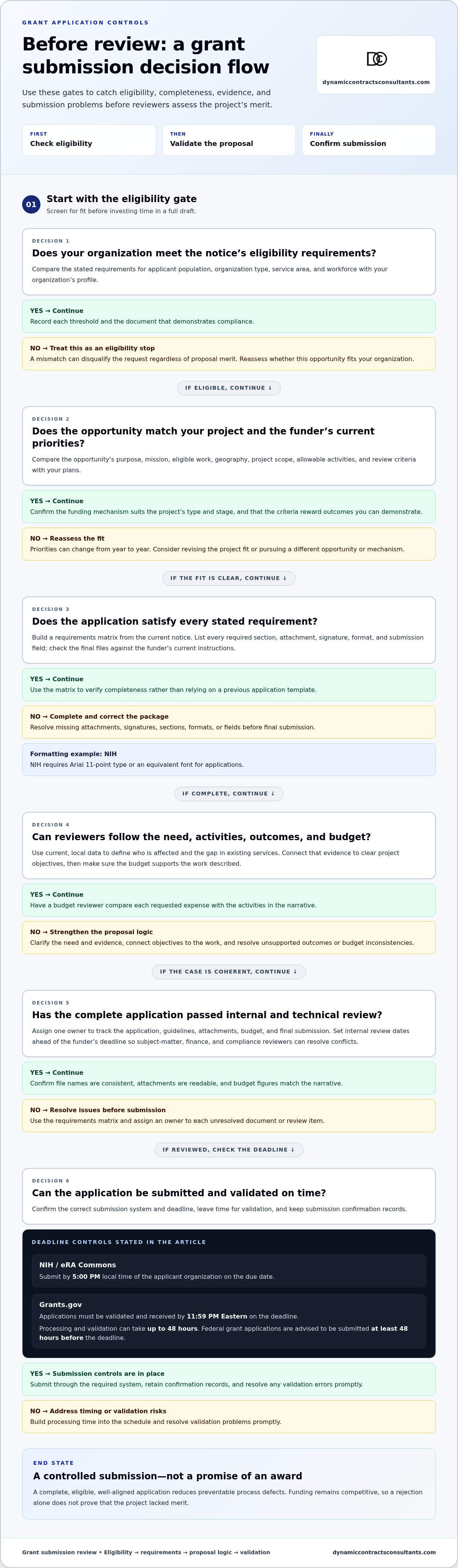
A controlled submission workflow helps catch preventable defects before reviewers assess the project’s merit. Assign one owner to track the application, guidelines, attachments, budget, and final submission. Set internal review dates ahead of the funder’s deadline, giving subject-matter, finance, and compliance reviewers time to resolve conflicting information. For example, a budget reviewer can compare each requested expense with the activities described in the narrative.
Formatting and missing documents can weaken an otherwise well-developed grant application. Build a requirements matrix from the current notice, listing every required section, attachment, signature, format, and submission field. Check the final files against the funder’s instructions rather than relying on a previous application template. The National Institutes of Health (NIH), for example, requires Arial 11-point type or an equivalent font for applications. A final technical review should also catch inconsistent file names, unreadable attachments, and budget figures that do not match the narrative.
A weak needs statement or insufficient evidence can leave reviewers unsure whether the problem is significant or whether the organization understands its scale. Use current, local data to define who is affected, explain the gap in existing services, and connect that evidence to clear project objectives. Without this foundation, an application may describe activities without showing why they address the stated need.
Late submissions and system validation problems require their own controls. According to NIH, applications must be submitted through eRA Commons by 5:00 PM local time of the applicant organization on the due date. Grants.gov applications must be validated and received by 11:59 PM Eastern on the deadline, while federal grant applications are advised to be submitted at least 48 hours before the deadline. Grants.gov can take up to 48 hours to process and validate an application, so build that interval into the submission schedule. Keep confirmation records and resolve validation errors promptly.
Screen for eligibility before drafting. Compare the notice’s requirements for applicant population, organization type, service area, and workforce with your organization’s profile. Treat these as eligibility gates, not objectives that stronger writing can overcome. If an application limits participation to a particular population or organization size, a mismatch can disqualify the request regardless of its merits. Record each threshold and the document that demonstrates compliance.
After a rejection, review the organization’s workflow as carefully as the proposal. Identify whether a missing attachment, unclear responsibility, or validation delay contributed to the result. Updating the requirements matrix and assigning an owner to each document turns that finding into a specific process improvement for the next application.
3. What Do Funded Grant Proposals Have in Common?
A proposal can be well written and still miss the funder’s current purpose. Funders may change priorities from year to year, so an organization that qualified previously may no longer fit the current cycle. Compare the opportunity’s mission, eligible work, geography, and review criteria with your project before drafting. If a foundation funds neighborhood-based services, for example, a proposal focused on broad national research may not align, even when the issue matters.
Turn the funder’s published priorities into a practical alignment test. Identify the specific priority your project advances, the population or location it serves, and the outcomes reviewers will assess. Connect each major activity to that priority. Make the connection clear in the needs statement, project design, and evaluation plan. If reviewers must infer how the work supports the funder’s mission, the alignment case is incomplete.
Use current guidelines as criteria, not background reading. Compare your proposed scope with eligible activities, award objectives, geographic restrictions, and required outcomes. Mark any missing connection, then decide whether you can adapt the project without changing its core purpose. For example, a regional foundation’s focus on local workforce access may suit a job-training project only if its participants and intended outcomes match that focus.
A conversation with the funder can clarify fit before submission, when contact is permitted. Introduce the organization and summarize the project’s purpose, population, and location. Ask whether those elements match the program’s current priorities. This conversation does not replace the written criteria, but it can help identify a mismatch early. Organizations can also build familiarity by communicating clearly after previous awards and completing reporting commitments.
Unrealistic goals, methods, or timelines arise when promised outcomes exceed the project’s staffing, resources, or delivery period. A proposal that plans to serve a broad population through a brief intervention, without a workable sequence or measurement method, gives reviewers little basis for assessing feasibility. Match each objective to specific activities, responsible staff, available resources, and a realistic completion schedule.
If an application is declined, compare reviewer comments with the funder’s criteria rather than revising every section indiscriminately. Determine whether the gap involved mission fit, project scale, geography, or evidence of outcomes. Revise only where the project can genuinely respond. Strong alignment is not simply repeating a funder’s language; it means showing, through a coherent project plan, how the proposed work advances the funder’s stated priorities.
4. Why Most Grant Proposals Fail the First Review
A rejection notice is a decision about one application, not a complete diagnosis of your organization. Start by separating reviewer concerns from funding constraints, then record each stated weakness against the proposal section it concerns. Peer or panel review rejection notices typically arrive 2 to 5 months after the deadline, while agency funding decisions may take 1 to 3 months after review. Use the waiting period to preserve the submitted version and prepare a structured review.
Request clarification when the funder permits follow-up. Ask whether the application was competitive, whether reviewer feedback is available, and whether resubmission is welcome. Keep the request concise: identify the application, thank the funder, and ask specific questions about unclear comments. If feedback points to a missing explanation or unsupported claim, record the issue before revising. A nonprofit can also ask whether the project remains aligned with the funder’s current priorities.
Read comments in a consistent sequence. First, identify concerns repeated across reviewers; recurring issues often point to a central weakness. Next, distinguish correctable mistakes, such as unclear methods, from larger concerns about project fit or feasibility. Finally, map each comment to a planned revision, a responsible team member, and a completion point in the next application timeline. This keeps feedback actionable rather than personal.
Weak evaluation plans and unmeasurable outcomes make it difficult for reviewers to judge whether a project will achieve its purpose. State the intended change, how it will be measured, and when evidence will be collected. For example, distinguish an activity count from an outcome measure, such as tracking whether participants demonstrate improved financial literacy by the end of the program.
A resubmission should respond directly to the review, not simply repeat the original case. If feedback identifies an unclear method, explain the revised approach and how it supports each objective. If the timeline seems unrealistic, adjust the work sequence to match staff capacity and project duration. When a funder accepts a revised application, follow its instructions to show what changed and where reviewers can find the response.
Some applicants are declined once or twice before securing funding, so an initial decision can inform the next submission. Reapply when the opportunity remains a strong fit and the proposal can address the review concerns. If feedback identifies a fundamental mismatch, redirect effort to a better-aligned opportunity. A disciplined response turns reviewer observations into specific improvements without assuming every declined proposal needs the same revision.
5. Common reasons grant proposals are rejected
Among the common grant proposal rejection reasons, some concern basic eligibility; others reflect whether the project is credible, useful, and deliverable. Common disqualifiers include ineligible applicants, prohibited expenses, missed deadlines, and missing required documents. Before writing, compare your organization and project with every eligibility condition, then check the final submission against the funder’s current instructions.
A proposal can meet formal requirements yet fail to persuade reviewers that its problem deserves investment. A broad claim about community need, for example, gives little basis for assessing scale or urgency without relevant evidence. Use current local information to define the problem, identify the affected population, and explain where existing approaches fall short. Then show how the proposed solution addresses that specific gap.
Project design creates another point of risk. Reviewers may question a method that does not serve the stated purpose or objectives that exceed the organization’s experience and available resources. Connect each activity to a measurable outcome, identify who will carry it out, and explain how progress will be assessed. Without an evaluation method for a promised result, funders cannot judge its likely value or learn whether the approach worked.
The budget and narrative must describe the same project. For example, a proposal may request personnel funding while assigning staff responsibilities that the budget does not support. Review each cost against the activities, timeline, and project scope; remove unsupported expenses and explain which costs the grant will cover. An unrealistic budget, unclear project period, or timeline that conflicts with the work plan can raise feasibility concerns.
Writing and presentation also shape how reviewers interpret a request. Sweeping claims, repeated points, convoluted reasoning, or excessive length can obscure the project’s strongest evidence. Follow the required format and length, define technical terms, and make the central argument easy to follow. A literature review that overlooks relevant work may also suggest that applicants have not adequately examined the field.
Organizational readiness matters beyond the proposal. Late or incomplete reports from a previous award can weaken confidence in future execution, while weak governance may raise concerns about oversight and continuity. For projects involving vulnerable groups, explain relevant safeguarding systems and how concerns are reported. A sustainability plan that relies only on future grants may also leave funders uncertain about how activities will continue. Review these operational elements alongside the writing, budget, and expected outcomes before submission.
Dynamic Contracts Consultants LLC: Proposal Writing
Dynamic Contracts Consultants LLC provides Proposal Writing and Grant Writing for organizations preparing funding applications. Turn to this support when your team needs to develop a clear narrative, align project objectives with funder requirements, or strengthen the connection between activities, outcomes, and budget. A focused writing process helps organize complex inputs and present them in a structured, reviewer-ready proposal.
For a grant application, begin with the opportunity’s criteria and your project’s core case. Explain the need, show how planned activities address it, and make the intended results clear. This support is especially relevant when internal capacity is limited or multiple contributors need to bring their information together in one coherent submission.
Contact Dynamic Contracts Consultants LLC to discuss support for your proposal or grant application.
Make the Next Funding Decision Deliberately
Use each application to inform your organization’s broader funding strategy. Record which opportunities matched your mission, what reviewers emphasized, and what your team would change before applying again. Over time, this creates an internal decision record that helps distinguish a proposal issue from an opportunity that no longer fits your priorities.
The common grant proposal rejection reasons are most useful when they lead to a specific next action, not a wholesale rewrite. Set a clear standard for pursuing, revising, or pausing each opportunity, and assign responsibility for turning feedback into improvements. For organizations whose work also involves federal contracting requirements, Dynamic Contracts Consultants LLC offers DCAA Compliance Consulting alongside proposal support.
If you’re preparing a new application or refining an existing proposal, contact Dynamic Contracts Consultants LLC to discuss your next step. A disciplined process can help your team approach future opportunities with greater clarity and purpose.
Frequently Asked Questions
What Do Funded Grant Proposals Have in Common?
Funded proposals make their decision logic easy to assess: the claims, evidence, and requested support form a consistent case. A useful final test is to ask someone unfamiliar with the project to read the application. Can they identify what the project will change and why the requested support matters? If not, clarify those connections before submission. This tests reader comprehension, not merely whether the application meets technical requirements.
Why Do Most Grant Proposals Get Rejected in the First Review?
First-review outcomes reflect both proposal quality and how review stages handle the application pool. Through the October 2026 Advisory Council round, NIH study sections discuss about one-third of applications. NIH classifies the middle third as competitive but not discussed, and those applications can still be considered for funding. Read the agency’s review status and final notice carefully rather than assuming that a proposal not discussed was automatically rejected.
What are the most common reasons grant proposals are rejected?
Common causes generally involve either application responsiveness or the strength of the proposed case. A responsiveness issue means the submission fails to address a stated requirement; a merit issue means reviewers question the project’s rationale or execution. This distinction helps identify the remedy. Address a responsiveness gap by following the applicable instruction; strengthen a merit-based case by revising the underlying explanation, evidence, or project logic identified in the review.
How often are grant applications rejected for being ineligible or incomplete?
The frequency varies by program because eligibility conditions and required materials differ; there is no single rate that applies to all grant applications. One program may screen for applicant type or service area, while another may require specific attachments or signatures. Before drafting, create a program-specific record of eligibility requirements and documents. This helps your team resolve disqualifying mismatches early and distinguish administrative screening from competitive review.
How do grant proposals fail to align with a funder's priorities?
A proposal can echo a funder’s stated mission yet lack a clear connection to the work being funded. For example, describing a project as promoting “community opportunity” is not enough if the application does not explain which funded activity advances that aim. Compare the funder’s selection criteria with the project’s central activities, then make the relationship explicit without overstating the project’s impact.
Why do funders reject proposals with unclear budgets or unreasonable costs?
An unclear budget prevents reviewers from understanding what the requested funds would support and how costs relate to the proposed work. For example, a combined staffing line may obscure which roles deliver which activities. Explain the purpose of each major cost and connect it to the narrative. If an expense seems disproportionate to the project’s scope, clarify its basis or revise the request so the funding plan is clear.
How do an applicant's qualifications or organizational capacity affect grant decisions?
Reviewers assess whether the applicant can carry out the proposed work, not just whether the idea is compelling. Make that capacity visible by connecting staff responsibilities to relevant experience and explaining how essential tasks will be managed. For a project involving specialized research, for example, explain who leads the method and how the organization will support implementation. Clear role descriptions help reviewers assess readiness to execute.
How can poor writing, formatting, or failure to follow application instructions cause rejection?
Unclear presentation can make a proposal’s substance difficult to evaluate. If headings do not match the application’s requested topics, reviewers may struggle to locate answers, even when relevant information appears elsewhere. Follow the funder’s structure, label sections clearly, and keep terminology consistent across the narrative and supporting documents. A final read in the submitted format can reveal layout problems that were not apparent during drafting.
Have a question this article didn’t answer?
Talk it through with a certified contracting professional. The first 30 minutes are free.