
Learn who must meet single audit requirements for federal grants, what expenditures count, and how to prepare records, meet deadlines, and manage findings.
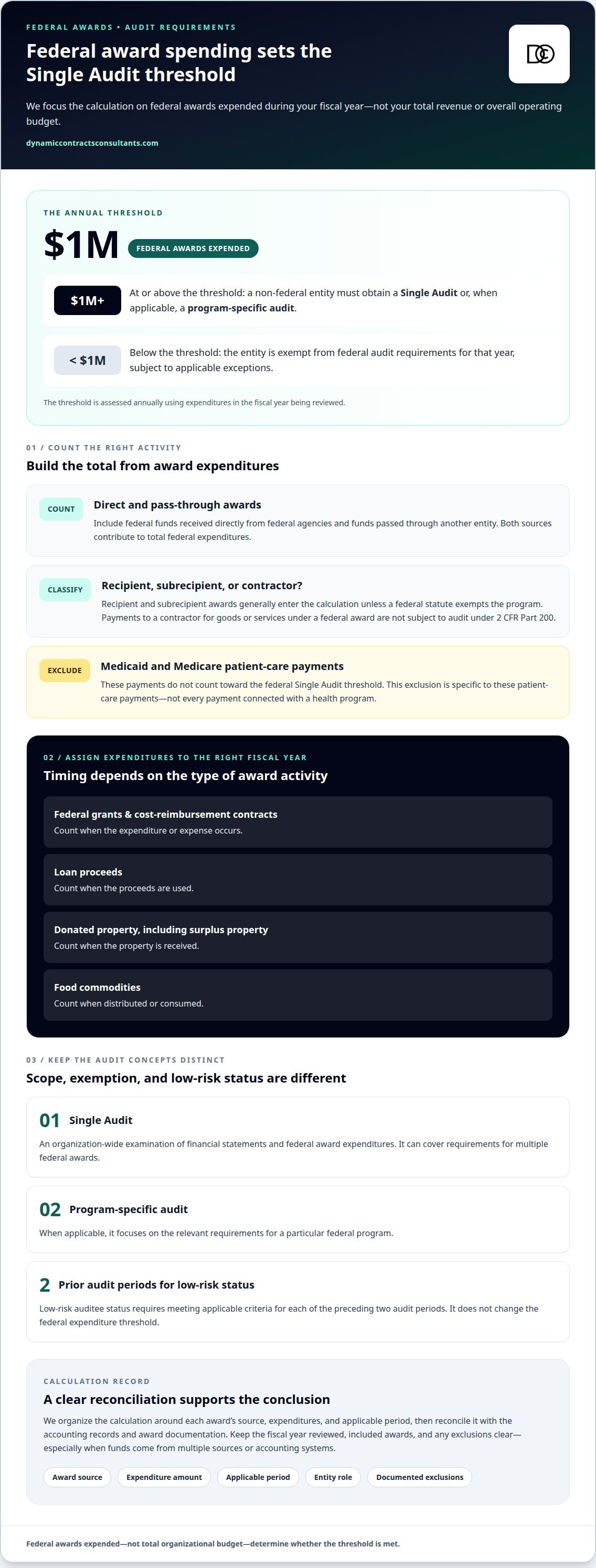
The trigger is the amount of federal awards an organization expends, not its overall budget. Under the single audit requirements for federal grants, a non-federal entity that expends $1 million or more in federal funds during its fiscal year must obtain a Single Audit or, when applicable, a program-specific audit, according to the Office of the Federal Register, National Archives and Records Administration. The threshold can seem straightforward, but correctly classifying federal funds is essential.
Understanding which expenditures count is the first step. You also need to determine whether your organization qualifies for an exemption and what the audit requirement entails. This article explains how direct and pass-through awards affect the threshold, how contractor payments are treated, and how financial statements and the schedule of expenditures of federal awards contribute to the audit. It also covers reporting deadlines, record retention, and the documents entities should prepare to assess their obligations and plan effectively.
Key Takeaways
- Separate an audit exemption from low-risk auditee status; they affect different parts of the audit process.
- Organize financial statements and the federal awards schedule so the records align with the entity’s award activity.
- Plan reporting and record retention together, since submission timing and supporting documentation are both part of audit readiness.
- Address audit findings promptly and coordinate the financial, compliance, and reporting work before submission.
What triggers the requirement for a Single Audit?
In the United States, a non-federal entity that expends $1 million or more in federal funds during its fiscal year must obtain a Single Audit or, if applicable, a program-specific audit, according to the Office of the Federal Register, National Archives and Records Administration. The threshold concerns federal awards expended, not the organization’s total revenue or overall operating budget. A reliable calculation therefore starts with identifying and classifying federal award activity for the fiscal year.
Count federal funds received directly from federal agencies and funds passed through another entity. For example, an organization may receive one award directly and administer another through a state or other pass-through entity. Both sources count toward total federal expenditures. Maintain records identifying each award, its source, expenditures, and applicable period, then reconcile them with the organization’s accounting system.
A Single Audit is organization-wide: it examines a non-federal entity’s financial statements and expenditures of Federal awards. A program-specific audit instead focuses on the applicable requirements for a particular Federal program. A Single Audit can cover requirements for multiple Federal awards, while a program-specific audit is limited to its relevant program.
The Single Audit Act Amendments of 1996 describe the audit’s organization-wide scope. The audit brings financial reporting and federal award compliance into one examination, rather than treating each award as an isolated engagement. This structure helps show how award expenditures relate to the entity’s financial statements and applicable award requirements.
Independent non-Federal auditors conduct Single Audits, and auditors must follow Generally Accepted Government Auditing Standards, or GAGAS. Entities subject to an audit must follow Subpart F of 2 CFR. The Uniform Guidance for Federal awards is codified in 2 CFR Part 200. These standards and requirements frame the audit; they do not replace the need to identify each award and its expenditures accurately.
Recipient and subrecipient awards generally enter the audit calculation, unless a federal statute exempts a program. By contrast, payments to a contractor for goods or services under a federal award are not subject to audit under 2 CFR Part 200. The distinction depends on the entity’s role and the nature of the payment, not simply on whether federal funds are involved. For example, document whether an entity receives an award as a subrecipient or provides contracted services.
Low-risk auditee status is separate from whether federal expenditures reach the audit threshold. To qualify, an auditee must meet the applicable criteria for each of the preceding two audit periods, according to the Office of the Federal Register, National Archives and Records Administration. Low-risk status does not change the threshold calculation. Assess federal expenditures, the entity’s award roles, and prior audit-period criteria separately.
- Identify direct and pass-through awards in the accounting records.
- Classify payments by whether the entity acts as a recipient, subrecipient, or contractor.
- Reconcile federal expenditures to the financial statements and award documentation.
Audit exemption for entities below the threshold
A non-federal entity that expends less than $1,000,000 in federal awards during its fiscal year is exempt from federal audit requirements for that year, subject to the applicable exception. The determination is based on federal awards expended during the fiscal year, not the entity’s total receipts, budget, or funding from every source. A careful calculation can therefore distinguish federal award activity from other organizational income.
Start with the award ledger and identify expenditures associated with each federal award. Include direct awards and funds passed through another entity, then reconcile the entries with the accounting records. For example, a nonprofit with substantial private donations may still fall below the federal threshold if its federal award expenditures remain below it. Conversely, a smaller organization may exceed the threshold by combining direct and pass-through awards.
Medicaid and Medicare patient-care payments do not count as funds expended for the federal Single Audit threshold. An organization receiving these payments should separate them from other federal award expenditures before determining whether it falls below the threshold. This exclusion applies to these patient-care payments in this calculation; it is not a general exclusion for every payment connected with a health program.
Timing can determine which fiscal year includes an expenditure. For federal grants and cost reimbursement contracts, funds are considered expended when the expenditure or expense occurs. Loan proceeds are considered expended when used. Donated property, including surplus property, is considered expended when received. Food commodities are considered expended when distributed or consumed. These distinctions matter when award receipt, use, and distribution occur across different periods.
Below-threshold status is determined annually. Keep a clear calculation identifying the fiscal year reviewed, the awards included, and any exclusions applied. This documentation explains why the organization concluded it fell below the threshold, especially when federal funds come from multiple sources or are recorded in different accounting systems.
The exemption applies only to federal audit requirements for that year. It does not remove federal agencies’ authority to audit or evaluate their programs and the entities receiving federal funds. The Single Audit Act does not restrict federal agencies or their Inspectors General from auditing or evaluating Federal awards. An entity below the threshold should therefore distinguish the Single Audit exemption from other oversight that may apply to its awards.
Before relying on the exemption, compare the award ledger with the general ledger, confirm the treatment of Medicaid and Medicare patient-care payments, and document the timing of items such as loans or donated property. If the resulting federal expenditure total is below $1,000,000, the entity meets the stated threshold condition for exemption that fiscal year, subject to the applicable exception.
Audit report submission and retention
For a nonprofit, submission timing depends on both the auditor’s report date and the end of the audit period. The nonprofit generally must submit its Single Audit electronically to the Federal Audit Clearinghouse within 30 days after receiving the auditor’s report or nine months after its audit period ends, whichever comes earlier, according to the Office of the Federal Register, National Archives and Records Administration. The earlier deadline controls, so the two dates should be tracked together.
For example, receiving the auditor’s report may start a deadline that falls before the audit-period filing limit. If the report arrives later, the audit-period deadline may come first. Record the audit-period end date and report-receipt date as separate milestones, then determine which deadline comes earlier. Tracking only one date can leave the organization exposed to a missed submission window.
The Federal Audit Clearinghouse submission is electronic. Before filing, the auditee should coordinate completion of the federal audit data collection form and reporting package, ensure the package is ready, and confirm that the submission is completed. Assign responsibility for assembling records, reviewing the package, and transmitting it to prevent gaps between the auditor’s report and filing.
What are the consequences of late or noncompliant Single Audit reporting? A late submission misses the applicable deadline and leaves the reporting obligation unmet. Federal agencies retain authority to monitor and oversee their programs and entities receiving federal funds under 2 CFR § 200.503(b-c), so late or incomplete reporting does not remove federal oversight.
Record retention continues after submission. Auditees must retain a copy of the federal audit data collection form and reporting package for three years from the date of submission to the Federal Audit Clearinghouse, according to the Office of the Federal Register, National Archives and Records Administration. Keep the submitted versions and proof of the submission date together so the retention period is clear.
Organize the file to connect the package to the audit period and submission. A practical record set can include:
- The final federal audit data collection form and reporting package.
- The submission date and confirmation record from the Federal Audit Clearinghouse.
- The auditor’s report and the audit-period dates used to calculate the deadline.
- Supporting correspondence that explains corrections or follow-up submissions.
Auditees and auditors must ensure that their respective parts of the reporting package contain no protected personally identifiable information. Review materials before submission, especially attachments that may include individual-level details. Unless federal law or regulation restricts disclosure, auditees must also make copies of the Single Audit report available for public inspection. These privacy and disclosure responsibilities make controlled file preparation important, alongside deadline tracking and three-year retention.
Financial statements and federal awards schedules
A Single Audit connects an entity’s financial statements with its federal award activity. The financial statements present the organization’s financial position and results, while the schedule of expenditures of federal awards (SEFA) identifies federal award expenditures. Preparing both together helps the auditor trace award activity through the organization-wide financial picture and assess whether the records align.
Begin with the accounting records for the fiscal year under audit. Identify expenditures associated with each federal award, then reconcile them to the general ledger and financial statements. For example, if one grant’s costs appear in several expense accounts, document how those entries combine into the reported award expenditure. This reconciliation clarifies the connection between financial reporting and grant activity.
Support the SEFA with records that explain each reported amount. Maintain award documents, expenditure details, and reconciliations connecting recorded costs to the relevant federal funding. If an award passes through a state or another entity, retain records showing that relationship. These details help distinguish federal award activity from other revenue in the accounting system.
Timing matters when assembling the schedule. Federal grant and cost reimbursement contract funds are considered expended when the expenditure or expense occurs. Loan proceeds are considered expended when used; donated property, including surplus property, when received; and food commodities when distributed or consumed. Apply the relevant timing treatment consistently, then reconcile the figures to the records for the correct fiscal year.
A practical preparation file brings related evidence together. Include the final financial statements, the SEFA, general ledger extracts supporting award expenditures, and reconciliations between the schedule and accounting records. Keep award documentation alongside the relevant entries. This organization helps the auditor trace an expenditure from its source documentation through the ledger and into the schedule.
- Map each federal award to its accounting records and supporting documents.
- Reconcile schedule totals to ledger balances and financial statement amounts.
- Record how timing treatment affects grants, loan proceeds, donated property, and food commodities.
- Separate federal award activity from other revenue and document pass-through relationships.
Resolve differences before audit fieldwork begins. For instance, investigate a schedule amount that does not match the general ledger, determine whether an entry belongs to another period, and document the adjustment. A clear audit trail supports accurate reporting and helps auditors examine the financial statements and federal award expenditures as connected parts of one organization-wide audit.
What are the key steps to prepare for a Single Audit?
Preparation starts by confirming the entity’s audit obligation and defining the fiscal year under review. Assign responsibility for coordinating the audit, gathering records, and tracking decisions. The auditee must arrange for the required federal audit, ensure it is properly performed and submitted, prepare financial statements and a schedule of expenditures of federal awards, and promptly address findings.
Selecting an independent auditor requires attention to independence and procurement. Single Audits are conducted by independent non-Federal auditors. Auditors or firms that previously prepared program indirect cost proposals or cost allocation plans are restricted from performing the audit. When procuring audit services, auditees must comply with procurement standards in 2 CFR 200.317 through 2 CFR 200.327.
Build a central audit file that connects federal awards to accounting records. Include award documents, pass-through details, expenditure support, and reconciliations. For example, if an award’s costs appear across several general ledger accounts, retain a reconciliation explaining how those entries support the reported total. Organized records help the auditor trace transactions and understand the entity’s award activity.
Prepare the financial statements and schedule of expenditures of federal awards using reconciled accounting data. Compare schedule amounts with the general ledger, resolve differences, and document adjustments. Keep the source records for each reported expenditure accessible. Connecting award documentation, ledger entries, and schedule totals supports the organization-wide audit of financial statements and federal award expenditures.
Coordinate audit timing and responsibilities with the auditor before fieldwork. Identify who will provide financial statements and award records and respond to audit requests. Track open questions and assign follow-up. This approach helps prevent unresolved information requests from delaying the auditor’s work or affecting completion and submission of the reporting package.
Address findings promptly and document the response. Assign an owner to each finding, identify the relevant records or process, and track the response through resolution. For example, a finding involving unsupported expenditures calls for locating relevant supporting records and documenting the response. Clear ownership makes follow-up part of audit preparation, rather than a task left until after reporting.
- Assign a coordinator for audit records, communications, and deadlines.
- Reconcile the financial statements and federal awards schedule before auditor review.
- Retain award-level support that traces expenditures to accounting records.
- Document responsibility and follow-up for each audit finding.
Use these preparations to strengthen strategic compliance across federal award activity. Discuss your audit preparation priorities and the compliance processes that support your federal awards.
Dynamic Contracts Consultants LLC: Proposal Writing
Dynamic Contracts Consultants LLC supports organizations pursuing federal opportunities through Proposal Writing, Grant Writing, DCAA Compliance Consulting, and Capture Management. These services can help when your team is preparing a proposal, strengthening compliance processes, or assessing an opportunity before committing resources.
Single Audit preparation remains the auditee’s responsibility, including arranging the audit, maintaining supporting records, and addressing findings. For organizations managing federal awards, Dynamic Contracts Consultants LLC helps align grant and proposal development with disciplined compliance processes and clearer planning across the award lifecycle. Its DCAA Compliance Consulting addresses federal contracting compliance needs, but does not replace an independent Single Audit.
Build Compliance Into Your Next Federal Award
Audit readiness is more than a year-end exercise. Treating compliance as part of ongoing award management helps teams maintain clear records, assign responsibilities, and respond to changing operational demands. The single audit requirements for federal grants can also inform how you structure processes before pursuing or administering new awards.
Start by identifying where current workflows create friction, such as award documentation, accounting coordination, or compliance follow-up. Addressing those gaps can strengthen your organization’s ability to manage federal work while keeping financial and program teams aligned. Consistent internal processes give leaders a clearer foundation for decisions across the award lifecycle.
At Dynamic Contracts Consultants LLC, we work with organizations on federal contracting and grant-related needs. If you are assessing how to align your growth plans with compliance priorities, contact us to discuss your goals. A focused conversation can help you identify a useful direction for your next step and move forward with greater clarity.
Frequently Asked Questions
What is a Single Audit under 2 CFR Part 200?
A Single Audit is an organization-wide examination of a non-federal entity’s financial statements and federal award expenditures. The Uniform Guidance for Federal awards is codified in 2 CFR Part 200, and entities subject to an audit follow Subpart F. Understanding how the single audit requirements for federal grants apply helps distinguish this broad review from an audit focused on one program. Its scope includes applicable federal award requirements.
Which organizations are subject to a Single Audit?
Non-federal entities that meet the federal expenditure threshold are generally subject to a Single Audit or, when applicable, a program-specific audit. This can include recipients and subrecipients, including entities receiving awards through a pass-through organization. A contractor paid to provide goods or services under a federal award is treated differently: those payments are not subject to audit under 2 CFR Part 200. The entity’s role matters.
What is the federal expenditure threshold for a Single Audit?
The threshold is $1 million or more in federal funds expended during the entity’s fiscal year, according to the Office of the Federal Register, National Archives and Records Administration. Reaching the threshold generally triggers a Single Audit or, if applicable, a program-specific audit. The single audit requirements for federal grants hinge on federal award expenditures, not total revenue, private contributions, or the organization’s full operating budget.
How do you determine federal expenditures for the audit threshold?
Identify federal award expenditures across direct awards and funds passed through another entity, then apply the appropriate timing to each item. Grant and cost-reimbursement contract expenses count when the expense occurs; loan proceeds count when used. Donated property counts when received, while food commodities count when distributed or consumed. Keep supporting records that show each item’s award, accounting entry, and timing.
What are the Single Audit reporting deadlines and extensions?
A nonprofit generally submits electronically to the Federal Audit Clearinghouse within 30 days after receiving the auditor’s report or nine months after its audit period ends, whichever comes earlier, according to the Office of the Federal Register, National Archives and Records Administration. Track both dates and plan around the earlier one. The standard deadline calculation does not itself provide extra time, so do not assume a later filing date applies.
What audit requirements apply when federal expenditures are below the Single Audit threshold?
An entity below the threshold is exempt from federal audit requirements for that fiscal year, subject to the applicable exception. The exemption applies to the federal audit requirement triggered by the threshold, not to all oversight. Federal agencies retain authority to monitor and oversee their programs and the entities receiving federal funds. For example, an agency may still monitor an award outside the Single Audit process.
What are the auditor’s responsibilities and required audit reports?
An independent non-Federal auditor conducts the Single Audit in accordance with Generally Accepted Government Auditing Standards. The audit examines the entity’s financial statements and federal award expenditures, while the auditee prepares financial statements and a schedule of expenditures of federal awards. The reporting package includes the federal audit data collection form. Auditees and auditors must ensure that their respective package materials contain no protected personally identifiable information.
What is the Federal Audit Clearinghouse submission process?
The auditee submits the Single Audit electronically to the Federal Audit Clearinghouse, including the federal audit data collection form and reporting package. Coordinate completion and review of the package before transmission, and keep the submission record with the final documents. Auditees must retain the form and package for three years from submission, according to the Office of the Federal Register, National Archives and Records Administration.
Have a question this article didn’t answer?
Talk it through with a certified contracting professional. The first 30 minutes are free.