
Managing federal grant funds compliance takes more than expense tracking. Learn how we align reporting, controls, and oversight throughout the award lifecycle.
We manage federal grant funds compliance as an award-wide process, connecting funding decisions with clear responsibilities and consistent oversight. For your organization, that means coordinating requirements, records, and program activity throughout the grant lifecycle.
Tracking expenditures alone isn’t enough. We help you account for how award terms shape operational decisions, while your team maintains the records needed to support them.
This article explains the grant manager’s role and practical ways to handle reporting, federal requirements, internal controls, assigned responsibilities, and lifecycle management. Together, these elements support disciplined grant administration.
Key Takeaways
- Define grant management responsibilities clearly so award requirements, financial records, and program delivery remain coordinated.
- Build reporting around funder deadlines and measures that show both expenditures and program performance.
- Translate applicable federal and award-specific requirements into practical procedures for procurement, documentation, and oversight.
- Use clear expense review steps, separate grant tracking, and assigned approval responsibilities to strengthen internal controls.
- Manage each award from pre-award planning through closeout, with reviews that address risks, performance, and final reconciliation.
1. What Does a Federal Grant Manager Do?
We view a federal grant manager as the coordinator connecting award terms with funding, oversight, and operational decisions. For your organization, that means clarifying which staff own financial records, program delivery, and required reviews. We can map each obligation to a responsible role, supporting evidence, and decision point. For example, a reporting obligation should have an owner who can gather source records and coordinate review before submission.
Audit readiness begins with understanding whether a Single Audit applies. According to the Office of Management and Budget, a non-Federal entity that expends $1,000,000 or more during the non-Federal entity's fiscal year in Federal awards must have a single or program-specific audit conducted for that year in accordance with the provisions of this part. The Office of Management and Budget also states that the revised Single Audit threshold is $1 million for awards with fiscal years beginning on or after October 1, 2024. We recommend distinguishing this threshold from other award-specific review obligations and organizing records to support reported expenditures.
Organize award records so reviewers can trace activity from approval through payment. Group the grant agreement, approved budget, amendments, procurement records, invoices, payroll support, and performance reports. Each transaction should link its ledger entry to source documentation and the program purpose it supports.
Assign an owner and establish a controlled process for record retention. Identify the retention terms in the award, preserve records in an accessible format, and document where they are stored. For personnel costs, time and effort records should support the amounts charged to the grant. A retention log can list each document category, custodian, location, and authorized disposition.
If an audit identifies a finding, organize the response around the affected transactions and relevant award terms. Document the control gap, assess its cause, and preserve evidence supporting the response. For an expense without adequate documentation, trace the original transaction and record the analysis used to resolve the issue.
Corrective action planning turns a finding into accountable work. Record the responsible role, required process change, evidence of completion, and monitoring step. A findings register helps track open actions, escalate overdue items, and test whether revised procedures work. Documented follow-up can connect findings to ongoing post-award compliance and award administration.
Federal programs can carry distinct administrative demands. The White House states that the Infrastructure Investment and Jobs Act was signed into law in November 2021. For an award connected to that legislation, we recommend identifying applicable terms, documenting their interpretation, and assigning related tasks to procurement, finance, and program staff. This makes the requirements part of your organization’s routine oversight and recordkeeping.
2. Performance reporting and impact metrics
Connect performance reporting to the objectives in your award. Translate each objective into a measurable indicator, a data source, an accountable owner, and a collection process. For example, a workforce program might track participant completion using enrollment records and completion documentation. This helps your team explain what funded work accomplished, not just what it cost.
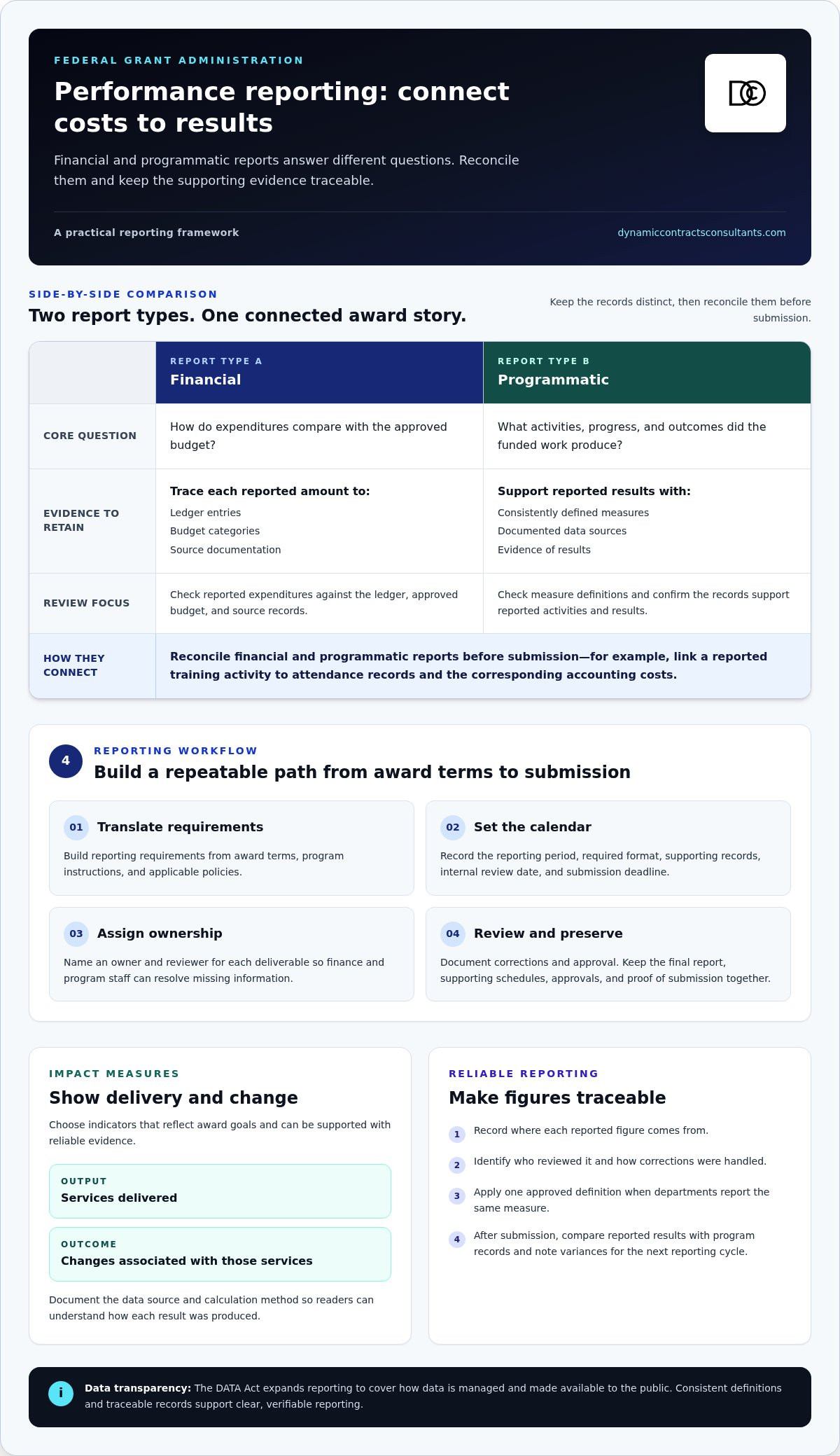
Treat financial and programmatic reports as related but distinct records because they answer different questions. A financial report shows expenditures against the approved budget; a program report describes activities, progress, and outcomes. Reconcile the two before submission. For example, link a reported training activity to attendance records and the corresponding costs in your accounting records.
Build reporting requirements from the award terms, program instructions, and applicable policies. Create a calendar based on those sources, then assign each deliverable to an owner and reviewer. Include the reporting period, required format, supporting records, internal review date, and submission deadline. This gives finance and program staff time to resolve missing information before a report reaches the funder.
- Financial data: Reconcile reported expenditures with your ledger entries, budget categories, and source documentation.
- Program data: Define each measure consistently, document its source, and retain evidence supporting reported results.
- Review controls: Assign a preparer and reviewer, then document corrections and approval before submission.
- Submission evidence: Retain the final report, supporting schedules, approvals, and proof of submission together.
Choose impact metrics that inform decisions, rather than collecting data solely to complete a form. Select indicators that reflect the award’s goals and your organization’s ability to gather reliable evidence. Distinguish outputs, such as services delivered, from outcomes, such as changes associated with those services. Document each data source and calculation method so readers can understand how the result was produced.
The Digital Accountability and Transparency Act (DATA Act) expands reporting to cover how data is managed and made available to the public. Treat consistent data definitions and traceable records as core reporting practices. Document where each reported figure comes from, who reviewed it, and how corrections were handled. If departments use different definitions for the same measure, establish and consistently apply one approved definition.
After submission, compare reported results with program records and note variances for the next reporting cycle. A missed target may reflect implementation issues, incomplete data, or a measurement method that needs refinement. Record the explanation, responsible follow-up, and any changes to collection procedures. This helps your team use reports for oversight and informed operational decisions.
3. Environmental and other federal requirements
The Uniform Guidance governing federal awards is identified as 2 CFR 200, according to the Office of the Federal Register, National Archives and Records Administration. Recipients should use the award terms alongside applicable federal requirements, agency instructions, and program-specific conditions. A requirement matrix can connect each condition to a responsible owner, supporting record, and review procedure. This helps an organization translate broad obligations into operational steps.
For 2 CFR Part 200 requirements, begin with the award agreement and identify the provisions that apply to the funded activity. Then compare those terms with the organization’s existing policies for accounting, procurement, documentation, and oversight. Record any required process changes and assign implementation responsibility. For example, a procurement file can document the purchase purpose, selection rationale, approvals, and connection to the award budget.
To track budgets, expenditures, and allowable costs, assign each award a distinct accounting code and reconcile its ledger against the approved budget. Before payment, match each expense to supporting documentation, the grant’s purpose, and applicable award terms. A documented review can flag costs that need clarification before they appear in a report.
To manage federal cash drawdowns and limit excess cash, base each request on near-term cash needs and a current expenditure forecast. Reconcile drawdowns with payments and recorded expenditures, then investigate balances that exceed planned disbursements. Align requests and reconciliations with the award’s payment terms, and document the review.
Assess environmental requirements in light of the funded activity and the award’s conditions, rather than treating them as a generic checklist. Identify project actions that could trigger environmental review, assign a knowledgeable staff owner, and retain relevant approvals or assessments. For infrastructure procurement, document how required domestic sourcing conditions apply to the funded purchase.
Federal and foundation grants require different compliance mapping. Federal awards are subject to applicable federal requirements and agency conditions; a foundation award’s obligations come from its agreement and funder instructions. In either case, read the specific award carefully. Organizations managing both types should keep separate obligation records, avoiding the mistaken application of federal rules to foundation funding or the oversight of foundation terms.
The Office of Management and Budget’s annual Compliance Supplement can help organizations understand federal grant requirements and assess compliance practices. Use the applicable sections to identify relevant compliance areas, then compare them with internal procedures and award terms. Record the review date, evidence examined, gaps identified, and assigned follow-up. This creates a traceable basis for updating policies as program conditions change.
For grants receiving Infrastructure Investment and Jobs Act funds, Build America Buy America requirements for domestic procurement apply. Map each covered purchase to the project scope, procurement file, and applicable award condition. Retain the rationale and supporting procurement records with the grant documentation. This links the federal requirement to the purchasing decision and supports consistent oversight.
4. Internal controls and assigned compliance responsibilities
Internal controls turn grant requirements into repeatable steps for finance and program teams. Assign an owner to each control, such as expense approval, account reconciliation, or report review. For example, the employee entering an invoice can be different from the person approving payment. This creates a review point before funds leave the organization and clarifies accountability for each transaction.
Use a distinct account or funding code for each grant so transactions are traceable. Before processing an expense, compare its purpose, documentation, and budget category with the award terms. A reviewer can check the invoice, approval, and ledger entry together. If supporting documentation is missing, return the transaction for resolution instead of relying on a later audit to find the gap. This makes managing federal grant funds compliance part of routine financial operations.
The GAO’s Standards for Internal Controls in the Federal Government, also called the Green Book, provides a framework for designing and operating controls. Organizations can use that framework to assess whether procedures address identified risks. A written control description should name the responsible role, evidence retained, review method, and escalation path. Assigning these elements helps staff apply a procedure consistently when personnel or project duties change.
- Payment review: Match invoices to approvals, documentation, and the grant purpose before payment.
- Access management: Assign system permissions according to each employee’s grant responsibilities.
- Reconciliation: Compare grant ledger activity with supporting records and investigate differences.
- Report review: Have a second staff member check calculations and source data before submission.
Compliance reviews test whether controls work as designed, not merely whether procedures exist. Review grant transactions, procurement files, and reporting records, then document exceptions and follow-up actions. A review may reveal that approvals are recorded but supporting documents are stored inconsistently. Assigning a records owner and standardizing file locations addresses that weakness and gives reviewers a clear evidence trail.
Subrecipient oversight should reflect the funded work and assessed risks. Review the subrecipient’s financial and programmatic information, examine supporting documentation, and track issues through resolution. Agencies can use risk assessments and risk-based monitoring to oversee federal grant subrecipients. Recipients can take a similar risk-informed approach to their own monitoring, documenting the rationale, review scope, and resulting actions.
Contractor monitoring requires a clear view of the agreement, deliverables, invoices, and approval responsibilities. Assign a program lead to verify that the work aligns with the contract, while finance checks invoices against approved terms. Keep monitoring records with procurement and payment documentation. This distinguishes contractor performance oversight from subrecipient monitoring and clarifies who addresses each concern.
Create a responsibility matrix that connects each grant requirement to an accountable role and review point. Include finance, program management, procurement, and leadership wherever their decisions affect compliance. Update the matrix when an award changes or staff responsibilities shift. A scheduled review can test whether assigned controls match actual practice, keeping managing federal grant funds compliance aligned with operations.
5. Federal grant lifecycle management
Federal grant compliance works best as a connected process, beginning before an application and continuing through closeout. Each stage creates decisions and records that inform the next. A lifecycle map can identify the responsible role, required evidence, and review point for every major transition. This prevents application assumptions from becoming post-award control gaps.
Before an award, grant managers may announce programs, solicit applications, assess eligibility, and evaluate proposals. Recipients can prepare by aligning program objectives with organizational capacity, a realistic work plan, and a supportable budget. Risk assessments and business reviews help identify implementation concerns before commitments are made. For example, staffing capacity, procurement needs, and data collection methods should match the proposed activities.
During application development, connect each planned activity to its cost, schedule, and intended result. Review estimates and supporting materials for consistency, then retain the submitted version and related approvals. If a government funding opportunity requires a particular format, assign an owner to each response component. This keeps narratives, budgets, and delivery assumptions aligned when the application is assembled.
At award, review the agreement against the submitted plan before work begins. Identify terms covering eligible activities, costs, schedules, reporting, and oversight responsibilities. Document differences between the proposal and final award, then communicate revised obligations to finance, program, and procurement staff. A clear handoff gives implementation teams a shared reference for decisions and records.
During performance, compare actual delivery with the award’s work plan and conditions. Grant managers monitor performance and assess compliance with award terms. Track schedule changes, spending patterns, deliverables, and emerging risks in one award record. If an activity changes, document why, assess the effect on objectives and costs, and follow the award’s process for approvals or amendments.
Post-award reviews can identify management, financial, and administrative issues while there is time to address them. Compare evidence with the agreement, record exceptions, assign corrective actions, and track resolution. A procurement delay, for example, may affect both the project schedule and planned expenditures. Escalating the variance early supports informed decisions and preserves a record of the response.
Closeout requires a final review of award activity, financial records, and remaining obligations. Grant managers may make appropriate adjustments or disallowances, process closeouts, and review final award records. Reconcile expenditures with supporting documentation, confirm required deliverables, and record unresolved matters and their disposition. Capture lessons about budgeting, implementation, and oversight so future applications and award plans reflect operational experience.
Use a lifecycle register to connect pre-award decisions, award terms, performance reviews, and closeout evidence. For support aligning your federal funding strategy with the award lifecycle, discuss your grant lifecycle requirements.
Dynamic Contracts Consultants LLC: Proposal Writing
Dynamic Contracts Consultants LLC supports organizations at key stages of the funding lifecycle through Grant Writing, Proposal Writing, and DCAA Compliance Consulting. Turn to grant writing support when developing an application that must align its program narrative, budget, and objectives. For post-award financial compliance, DCAA Compliance Consulting can help strengthen the controls and documentation practices behind disciplined financial management.
These services complement your internal grant administration: your team remains responsible for applying award terms, maintaining records, submitting reports, and overseeing performance. Choose support based on your immediate priority, whether that is developing a funding proposal or strengthening financial compliance practices.
Contact Dynamic Contracts Consultants LLC to discuss your grant writing or compliance needs, or visit dynamiccontractsconsultants.com.
Build a Stronger Foundation for Your Next Award
The next grant cycle is an opportunity to make compliance part of operational planning, not a separate administrative task. Treat managing federal grant funds compliance as an ongoing discipline: connect funding decisions to clear ownership, reliable information, and processes your team can sustain as program needs evolve. This approach can help your organization prepare for new opportunities while keeping its mission in focus.
Use your next planning cycle to identify where responsibilities, systems, or workflows need better alignment. Then set practical priorities that fit your organization’s capacity and funding requirements. Deliberate improvements, supported by clear decisions and consistent execution, can strengthen readiness over time.
Dynamic Contracts Consultants LLC can support your federal funding goals with proposal and grant writing, alongside DCAA Compliance Consulting. Contact Dynamic Contracts Consultants LLC to discuss your goals and identify a practical next step for your organization.
Frequently Asked Questions
What Does a Federal Grant Manager Do?
A federal grant manager coordinates award decisions, recipient communication, and oversight across the active stages of a grant. Depending on the role, responsibilities may include evaluating applications, clarifying award conditions, providing technical assistance, and coordinating audit finding resolution with responsible officials. For recipients, the manager also helps connect program, finance, and procurement staff so each understands how their work supports award objectives and documentation needs.
What is grant compliance?
Grant compliance means administering an award according to its terms and applicable requirements while retaining evidence of decisions and activities. For example, a recipient should be able to explain how a purchase supports the funded project and show the approval and records behind it. Compliance also includes meeting reporting obligations, monitoring progress, addressing identified gaps, and completing required closeout steps.
What federal regulations govern managing federal grant funds, including 2 CFR Part 200?
Federal grant requirements include the award’s conditions and applicable government-wide and agency-specific rules. The Uniform Guidance governing federal awards is identified as 2 CFR 200, according to the Office of the Federal Register, National Archives and Records Administration. Recipients should map relevant requirements to their activities, then review agency terms and program conditions for additional obligations. Requirements can differ by funding program and award.
What internal controls are required for federal grant recipients?
Recipients need controls suited to their award activities and risks, not a single procedure for every organization. The GAO’s Green Book offers a framework for designing and operating internal controls. Practical safeguards include assigning separate approval and payment roles, restricting accounting-system access according to responsibility, and documenting reconciliations. For instance, the employee who prepares a payment can differ from its approver.
What costs are allowable, allocable, and reasonable under federal grants?
Assess a proposed charge against the award’s purpose, the work performed, and the organization’s cost records. A cost is allocable when it can be assigned to the benefit received; reasonableness concerns whether the amount reflects the circumstances and sound business judgment. Before charging a cost, document its purpose, calculation, allocation method, and supporting evidence, then compare it with award conditions and applicable requirements.
What procurement rules apply when spending federal grant funds?
Procurement must follow applicable award conditions, federal requirements, and the recipient’s established procedures. Before committing funds, document the project need, selection rationale, approval, and connection to the grant. For a purchase tied to an Infrastructure Investment and Jobs Act-funded project, assess applicable Build America Buy America domestic procurement conditions and retain supporting records. Keep the procurement decision traceable from planning through payment.
What documentation and record-retention requirements apply to federal grants?
Keep records that substantiate award decisions, expenditures, program activity, approvals, and required reporting. A well-organized file might include the agreement and amendments, invoices, payroll support, procurement rationale, progress evidence, and submitted reports. Identify the award’s retention and access requirements, assign a records owner, and preserve documents so staff can retrieve them for oversight, audit inquiries, or closeout.
What reporting deadlines and financial reports are required for federal grants?
The award terms and applicable program instructions set required reports and due dates. Build a calendar from those requirements, noting each reporting period, preparer, reviewer, supporting records, and submission method. Financial reports should reconcile with the grant ledger, while program reports should describe activities and progress using consistent evidence. If an award amendment changes reporting obligations, update the calendar and notify responsible staff.
Have a question this article didn’t answer?
Talk it through with a certified contracting professional. The first 30 minutes are free.