
Use our federal grant application checklist to organize documents, assess readiness, align budgets, and plan compliant submissions for government grants.
Yes, you can apply for multiple government grants at the same time, provided your organization meets each opportunity’s eligibility requirements and can prepare a complete application for each one. A federal grant application checklist should account for the specific Notice of Funding Opportunity, required documents, and your organization’s capacity to deliver the proposed work.
Managing several applications can broaden your funding options, but federal, state, and local programs may use different eligibility criteria, forms, and deadlines. Start with the requirements for each specific opportunity rather than preparing one generic application package.
This guide explains how to organize core documents, assess organizational readiness, and develop a project narrative and budget that meet the funder’s requirements. It also covers matching funds, what to expect after submission, and differences between federal, state, and local applications, helping you plan your workload and funding strategy.
Key Takeaways
- Organize application files by opportunity and maintain clear version control so each submission uses accurate, current materials.
- Assess whether your organization has the governance, financial controls, leadership, and program capacity to manage an award.
- Determine how a funding opportunity treats matching contributions, then align the budget and supporting financial records with its requirements.
- Plan for review after submission and prepare early for the financial, performance, and reporting responsibilities that may follow an award.
- Adapt your approach to federal, state, and local opportunities, since eligibility criteria, application formats, and deadlines can differ.
What documents are typically required for a government grant application?
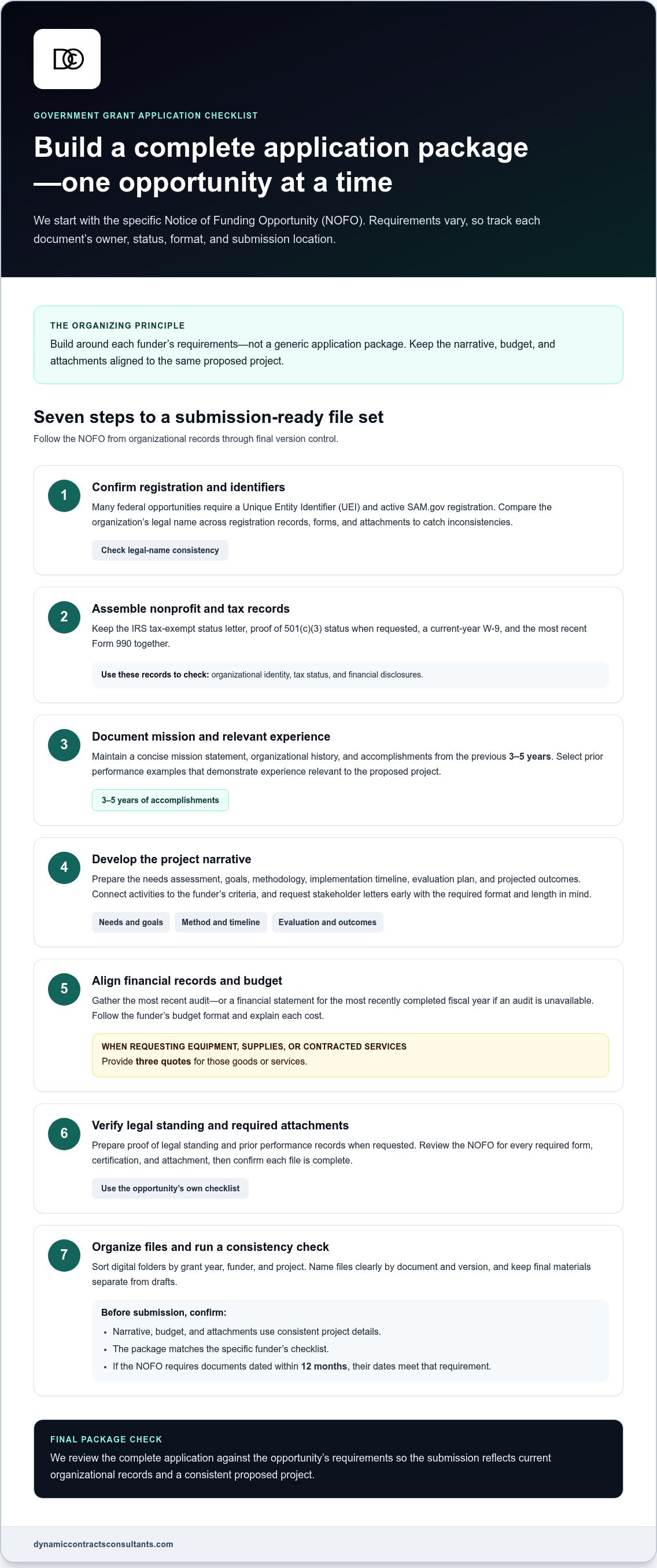
Start with the Notice of Funding Opportunity (NOFO), since each funder sets its own criteria and required attachments. Use a federal grant application checklist to distinguish core organizational records from materials specific to an opportunity. Track each item’s owner, status, format, and submission location to spot gaps early.
- Confirm registration and organizational identifiers. Many federal opportunities require a Unique Entity Identifier and active SAM.gov registration. We recommend comparing the organization’s legal name across registration records, forms, and attachments to catch inconsistencies.
- Assemble nonprofit status and tax documents. Keep the IRS tax-exempt status letter, proof of 501(c)(3) status when requested, a current-year W-9, and the most recent Form 990. We use this group of records to check identity, tax status, and financial disclosures.
- Prepare mission, history, and performance records. We suggest maintaining a concise mission statement, organizational history, and accomplishments from the previous 3-5 years. Select prior performance examples that demonstrate experience relevant to the proposed project.
- Develop the project narrative and attachments. Prepare a needs assessment, goals, methodology, implementation timeline, evaluation plan, and projected outcomes. We recommend connecting activities to the funder’s criteria and requesting stakeholder letters early, with the required format and length in mind.
- Compile financial documents and a funder-aligned budget. Gather the most recent audit, or a financial statement for the most recently completed fiscal year if the audit is unavailable. We advise following the funder’s budget format and explaining each cost. Applicants requesting equipment, supplies, or contracted services must provide three quotes for those goods or services.
- Check legal standing and required attachments. Prepare proof of legal standing and prior performance records when requested. We suggest reviewing the NOFO for every form, certification, and attachment, then confirming each required file is complete.
- Organize files with consistent version control. We recommend digital folders sorted by grant year, funder, and project. Name files clearly by document and version, and keep final materials separate from drafts. If the NOFO requires documents dated within 12 months, verify dates before submitting.
Before submitting, compare the package with the specific funder’s checklist instead of relying on an earlier application. Check that the narrative, budget, and attachments use consistent project details, and label older drafts clearly. This final review helps ensure the submission reflects your organization’s current mission, records, and proposed work.
Post-submission review and award timelines
After you submit, track the application’s status, preserve the submitted version, and prepare for evaluation. Federal award decisions typically take 3-6 months after submission, while some grant cycles take six months or longer.
- Save the submitted application and confirmation. Keep the final narrative, attachments, submission receipt, and timestamp together so your team can answer follow-up questions using the exact package reviewed.
- Record the funder’s review milestones. Add the application deadline, expected decision period, and any stated interview or clarification steps to a shared calendar to coordinate staff responsibilities.
- Plan for a competitive review period. Evaluators may review hundreds or even thousands of applications, so organize the project’s needs, methods, and expected outcomes for quick reference.
- Assign an owner to monitor funder communications. Identify a staff member to check the application portal and official messages, then route requests to the people responsible for each topic.
- Prepare a response process for clarifications. Keep source data and budget assumptions accessible so subject-matter and finance staff can provide consistent answers if the funder requests details.
- Review the award notice before accepting funding. Compare the approved scope, budget, period, and conditions against the proposed project so the organization understands what the award authorizes.
- Document acceptance and award-receipt requirements. Record required signatures, forms, and receipt steps from the award notice, because funding administration begins with the funder’s stated terms.
- Translate award conditions into assigned tasks. Give each requirement an owner and due date, and retain the award agreement as the reference for implementation and oversight.
- Set up financial tracking against the approved budget. Maintain accurate records and compare expenditures with approved categories to identify variances before they affect project delivery or reporting.
- Define how the team will measure project outcomes. Identify the staff member tracking data, outputs, and outcomes, and document which information the funder requires in reports.
- Calendar the applicable reporting schedule. Federal grant reporting may be quarterly, semiannual, or annual, so map each required submission to the award’s stated schedule.
- Retain supporting records for reported results and costs. Keep source documents, financial records, and outcome evidence organized so submitted reports can be reconciled to project activity.
- Monitor compliance throughout performance. Track applicable award terms alongside the approved budget, reporting duties, and documentation requirements rather than waiting until a report is due.
- Address civil rights requirements for transportation awards. The U.S. Department of Transportation requires grant recipients to comply with Title VI, so include that obligation in award oversight.
For a nonprofit, post-submission readiness means preparing staff, financial processes, and outcome tracking before a decision arrives. If an application is declined, retain reviewer feedback and use it to revise the narrative or supporting evidence for a future opportunity.
Administrative, governance, financial, leadership, and program capacity
Readiness means demonstrating that your organization can govern the award, manage funds, and deliver the proposed program. Before applying, assess these capabilities against the project’s scope, staffing plan, timeline, and reporting requirements.
- Assign an accountable lead for the proposal and program. A named lead can coordinate decisions, deadlines, implementation tasks, and communication across departments.
- Map each major project task to a responsible role. A staffing plan shows who manages delivery, finances, oversight, and outcome tracking if the proposal is funded.
- Document how leadership approves key decisions. Written approval steps help staff understand who can authorize spending, changes, and reports during the award period.
- Record the board’s annual giving participation percentage. This governance indicator helps describe board engagement alongside the organization’s mission and oversight structure.
- Test financial controls using a sample transaction. Trace an expense from approval through payment and recording to identify unclear responsibilities or missing documentation.
- Separate payment approval from account reconciliation where practical. Distinct review steps make it easier to identify errors and resolve discrepancies in financial records.
- Prepare recent balance sheets and profit and loss statements. These records give reviewers a view of assets, liabilities, revenue, and expenses relevant to the proposed work.
- Review cash flow against the project timeline. A cash flow analysis helps identify when the organization must cover project costs and when funds are expected.
- Include the most recent audit. If an audit is unavailable, prepare a financial statement for the most recently completed fiscal year.
- Connect each budget category to a program activity. This alignment helps demonstrate how proposed resources support project objectives and planned outcomes.
- Identify capacity gaps before committing to the timeline. Compare staff availability, financial processes, and program workload with the proposal’s delivery schedule.
- Define how managers will review progress. Set a consistent internal review process for comparing work completed, spending, and outcomes with the approved plan.
- Keep governance and financial records accessible. Centralized board approvals, statements, and audit documents support timely review during application preparation and award management.
For transportation funding, the governing framework is specific: according to Electronic Code of Federal Regulations, U.S. Department of Transportation awards are governed by the Federal 2 CFR 200 Uniform Administrative Requirements, Cost Principles, and Audit Requirements. Include this framework in your readiness assessment, then connect relevant financial procedures and oversight responsibilities to the award’s requirements.
A practical assessment should be supported by evidence, not assurances alone. Gather current role assignments, a documented approval process, financial statements, and a project schedule that identifies accountable staff. These materials help show whether your administrative systems can support the proposed work alongside daily operations.
What is matching funds and do all grants require it?
Matching funds are resources an applicant contributes alongside a grant to support project costs. A match is not required for every grant; the funding opportunity specifies whether one applies, its amount, and which contributions qualify. Check the instructions and record the permitted sources, calculation method, and required documentation before applying.
A federal grant may require an applicant to contribute 25% of project costs through cash, donated services, or other eligible resources. Treat that figure as an example, not a universal requirement: the funder’s terms govern each application. If a match is required, develop a calculation that clearly shows total project costs, the grant request, and the applicant’s contribution.
- Confirm the match requirement in the funding opportunity. Note whether the match is mandatory, how the funder calculates it, and which resources it accepts.
- Identify each proposed contribution source. Separate cash from donated services or other eligible resources, then document the source and its connection to project activities.
- Explain cost sharing in the budget narrative. Describe how each contribution supports a project goal and how the organization will track its use.
- Align every budget item with project work. Explain why each cost is necessary and how it supports the proposed activities, timeline, and outcomes.
- Reconcile the narrative, budget, and financial records. Confirm that amounts and descriptions match across the application before submission.
A budget justification explains what the figures represent. For example, connect a personnel cost to a defined role and project task, then explain how the amount was calculated. Have organizational leaders review these assumptions with finance staff so the narrative, budget tables, and supporting records describe one consistent plan.
Financial statements and audits can help demonstrate your organization’s ability to manage the proposed funding. Use the most recent audit, or a financial statement for the most recently completed fiscal year if an audit is unavailable. For a cash match, include the contribution in the project budget and retain records supporting its source and amount. For donated services, document the service and its connection to project activities, following the funder’s rules for acceptable records.
Prepare financial information in the format the funder requires, then compare projected costs with available resources and cash flow. A budget can balance on paper while still creating a timing challenge if your organization must cover costs before reimbursement. Review the grant’s payment terms and plan how you will track project expenses against the approved budget.
Matching requirements can determine whether a grant is practical to pursue. Before applying, confirm that your organization can identify eligible resources, document the proposed contribution, and maintain the required financial tracking throughout the project.
Federal, state, and local grant applications
Federal, state, and local opportunities can differ in eligibility criteria, application formats, and submission processes. Treat each funding notice as its own set of requirements, even when opportunities support similar projects.
Federal eligibility varies by agency and opportunity. Individuals, nonprofits, businesses, and state or local governments must meet the applicant categories and conditions in the Notice of Funding Opportunity (NOFO). State and local programs set their own criteria, so match your organization’s legal status and project to each notice.
Federal grants do not share one universal deadline. Each opportunity specifies its cutoff, required format, and submission process. Follow the NOFO’s instructions and submit before the portal closes; a late application may be disqualified.
To find and apply for a grant, identify your project’s funding needs, search Grants.gov for relevant federal opportunities, and review each NOFO’s eligibility rules. Register with Grants.gov, prepare the required package, and follow the designated submission process. For state and local programs, use the applicable funding notices.
Common rejection risks include applicant ineligibility, missing attachments, inaccurate information, format errors, and late submission. Review the application against the specific opportunity’s criteria to catch omissions before filing.
An organization can apply to multiple opportunities if it meets each program’s eligibility requirements and has the capacity to manage the workload. Create a separate calendar and document set for every funder, since deadlines and criteria may differ.
For federal opportunities, begin registration early because the System for Award Management process can take many weeks. Allow 7-10 business days for SAM.gov activations, start most federal applications at least 60 days before the deadline, and allow 90 days for complex applications such as SBIR or USDA Rural Development submissions.
- Compare funding levels before preparing a proposal. Federal notices identify agency priorities, applicant eligibility, and submission requirements; state and local notices establish their own conditions.
- Translate the funder’s criteria into a detailed work plan. Use specific, measurable, achievable, relevant, and timely objectives to connect project activities with intended outcomes.
- Coordinate partners and internal reviewers. Assign responsibility for narratives, budgets, attachments, and final review so contributors work from the same requirements.
- Set an internal cutoff before the official deadline. A 48-hour buffer provides time to resolve portal or document issues, while a submission 10 minutes after closing may be disqualified.
For a competitive opportunity, demonstrate a direct fit between the funder’s priorities and your project. Discuss your grant application strategy when you need structured support developing a clear, compliant submission.
Dynamic Contracts Consultants: Proposal Writing
At Dynamic Contracts Consultants LLC, we provide Grant Writing and Proposal Writing for organizations preparing funding applications. We work with your team to develop clear proposal narratives and organize application content around the funder’s requirements. Our AI-driven proposal development supports an efficient drafting process while keeping your project’s goals and details central.
Dynamic Contracts Consultants LLC provides Grant Writing support to coordinate grant narratives, supporting documents, and budget justifications. This is especially useful when your team has identified an opportunity and needs a structured process for preparing and reviewing the application. The goal is to make the writing process more efficient while keeping the funder’s criteria central.
Contact Dynamic Contracts Consultants LLC to discuss Grant Writing support for your application.
Turn Application Readiness Into a Repeatable Capability
Use your federal grant application checklist to build a repeatable funding strategy, not just a document set for one submission. After each opportunity, record the decisions, responsibilities, and lessons that can strengthen future applications. Over time, this helps your organization assess fit and allocate capacity more deliberately.
When you need help preparing or refining an application, Dynamic Contracts Consultants LLC offers Proposal Writing and Grant Writing. The firm also provides DCAA Compliance Consulting for organizations assessing financial compliance needs related to government work. Choose support that fits your immediate challenge, whether you are developing a proposal, structuring a grant submission, or addressing compliance considerations.
Bring your opportunity details, current draft, and key questions into a focused discussion about next steps. Contact Dynamic Contracts Consultants LLC to discuss your grant application needs. A disciplined preparation process can help your organization approach its next funding opportunity with greater clarity and purpose.
Most federal opportunities also require a Unique Entity Identifier and an active SAM.gov registration.
Frequently Asked Questions
Can I apply for multiple government grants at the same time?
Yes. You can apply to multiple opportunities if you meet each program’s eligibility requirements. Map each proposal’s scope, funding request, staff assignments, and due dates to keep overlapping applications manageable. If applications include related work, distinguish the activities and costs in each submission. This helps reviewers understand what each funder would support and helps your team coordinate commitments if awards are offered.
Do I need to register on SAM.gov to apply for a federal grant?
Most federal grant opportunities require a Unique Entity Identifier and active SAM.gov registration, so plan to complete registration before applying. The process can take many weeks, and SAM.gov activations may require 7-10 business days. Grants.gov registration is also needed before applying for a grant. Treat these registrations as separate readiness tasks, assign someone to monitor their status, and avoid leaving them until proposal materials are nearly complete.
Is a grant checklist useful for state and local grants too?
Yes. A checklist can organize preparation for state and local opportunities, but tailor it to each funder’s instructions. Track the program’s eligibility criteria, required attachments, submission portal, and deadline separately. Federal forms or registration steps may not apply to a state or local program. Keeping requirements distinct helps staff prepare the right package without carrying over irrelevant materials.
What documents are required for a federal grant application?
Required documents depend on the opportunity’s instructions and the applicant’s organization type. Common materials include a project narrative, budget, support letters, financial statements, audit records, and evidence of legal standing or prior performance. A nonprofit may also need its IRS determination letter, most recent Form 990, and current-year W-9. Build a document tracker that names each file, its owner, and whether the funder requires a particular format.
How do I register with SAM.gov and Grants.gov before applying?
Start by obtaining a Unique Entity Identifier and completing the organization’s SAM.gov registration, then register with Grants.gov before applying. Allow time for processing: SAM.gov registration can take many weeks, and activations may take 7-10 business days. Assign a staff member to track registration progress and keep the organization’s legal name and identifying details consistent across registration records and application materials.
What is a federal grant application package checklist?
A federal grant application checklist is a working tracker for every item needed to submit a complete application. Include eligibility evidence, registrations, forms, narrative sections, budget files, attachments, signatures, and portal submission tasks. Assign an owner and status to each item, then compare the tracker with the opportunity’s instructions before submitting. A separate checklist for each opportunity helps prevent one application’s requirements from being mistaken for another’s.
How do I write a federal grant proposal and project narrative?
Build the narrative around the need, proposed activities, delivery method, timeline, evaluation approach, and expected outcomes. Explain how each activity responds to the documented need, and connect the objectives to staffing and requested resources. For example, pair a documented community challenge with a defined intervention and a way to assess progress. Organize the response according to the funder’s format and criteria.
What budget and cost documentation is required for federal grant applications?
Prepare the budget in the funder’s required format and explain how each cost supports project activities. Supporting records may include recent financial statements and the most recent audit, or a financial statement for the most recently completed fiscal year if an audit is unavailable. For requested equipment, supplies, or contracted services, applicants must provide three quotes for those goods or services. Document any required match separately.
Have a question this article didn’t answer?
Talk it through with a certified contracting professional. The first 30 minutes are free.