
Meet the timekeeping requirements for DCAA compliance with daily labor entry, employee certification, supervisor approval, and audit-ready correction controls.
Accurate hours alone don’t make a timekeeping system DCAA-compliant. The timekeeping requirements for DCAA compliance also connect daily records to cost objectives, employee certification, and supervisor review. The system should preserve a clear trail of corrections and changes.
Timesheets need to show not just how much time was worked, but where the labor belongs and whether entries were reviewed. A consistent process links employee records to costs charged to government contracts.
This article explains daily entry, employee certification, supervisor approval, and controls for reliable records. It also covers relevant FAR clauses, including provisions for time-and-materials contracts and government audit rights.
Key Takeaways
- Record all hours worked each day and assign labor to the appropriate contract cost objective rather than relying on generic activity descriptions.
- Use employee certification and meaningful supervisor review to strengthen accountability for submitted time records.
- Document corrections and preserve an audit trail so changes to time entries can be understood and reviewed.
- Understand how applicable FAR clauses connect timekeeping records with cost support and government audit rights.
- When your policies, accounting practices, and contract requirements need alignment, DCAA Compliance Consulting can help assess the compliance framework.
What is DCAA-compliant time tracking?
For a small government contractor, implementation starts with written timekeeping procedures, daily employee entries, and supervisor approval. The accounting system must also connect recorded labor to contract-required cost objectives, supporting the timekeeping requirements for DCAA compliance.
Direct and Indirect Labor Hours
Direct labor hours relate to work performed for a specific contract or cost objective; indirect hours support broader business operations. Accounting must assign each type of labor to the appropriate cost category. For example, an engineer’s time on a contract task should be recorded against that task, while general administrative work belongs in an indirect category. Clear descriptions help employees classify hours consistently.
Labor Allocation to Cost Objectives
Labor allocation assigns recorded hours to the contract, task order, CLIN, or other cost objective required by the contract. Direct labor is charged to the objective that received the work; indirect labor is distributed through the applicable indirect cost category. This lets accounting records show where labor costs originated instead of grouping hours under generic activities. A specific task description gives supervisors a meaningful basis for reviewing the allocation.
System Implementation and Labor Floor Checks
A small contractor can implement time tracking by defining cost objectives, documenting entry and correction procedures, configuring the accounting system, and training employees. A labor floor check compares recorded hours with employee work activity and supporting records to identify unexplained differences. It complements system review: accurate software entries alone do not establish that labor was assigned correctly. Supervisor approval adds a review point before recorded time feeds into accounting and contract cost records.
Accounting system reviews assess whether a system can capture and allocate costs consistently. Before awarding a cost-reimbursement contract, DCAA conducts a Pre-Award survey to assess whether the contractor’s accounting system can track costs accurately. Contractors should examine how labor entries move from employee timesheets into accounting records, including whether corrections remain traceable and cost categories distinct.
Labor floor checks can assess whether an employee’s recorded activity aligns with the work performed and its assigned objective. A mismatch, such as contract labor recorded as general administration, can affect cost allocation and prompt further review. Contractors also need timekeeping practices that comply with federal and state labor laws, including minimum wage, overtime, and recordkeeping requirements.
After award, maintaining alignment between labor records and contract administration remains important throughout performance. Post-award compliance connects those ongoing responsibilities with the broader contract lifecycle.
Employee certification and supervisor approval
Employee certification and supervisor approval establish separate accountability points for government contract labor. Each confirms a different part of the timesheet record.
Employee Timesheet Certification
Employee certification is the worker’s signed confirmation that submitted hours and labor allocations reflect the work performed. Employees have direct knowledge of their activities and can identify errors before accounting relies on their entries. At the end of each reporting period, employees should review and sign their timesheets. A signature makes responsibility visible, but does not replace accurate daily tracking or supporting details.
Supervisor Timesheet Review
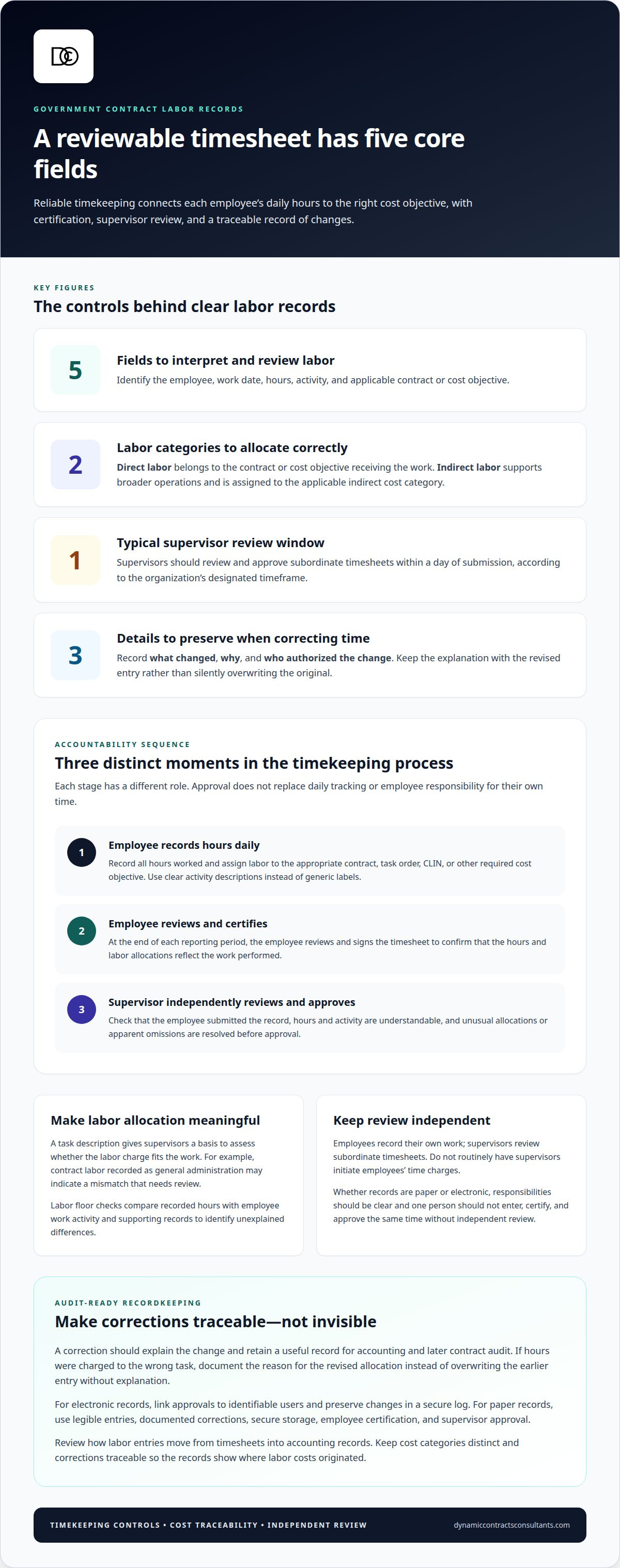
Supervisor review independently checks an employee’s recorded hours, work descriptions, and cost assignments before approval. Supervisors can identify entries that conflict with assigned duties or project records. They should review subordinate timesheets and approve them within the organization’s designated timeframe, typically within a day of submission. They should not routinely initiate employees’ time charges, since employees must record their own work.
Timesheet Fields and Approval
Timesheet fields capture the information needed to interpret, review, and account for recorded labor. Useful fields identify the employee, work date, hours, activity, and applicable contract or cost objective. Clear descriptions help supervisors assess whether an entry supports the stated assignment. If a field is missing or unclear, the reviewer should resolve the issue before approval, rather than treating approval as a substitute for complete records.
Approval should follow a consistent review sequence. The supervisor checks that the employee submitted the record, confirms that hours and activity are understandable, and examines unusual allocations or apparent omissions. For example, an entry assigning hours to a contract but describing only general administration needs clarification. The reviewer should document the resolution, preserving a useful record for accounting and a later contract audit.
Corrections need the same care as original entries. A corrected timesheet should show what changed, why, and who authorized the change. For example, if an employee entered hours against the wrong task, the revised allocation should include an explanation instead of silently overwriting the earlier record. This audit trail distinguishes a documented correction from an unexplained change.
Paper and electronic processes can both support these controls when responsibilities are clear. Paper records need secure storage, legible entries, documented corrections, employee certification, and supervisor approval. Electronic systems should link approvals to identifiable users and preserve changes in a secure log. Either format should prevent one person from entering, certifying, and approving the same time without independent review.
Written procedures should explain who certifies time, who approves it, and how exceptions are handled. Training employees on those procedures helps make their responsibilities operational, not merely administrative. For organizations aligning post-award records with contract obligations, discuss post-award contract administration as a way to address approval workflows within contract oversight.
What is the DCAA Timekeeping Requirement?
A DCAA-ready timekeeping system must preserve evidence linking labor entries to costs claimed on government contracts. It should capture original entries, documented corrections, approvals, and accounting records in a traceable way. Accurate hours are insufficient if the system cannot show how labor became a contract cost. The control objective is traceability from employee record through cost allocation.
Corrections should show the original entry, revised information, reason for the change, and responsible person. A detailed audit trail makes modifications visible instead of silently replacing earlier data. For example, moving hours from one task to another should leave a dated explanation and identifiable authorization. DCAA reviewers examine whether systems prevent errors, backdated entries, and unauthorized changes. An unexplained edit can raise questions about the reliability of related records.
System security supports record integrity. Electronic timekeeping should use unique user authentication, protected access controls, and secure logs that record modifications. Regular password changes are also recommended. Paper systems need secure storage, ink entries, and documented corrections. Either format should restrict unauthorized changes and preserve readable records. A control is useful only if it operates consistently across employee entry, supervisor review, and accounting transfer.
Audit preparation requires connecting timesheets with supporting accounting records and the costs claimed. According to the Federal Acquisition Regulatory Council, FAR 52.215-2, Audit and Records, Negotiation, gives the U.S. government rights to examine and audit records and evidence sufficient to reflect costs claimed. FAR 31.201-2 addresses whether costs are allowable, while supporting documentation helps substantiate the amounts charged. FAR Subpart 4.7 generally expects cost-supporting records to remain available for audit, typically for three years after final payment, subject to contract terms and record categories, according to the Federal Acquisition Regulatory Council.
A DCAA audit or accounting-system review may examine whether recorded labor supports reported costs and follows established procedures. DCAA typically audits cost-related systems, such as accounting software, every 4 years; more frequent audits are possible when higher noncompliance risks are identified. Inconsistent billing, inaccurate timesheets, and unusual overtime patterns can trigger scrutiny. Missing approvals, unsupported corrections, or labor assigned to the wrong cost objective are common red flags.
Before an audit, contractors should reconcile time records to accounting data, organize correction support, and confirm approvals are retained. They should also review whether written procedures match actual system use. FAR 31.201-2 states that costs are allowable when they comply with accepted accounting principles. A clear relationship between timekeeping records and cost treatment helps reviewers assess the basis for claimed costs without relying on unexplained adjustments.
Daily time entry
Daily entries provide a timely record of hours worked and their connection to government contracts. Employees should record all work each day, including overtime, rather than estimating hours later.
Contemporaneous Time Recording
Contemporaneous time recording means entering hours as work occurs or as soon as practicable that day. It matters because delayed entries rely more heavily on memory and can obscure how time was spent. An employee moving between contract work and internal administration should record each activity separately. Entries should reflect actual hours worked, not planned schedules or rounded estimates.
Charge Code Structures
Charge codes identify the contract, task, or other cost objective receiving recorded labor. A usable structure lets employees select the correct code for each activity without relying on generic labels. For example, separate codes for contract tasks and indirect administration help distinguish labor categories in reporting. Codes should match the organization’s accounting structure and the cost objective level required by contract terms.
Daily recording should capture every hour worked, including work outside the standard schedule. Unpaid overtime must also appear in the time record; omitting it can make the labor picture incomplete. An employee who works on a contract task and then handles internal administrative requests should divide those hours between the relevant codes. The record should show what happened, not just the day’s expected total.
Timesheets should not be completed in advance with prefilled entries or estimates. A planned shift may change because a task takes longer, work moves to another contract, or an employee handles indirect duties. Recording actual activity each day preserves those distinctions. If an agency or contractor uses a weekly reporting cycle, employees still need daily entries within that cycle.
Clear charge-code descriptions reduce avoidable selection errors. A code list can identify each contract objective and explain which activities belong there. For instance, a task-specific code should distinguish project work from general meetings or administrative support. When employees cannot tell codes apart, entries may end up in broad categories that offer little information for accounting or later review.
Timekeeping software should support daily entries, approval flows, and secure logs. Automated reminders can prompt employees to complete missing daily records, while system logs preserve submitted changes. These tools support the process but cannot determine which task an employee performed. Employees must enter the correct activity and cost objective for the record to be useful.
Corrections should preserve the original entry and explain the reason for a change. If an employee finds that hours went to the wrong contract code, the correction should identify the affected date, revised allocation, and explanation. Supervisor approval can then review the corrected record. A documented correction is easier to interpret than a silent replacement, especially when accounting uses the entry for contract cost reporting.
Written procedures should explain how employees record split workdays, overtime, and time away from work. For example, someone dividing a day between two contract tasks needs a clear method for allocating each period. Training at hire and at least annually helps employees apply consistent conventions. Retaining evidence of completed training also supports consistent administration of the timekeeping process.
DCAA compliance and applicable FAR clauses
DCAA compliance connects a contractor’s accounting policies and systems with federal requirements, including applicable FAR clauses and DCAA Contract Audit Manual guidance. The clauses do not all address the same issue. Their relevance depends on contract type and terms, so contractors should map each applicable provision to the records and cost treatment it governs. This connects accurate labor costs, allocation, and supporting documentation in one control framework.
For time-and-materials contracts, FAR 52.232-7 governs the contract type and reinforces timekeeping requirements, according to the Federal Acquisition Regulatory Council. Its relevance is practical: labor charges must be supported by records that correspond to the work billed. A contractor should therefore connect each reported labor amount with its time record, labor category, and contract activity. This linkage helps accounting teams assess whether billed labor reflects documented work.
FAR 31.201-2 addresses whether costs are allowable for government billing and makes contractors responsible for accounting for costs appropriately and maintaining adequate supporting records. The practical takeaway is that a time entry and its cost treatment must be consistent. If labor is assigned to a direct contract objective, accounting should be able to trace that allocation through supporting records. If an expense is indirect or unallowable, its treatment should remain distinguishable.
Timekeeping also intersects with labor-cost treatment for exempt employees. FAR 52.237-10 addresses separating exempt employees’ overtime hours from regular hours when calculating an adjusted hourly rate. That distinction means time records may serve more than one accounting purpose. Contractors should ensure that the hours reported, their classification, and any associated calculation can be reconciled using documented procedures and records.
Contractors can apply these clauses by reviewing the award’s terms, identifying applicable provisions, and mapping each to a control or record. For example, an accounting procedure can specify how labor entries reach cost objectives, while the contract file retains supporting documentation. A clause-to-control map helps teams distinguish contract-specific requirements from general accounting procedures. Review it when contract terms change, since a revised requirement may affect coding, billing support, or approval workflows.
The DCAA Contract Audit Manual provides guidance on recording and reporting labor costs, while the Federal Acquisition Regulation sets relevant contract and cost provisions. Neither replaces an accurate accounting process. A thorough internal review should compare time records, cost allocations, and billing support for consistency. For example, labor reported against a task should reconcile with the underlying time record and accounting entry, not just a summary total.
For a focused review, organize records around the contract clause, labor entry, cost classification, and related support. This structure makes gaps easier to find before a contract audit. When a clause affects labor treatment, document the applicable procedure and apply it consistently across reporting periods. The central takeaway is straightforward: interpret timekeeping alongside the contract’s FAR clauses, then preserve an accurate, traceable link between work performed and labor costs claimed.
Dynamic Contracts Consultants: DCAA Compliance Consulting
Dynamic Contracts Consultants LLC provides DCAA Compliance Consulting for government contractors assessing timekeeping controls, accounting practices, and documented procedures. Consider this support when implementing a system, reviewing labor allocation processes, or preparing for a DCAA accounting-system review. The work can help you examine how employee entries, supervisor approvals, corrections, and contract cost records fit together, then identify areas that need closer attention.
Engage consulting support when timekeeping procedures need to reflect actual practice or contract requirements have changed. For contractors managing performance after award, coordinated contract administration can also connect compliance responsibilities to ongoing contract obligations. The next step is to discuss your current process and the timekeeping or accounting challenge you need to address. Contact Dynamic Contracts Consultants LLC to discuss DCAA Compliance Consulting for your organization.
Build Compliance Into Your Next Contract Cycle
Make timekeeping part of operational governance, not a process reviewed only when a contract audit approaches. Assign responsibility for maintaining procedures, training employees, and aligning accounting practices with contract changes. This creates a repeatable framework for applying the timekeeping requirements for DCAA compliance as your contract portfolio and internal workflows evolve.
Dynamic Contracts Consultants supports contractors through DCAA Compliance Consulting, as well as Proposal Writing and Grant Writing. These services address distinct federal contracting needs, from strengthening compliance practices to developing submissions for new opportunities. The right support depends on the work your organization needs to advance.
To discuss your compliance priorities and potential next steps, connect with Dynamic Contracts Consultants. A clear plan can help your team approach its next contract cycle with greater structure and confidence.
Frequently Asked Questions
What are DCAA timekeeping requirements for government contractors?
Contractors need an accounting process that can identify employee labor at the cost-objective level required for their work. For DoD contractors, DFARS 252.242-7006 addresses whether an accounting system can identify labor by intermediate or final cost objectives. This system-level capability matters beyond individual timesheets: accounting must be able to use labor data consistently when accumulating and reporting contract costs.
What FAR and DFARS rules govern labor timekeeping and time-and-effort records?
The relevant clauses depend on the contract and the costs being charged, so their application should be assessed against the award’s terms. FAR 52.232-7 addresses time-and-materials contracts, while DFARS 252.242-7006 addresses accounting-system criteria for DoD contractors. FAR 31.201-2 concerns cost allowability and supporting records. These provisions address related but distinct issues, so a contractor should not treat one clause as a substitute for the others.
What information must employees record on DCAA-compliant timesheets?
Records should identify who performed the work, when it occurred, and the cost objective receiving the labor. They also need enough activity detail to distinguish contract work from general business support. Contractors should record time off, including parental leave, so the labor record reflects time not worked as well as productive hours. The accounting system should preserve this information in a form that can be reconciled with labor costs claimed.
How often must employees record and submit time under DCAA guidance?
Employees should enter hours daily, while submission and certification follow the contractor’s established reporting period. A reporting cycle determines when a complete timesheet moves to review; it does not change the daily-entry expectation. Procedures should state the period covered, submission deadline, and route for late entries. This distinction helps employees separate prompt recording of work from formal submission of a completed period.
What are the rules for charging labor to indirect, direct, and overtime accounts?
Charge labor according to the work performed and the cost treatment applicable to that activity; keep unallowable costs distinguishable from costs claimed under a contract. Overtime pay is a separate issue from recording overtime hours. According to the U.S. Department of Labor, only employees exempt from the Fair Labor Standards Act do not receive additional pay for working more than 40 hours per week. Classification and applicable labor rules therefore matter alongside cost coding.
What employee and supervisor approvals are required for timesheets and corrections?
The employee who performed the work should certify the submitted record, and a supervisor should provide a meaningful review. The approval workflow should identify each responsible person and link the review to the correct reporting period. For paper processes, signatures should be legible and records securely stored. For electronic workflows, individual user access helps establish who certified or approved a record, keeping responsibility clear.
How should contractors document, approve, and audit timesheet changes?
Reviewers should be able to distinguish a legitimate correction from a backdated or unauthorized change. A useful control compares the change history with the stated reason and available supporting documentation, then records the review outcome. For example, if an entry changes after accounting close, the review should establish why the adjustment occurred and how it affects the cost record. Regularly examining changes can surface unusual patterns before they affect billing.
What internal controls and records must a contractor maintain for DCAA timekeeping?
Controls should address access, record security, review responsibilities, employee instruction, and retention of supporting documentation. Electronic systems can use unique authentication and protected access; paper records require secure storage and controlled handling. Contractors should preserve evidence that employees received timekeeping training at hire and at least annually. Together, these controls help show that recorded labor data is managed through an established process, not changed without accountability.
Have a question this article didn’t answer?
Talk it through with a certified contracting professional. The first 30 minutes are free.