
What to do after winning a government contract: plan cash flow, align subcontractors, fund mobilization, and set compliance controls for reliable delivery.
Winning the award is only the start of execution. Knowing what to do after winning a government contract means turning its terms into a funded, staffed, and controlled plan. Define subcontractor responsibilities, forecast cash needs before payment arrives, confirm operational capacity, budget for mobilization, and establish compliance oversight.
The pressure to start work quickly is understandable, but early decisions about staffing, cash flow, and documentation can shape performance throughout the contract. This guide provides a practical sequence for managing those priorities, from aligning subcontractor deliverables and reporting lines to tracking costs, coordinating work, and keeping requirements visible. The goal is not simply to start fast, but to build the project-management discipline needed for reliable delivery.
Key Takeaways
- Put subcontractor deliverables, timelines, payment terms, and reporting relationships in writing so accountability is clear from the start.
- Map expected costs against invoice and payment timing to identify how much working capital the contract may require.
- Test staffing, supplier, and backup capacity against the contract’s performance needs before setting the delivery plan.
- Organize mobilization costs by due date and connect each expense to the activity it supports.
- Assign clear ownership for project tracking, contract records, and compliance so issues are surfaced and managed promptly.
Defining subcontractor deliverables and reporting structures
Organize the award before mobilization begins. Use SAM.gov to register your entity and keep its status active by tracking registration renewal. Compare the award with your proposal, review its terms and incorporated documents, then acknowledge it through the agency’s stated process. Assign owners for subcontractor records, performance oversight, and payment coordination.
Organize contract and subcontractor paperwork
We start by creating a controlled contract file containing the award, solicitation, amendments, correspondence, and signed subcontractor agreements. Keep current versions together, and record who approved each change. We also recommend collecting a completed W-9 from every subcontractor for tax records and storing it with the corresponding agreement. Don’t rely on informal conversations to document changes to scope, schedule, or payment.
- We create a requirement tracker linking each subcontractor task to the prime contract. For every deliverable, record its owner, due date, reviewer, acceptance evidence, and related contract requirement. For example, if a subcontractor prepares a report, identify who reviews it before submission and retain the approved version in the contract file.
Define subcontractor deliverables and reporting
Put deliverables, timelines, payment terms, and reporting structures in each subcontract. Specify required formats and acceptance criteria, and name the person who will receive progress reports. For staffing contracts, establish that subcontractors report to the prime contractor, not directly to government employees. Set a reporting cadence tied to milestones, with prompt notice of delays or quality issues.
- We keep prime and subcontractor employment responsibilities distinct. The subcontractor manages its employees; the prime coordinates contract work and remains responsible for overall performance. We monitor subcontractor progress and applicable FAR requirements rather than assuming a signed agreement transfers the prime’s accountability.
- We coordinate payroll and subcontractor payment planning before work starts. Put payroll dates, invoice submission dates, and subcontractor payment terms on one schedule, then identify when outgoing payments precede customer receipts. We recommend communicating payment timing expectations to subcontractors in advance, especially when government payment delays could affect the prime’s cash position.
- We assess financing mechanisms against the contract’s payment terms. Most federal contracts include FAR clause 52.232-23, which allows assignment of payments, according to the Federal Acquisition Regulatory Council. Assignment isn’t automatic; it requires written notice to the contracting officer, disbursing officer, and surety on bonded work.
- We also track award-related dispute deadlines as part of contract administration. A protest challenging a federal contract award generally must be filed within 10 days after the protester knows or should have known the basis of the protest, according to the U.S. Government Accountability Office.
Calculating the working-capital gap before the first payment
Build a dated cash forecast from award through first collection. The expected first payment date is only one input: costs begin before invoices turn into cash.
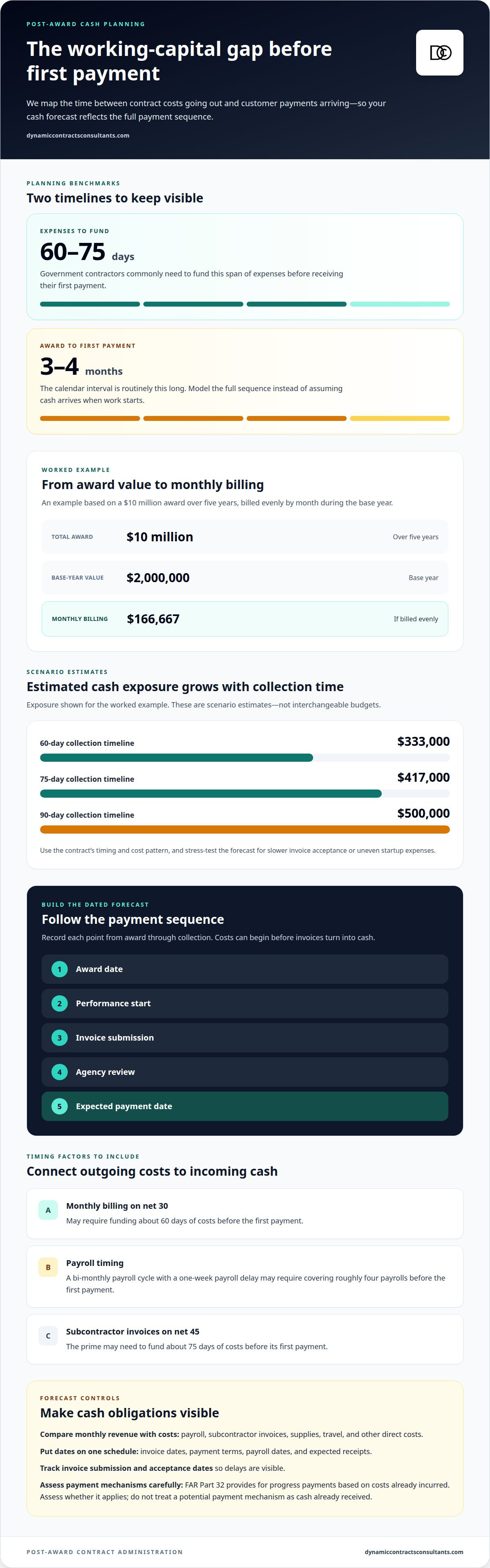
- Map the payment sequence. Record the award date, performance start, invoice submission, agency review, and expected payment date. Federal contract billing monthly on net 30 terms may require funding about 60 days of costs before the first payment. The calendar interval from award to first payment is routinely three to four months, so model the full sequence rather than assuming cash arrives when work starts.
- Translate the award into monthly billings and costs. For a $10 million award over five years, the base-year value is $2,000,000. If billed evenly monthly, that base year produces billing of $166,667 per month. Compare each month’s planned revenue with payroll, subcontractor invoices, supplies, travel, and other direct costs. The working-capital gap is the cash outflow not yet covered by collected payments.
- Calculate exposure across several collection timelines. In that example, estimated exposure is $333,000 at 60 days and $417,000 at 75 days. If collection takes 90 days, exposure reaches $500,000. These are scenario estimates, not interchangeable budgets. Use the timing and cost pattern in your contract, and stress-test the forecast against slower invoice acceptance or uneven startup expenses.
- Align payroll and subcontractor terms with expected receipts. A bi-monthly payroll cycle with a one-week payroll delay may require covering roughly four payrolls before the first payment. A subcontractor billing a prime on net 45 terms waits 45 days after invoicing; the prime may need to fund about 75 days of costs before its first payment. Put invoice dates, payment terms, and payroll dates on one schedule, then identify the largest cash-demand weeks.
- Review contract payment mechanisms and funding options. FAR Part 32 provides for progress payments based on costs already incurred. Assess whether that mechanism applies to the contract and how it affects the forecast; don't treat a potential payment mechanism as cash already received. In each situation, track available cash against upcoming obligations, including payroll and subcontractor invoices. Keep SAM.gov registration as a separate administrative control, and record invoice submission and acceptance dates so delays are visible.
The broader funding window is a useful planning baseline: Government contractors commonly need to fund 60 to 75 days of expenses before receiving their first payment. Compare the forecast’s cash needs with that interval while retaining the contract-specific invoice, payroll, and startup assumptions already mapped. Check a shorter modeled gap against delayed acceptance and uneven costs, and make any longer gap visible in the funding plan before performance begins.
Working-capital exposure can be substantial relative to the contract’s overall value and base-year value. The $2 million base-year government services award has an estimated performance cost of $5,556 per day. Use that daily cost to make the scale of the exposure tangible, then confirm that available cash can cover projected obligations through collection. Keep the exposure estimate distinct from total award value and expected billings.
Assessing inventory, labor, and backup capacity
Translate the solicitation into a capacity plan before setting the performance schedule. Match the people, materials, equipment, and backup resources required to each contract deliverable.
- Convert requirements into a resource schedule. Extract each quantity, specification, and delivery date from the solicitation, then assign an owner. If the contract requires 50 units of a custom item within a stated timeframe, confirm the supplier can provide that quantity by the required date. Track lead dependencies, inspection steps, and delivery milestones in one schedule.
- Test supplier capacity against the exact requirement. Ask each supplier to identify available inventory, production capacity, and delivery constraints for the required items. Compare the response with the solicitation’s specifications and schedule. Record the supplier relationship, the item or service covered, and a fallback plan if a shipment arrives late or fails inspection.
- Match labor skills to contract tasks. List the roles required for each deliverable, then map available employees and subcontractors to them. For a federal contract requiring specialized knowledge, identify the experience and access requirements for each assignment. Flag conflicting commitments that could leave a critical task without an assigned worker.
- Plan workforce continuity during transition. Incoming federal contractors may hire from the existing workforce to preserve continuity, institutional knowledge, and access to cleared personnel. Identify positions that depend on program knowledge or existing access, and account for hiring and onboarding in the schedule. Treat this as a continuity option, not an assumption that employees will transfer.
- Define backup coverage for critical resources. Identify tasks that depend on a single employee, supplier, or piece of equipment. For each, name a qualified backup or alternate supply route, and specify who will activate it. For example, a second supplier can reduce reliance on one source if it can meet the same contract specifications and delivery requirements.
- Review capacity when requirements or demand change. Compare actual staffing and inventory with the resource schedule at each performance milestone. If the federal agency changes a delivery sequence through authorized contract direction, assess the effect on labor availability, supplier commitments, and backup coverage before revising assignments. Clearly distinguish the solicitation requirement from any later direction in your plan.
- Document the capacity decision. Record the evidence behind each major resource assignment, including supplier responses, workforce availability, and unresolved dependencies. If the solicitation refers to a capability, link it to the responsible person, supplier, or equipment. This record helps management identify gaps early and maintain a traceable basis for operational decisions.
Building a dated mobilization budget
Turn the awarded contract’s start requirements into a calendar-based spending plan. Use dated milestones, assigned owners, and documented assumptions to connect each mobilization expense with the work it enables.
- Set the budget baseline from the award. Use the executed contract, schedule, and approved scope as your planning baseline, not earlier bidding assumptions. Record the performance start, required deliverables, and any stated mobilization milestones. For example, connect a scheduled site launch to the staffing, equipment, and materials needed beforehand, while keeping optional plans separate from authorized work.
- Place each expense on its expected due date. Add calendar entries for recruiting, onboarding, equipment orders, software access, travel, facilities, and supplier commitments. Identify when deposits or other payments are due, then compare those dates with expected invoicing and collection. Include a cost in the forecast when it must be funded, not only when the related deliverable is accepted.
- Separate startup spending from recurring operations. Distinguish one-time costs, such as initial equipment setup, from recurring expenses, such as payroll or routine supplies. This shows whether later contract revenue can support ongoing delivery after mobilization. For example, do not mistake a required initial purchase for a monthly operating expense.
- Sequence workforce and clearance dependencies. Assign hiring, onboarding, training, and any required clearance-related steps to responsible owners and relevant contract milestones. If a specialist needs access to a facility or sensitive work area, schedule that dependency before assigning the specialist to the task. Do not assume the person can begin productive work until access and project readiness align.
- Distinguish commitments from planning allowances. Track approved purchase orders and signed subcontractor commitments separately from estimates that may change. For each allowance, document its purpose and the assumption behind it, such as a pending supplier quote or unresolved delivery sequence. Do not treat an estimate as a confirmed obligation or use an unapproved expense as authority to change contract scope.
- Review the budget against actual milestones. At each scheduled review, compare planned dates and spending with actual commitments, deliveries, and staffing. If a supplier delay shifts equipment delivery, update dependent launch activities and forecast timing rather than merely changing the expense entry. Preserve the prior version so decision-makers can see what changed, when, and why.
- Assign ownership for budget updates. Name a budget owner and identify who reports changes in procurement, staffing, or subcontractor schedules. A project manager can consolidate updates into a dated forecast for leadership review. Escalate a variance if it affects a contractual milestone, requires unplanned cash, or depends on a new approval.
Project management and contract compliance
Establish a documented control process before performance begins. A named owner, clear approvals, and traceable records help teams manage government contracts and respond to changes.
-
Distinguish federal, state, and local steps
Identify the awarding government and use the contract award, incorporated terms, and instructions as your control baseline. Federal work may include FAR requirements when incorporated; state and local contracts follow the terms and processes set by their respective agencies. Do not assume that one jurisdiction’s forms, reporting channels, or payment procedures apply to another.
-
Submit performance and payment bonds
Review the award and solicitation for bond requirements, submission instructions, and the stated deadline. Coordinate required documents with the surety and record delivery evidence in the contract file. The deadline depends on the applicable award instructions, so use the date in the contract documents rather than a general assumption.
-
Keep audit records for the required period
Maintain accounting entries, invoices, payroll support, purchase orders, subcontractor records, approvals, deliverable evidence, and contract correspondence. Identify the retention period from the contract’s recordkeeping terms and applicable audit requirements, then preserve records for that period. Organize records by contract and transaction so an auditor can trace costs to supporting documentation.
-
Resolve unclear or unworkable contract terms
Document any unclear clause or performance barrier, its operational effect, and the decision needed. Raise it promptly through the authorized contracting officer or contract communication channel, and retain the response. Do not change scope, schedule, or performance methods based on an informal assumption. Wait for authorized direction before acting on a proposed contract change.
- Run a focused kickoff meeting. Align the project manager, finance lead, technical leads, compliance owner, and relevant subcontractor representatives on deliverables, milestones, risks, and reporting. Include government personnel only through the agency’s designated meeting process. Record decisions, action owners, due dates, and unresolved items in the meeting notes.
- Configure invoicing through the agency’s designated payment system. Follow the award instructions to establish vendor access, authorized users, payment details, and invoice routing. Match each invoice to the contract, billing period, deliverables, and required supporting records. Confirm submission status and retain the system’s receipt or rejection notice for follow-up.
- Maintain a live compliance and issue log. Assign each requirement an owner, evidence location, and review date. For example, track an invoice correction from submission through acceptance, noting the responsible person and resolution. Escalate schedule or performance risks early, and involve the contracting officer when authorized direction is needed.
Assign a dedicated project manager to track progress, coordinate subcontractors, and resolve issues. Use email for formal documentation, and act only when directed by the PCO or ACO, or when authorized by the COR or the contract itself.
Dynamic Contracts Consultants: Post-Award Contract Administration
Dynamic Contracts Consultants LLC supports contractors with structured oversight after award through Post-Award Contract Administration. We help organize post-award processes, including contract requirements, subcontractor flow-down clauses, performance tracking, and compliance documentation.
Turn to this support when mobilization involves multiple subcontractors, complex reporting obligations, or competing delivery and compliance priorities. Our approach connects contract terms with practical administration, helping your team maintain visibility across responsibilities and records. DCAA Compliance Consulting can complement post-award administration when your accounting and contract-cost compliance needs require attention.
Contact Dynamic Contracts Consultants LLC to discuss your post-award contract administration needs.
Turn Contract Readiness Into a Lasting Capability
Build a repeatable operating rhythm that keeps decisions visible after kickoff. An award also creates an opportunity to improve how your organization plans future government work. Capture lessons as they emerge, assign owners for follow-through, and combine disciplined procurement lifecycle planning with AI-assisted proposal development and professional review.
A practical part of what to do after winning a government contract is to make accountability part of routine operations, not treat mobilization as a one-time event. Dynamic Contracts Consultants LLC supports contractors through Post-Award Contract Administration and DCAA Compliance Consulting, as well as Proposal Writing and Grant Writing. These services can support different stages of your government contracting work.
As you determine what to do after winning a government contract, consider where structured support could strengthen your process. Contact Dynamic Contracts Consultants LLC to discuss your needs and move forward with a clear plan.
Frequently Asked Questions
What should a contractor do immediately after receiving a government contract award?
Start by establishing one controlled award file and assigning an owner to each immediate action. Reconcile the signed award with the final proposal, noting differences in scope, assumptions, or promised deliverables. Then distribute the authoritative contract version to finance, operations, compliance, and project leads. For example, if the award changes a proposed delivery sequence, document the change and update internal work plans before teams rely on outdated assumptions.
What are the federal contract requirements for reporting, deliverables, and progress updates?
Follow the reporting schedule, formats, acceptance criteria, and submission channels stated in the contract and its incorporated documents. Requirements vary by award, so build a deliverable register showing each item’s owner, due date, reviewer, and required evidence. A progress update might identify completed work, open dependencies, schedule variance, and decisions needed. Keep a copy of every submission and agency response for traceability.
How do you comply with government contract cybersecurity, data protection, and CMMC requirements?
Use the award documents to identify applicable cybersecurity clauses, data-handling conditions, and any stated CMMC requirement. Map covered information to the systems and people that access it, then document access approvals, handling procedures, and incident escalation responsibilities. For example, restrict a project folder to authorized team members and record access changes. Do not assume a particular CMMC level applies unless the contract identifies that requirement.
What are common post-award compliance risks, penalties, and remedies for federal contractors?
Common risks include unsupported invoices, missed deliverables, unapproved work, weak subcontractor flow-downs, and incomplete performance records. Inaccurate or unethical billing can create False Claims Act risk. If an issue is suspected, preserve relevant records, assess its scope, and document corrective actions. Notify the appropriate government contact through the contract’s established process when required, and track each action to closure rather than relying on informal assurances.
Have a question this article didn’t answer?
Talk it through with a certified contracting professional. The first 30 minutes are free.