
Learn how to manage contract modifications by reviewing clauses, documenting impacts, and assessing cost, schedule, and performance before approving changes.
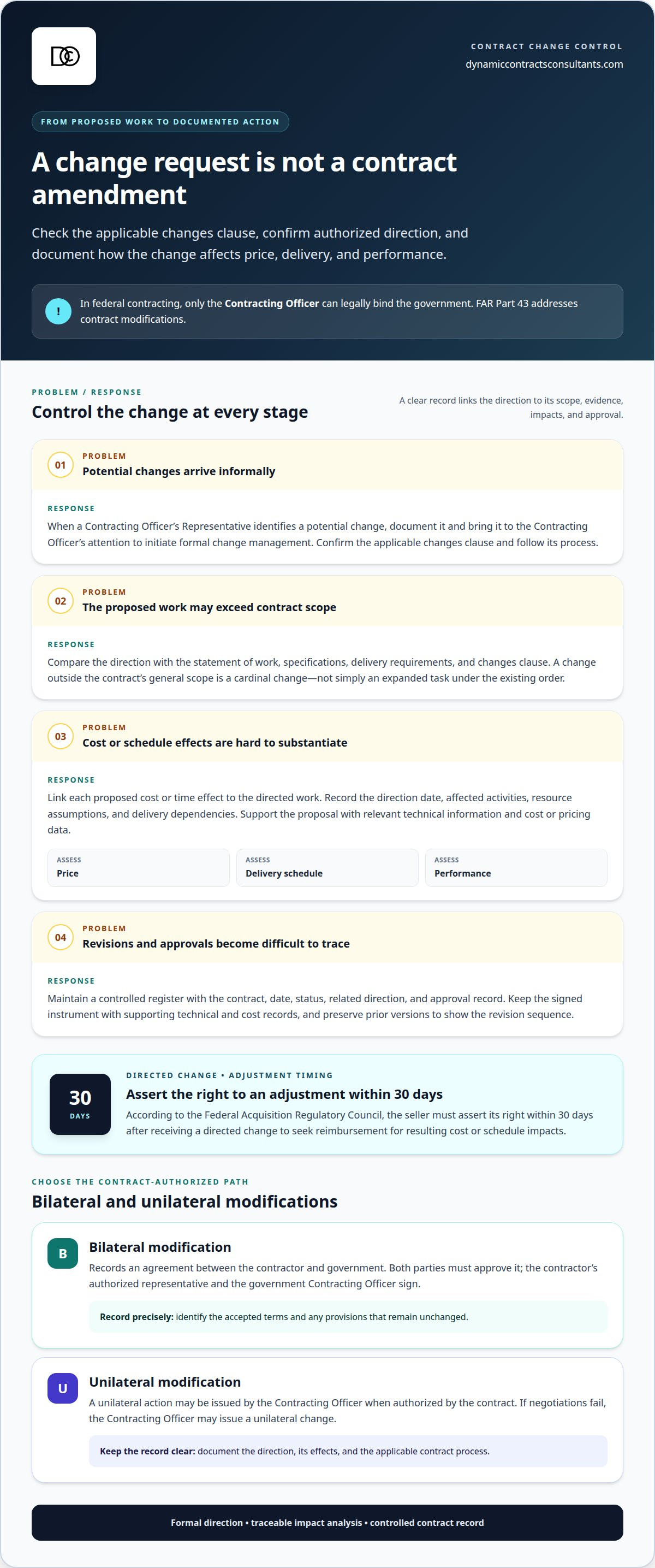
A change request does not automatically amend your contract. When we assess how to manage contract modifications, we start with the applicable changes clause, document the proposed work and its effects, and follow the authorized process. In federal contracting, only the Contracting Officer can legally bind the government, and FAR Part 43 addresses contract modifications.
Because changes can affect price, delivery schedules, and performance obligations, start by checking how the contract’s clauses apply to the specific modification. This guide explains bilateral and unilateral modifications, how to assess their practical effects, and what to consider before a proposed change alters contract performance.
Key Takeaways
- Start with the contract’s applicable changes clause: it determines which changes may be directed and what formal process applies.
- Distinguish bilateral modifications, which require both parties’ agreement, from unilateral actions authorized by the contract.
- Assess a proposed change across price, delivery schedule, and performance, and support any adjustment request with relevant cost and technical information.
- For a directed change, assert the right to an adjustment within 30 days of receipt to seek reimbursement for resulting cost or schedule impacts, according to the Federal Acquisition Regulatory Council.
- Understand how modifications, change orders, and novations differ so the contract record reflects the actual change and its effect on the parties’ obligations.
Contract clauses for changes, delays, and differing site conditions
Start with the applicable changes clause: it defines which changes the government may direct and how the contract addresses their effects. Reviewing the clause helps connect a proposed change to the contract’s scope, schedule, price, and performance requirements.
Clauses for Changes and Delays
A changes clause sets out the government’s authority to direct specified contract changes and the process for addressing their effects. Under FAR 52.243-1, a contracting officer may issue a written order for changes within the contract’s general scope, including certain changes to specially manufactured supplies, shipping or packing methods, and delivery location. We assess the actual clause with you because a delay or differing site condition does not automatically establish a right to an adjustment.
Construction contracts may use FAR 52.243-4 when a fixed-price contract is contemplated and the expected value exceeds the simplified acquisition threshold. For delay-related direction or differing site conditions, we compare the facts with the contract language before assessing consequences. If you negotiate changes-clause terms in a higher-tier contract, align them with FAR Section 52.243 so subcontract requirements remain consistent with the prime contract’s change process.
Documenting Proposed Changes
Change documentation should record what was directed, why it affects performance, and its potential consequences. When a contracting officer’s representative (COR) identifies a potential change, the COR should document it and bring it to the contracting officer’s attention to initiate formal change management. Organize the technical analysis around the reason for the change, its relationship to the contract’s scope, work not covered by existing terms, and effects on price, schedule, and performance.
To track, version, and store modifications, we use a controlled register identifying the contract, date, status, related direction, and approval record. We keep the signed instrument and supporting technical and cost records together, preserving prior versions to show the revision sequence. A contractor’s proposal should include relevant technical information, cost or pricing data, and other material that helps the contracting officer evaluate the change. According to the Federal Acquisition Regulatory Council, a seller must assert its right to adjustment within 30 days after receiving a directed change to seek reimbursement for resulting cost or schedule impacts.
Assessing Change Scope
Assess whether proposed work fits the contract’s general scope or materially changes the bargain. Compare the direction with the statement of work, specifications, delivery requirements, and applicable changes clause. For example, a delivery-location revision may fit a clause covering that type of change, while a materially different service may raise a scope concern.
We document the rationale rather than relying on an email or meeting label. A change outside the contract’s scope is a cardinal change, not simply an expanded task under the existing order. If you receive unclear direction, document the issue and bring it to the contracting officer, the official authorized to bind the government.
Financial and Schedule Impacts
Poorly controlled changes can leave work uncompensated, delay milestones, and obscure which requirement governs. We help separate original work from additions, such as labor, materials, or rework triggered by informal direction. Our impact analysis connects the direction date, affected activities, resource assumptions, and delivery dependencies.
Build an adjustment analysis from traceable evidence, linking each proposed cost or time effect to the directed work. A request alone does not establish entitlement to additional money or time. The contractor must show a qualifying change, not caused by its own fault, that increased cost or caused schedule slippage. If negotiations fail, the contracting officer may issue a unilateral change, and the contractor may pursue a claim under the contract’s disputes clause.
Bilateral and unilateral contract modifications
Bilateral and unilateral modifications differ in how the contract authorizes and records the action. The distinction helps you determine whether a proposed revision needs both parties’ agreement or can be issued by the contracting officer under the contract.
Mutual Approval for Bilateral Changes
A bilateral modification records an agreement between the contractor and government, signed by the contractor’s authorized representative and the government contracting officer. Under FAR Section 43.103, either party may propose a bilateral modification, but both parties must approve it.
Use mutual approval to establish exactly which requested terms the parties accepted. For example, if you and the government agree to revise a delivery point and a related payment milestone, the signed document should describe both changes and identify any provisions that remain unchanged. Compare the final document with the negotiated agreement so draft language is not mistaken for an approved obligation.
Post-award contract administration helps maintain records of proposed revisions, approvals, and resulting obligations. This is especially useful when a request changes several contract terms or when teams need to distinguish an agreed revision from an open negotiation.
Modifications, Change Orders, and Novations
A contract modification is the formal instrument or action that changes, records, or administers a contract; a change order directs work under an applicable contract clause. A novation addresses the substitution of a contracting party, rather than a change to the work itself.
FAR Section 43.103 identifies bilateral and unilateral modifications. A contracting officer may use a unilateral modification for administrative actions, change orders authorized by a clause, termination notices, or contractual requirements already completed. A novation serves a different purpose: it documents the change in party identity. We help you classify the proposed action before determining which record should describe it.
Risks of Modifying Without Written Consent
Without written consent, parties may dispute whether a bilateral change was accepted and which terms govern. In federal contracting, only the contracting officer is authorized to legally bind the government, so direction from another official does not by itself establish government approval.
For a unilateral action, distinguish an action authorized by the contract from an informal instruction. Keep the original agreement, proposed revisions, approval records, and executed documents in version order. This record helps identify the operative terms and resolve disagreements over authorization, price, delivery, or performance.
Analyzing effects on price, delivery schedule, and performance
Assess a contract change across price, delivery, and performance as connected effects, not isolated adjustments. For example, adding a required system feature may change labor assumptions, testing needs, delivery milestones, and acceptance criteria. Identify each affected obligation and explain how the revised requirement changes the acquisition’s cost and execution plan.
For price, separate the work already covered by the contract from the incremental work caused by the change. Connect proposed labor, materials, subcontract effort, and other cost elements to the revised requirement. Explain the assumptions behind each estimate, including any work that can be removed or avoided. Under FAR 15.404-1(c), the contracting officer considers cost analysis when appropriate and obtains additional funds before adjusting a contract when the change requires them.
An unpriced change order creates a separate pricing challenge. Under U.S. revenue guidance, an entity estimates the transaction-price change for an approved modification with an unpriced change order using variable-consideration guidance. ASC 606-10-55-134 through ASC 606-10-55-135 addresses an example of an unpriced change order. This accounting estimate does not itself establish a contractor’s right to added payment under the contract.
Trace schedule effects through the sequence of performance. Identify affected tasks, dependencies, review periods, testing, and delivery milestones; then distinguish direct delay from work that can proceed in parallel. For example, a revised specification may postpone fabrication while design review continues. A defensible schedule impact explains which activities move, why they move, and how the revised sequence affects delivery.
Performance effects extend beyond completing additional work. A modification may change required quality, acceptance evidence, staffing, security controls, or coordination with government personnel. Compare each revised obligation with the existing performance baseline. If the change adds a deliverable but leaves acceptance requirements untouched, state that distinction. If testing or approval steps also change, include their effects on workload and timing.
Keep entitlement separate from impact measurement. A request for a price adjustment does not automatically entitle a contractor to additional money or time. The contractor must demonstrate a qualifying change, not caused by its own fault, that increased cost or caused schedule slippage. If the circumstances instead point to unresolved performance issues, assess whether correction, a negotiated modification, or termination provisions apply. This analysis gives the contracting officer a traceable basis for considering the requested adjustment.
Contract modification clauses
For U.S. federal contracts, FAR Part 43 governs contract modifications, while the applicable clause depends on contract type and situation. The solicitation and award establish which changes the agency may direct and how the parties document them.
For fixed-price supply contracts, the contracting officer must insert the Changes-Fixed-Price clause, FAR 52.243-1. For cost-reimbursement supply contracts, the required clause is Changes-Cost-Reimbursement, FAR 52.243-2. These clauses do not create identical procedures, so a contractor should assess the contract’s actual terms before evaluating a proposal or direction.
FAR 52.243-1 identifies possible directed changes to drawings, designs, or specifications for specially manufactured supplies, shipment or packing methods, and place of delivery. A written order under this clause must remain within the contract’s general scope. For construction contracts expected to exceed the simplified acquisition threshold, the contracting officer must insert FAR 52.243-4 when a fixed-price contract is contemplated. Time-and-materials and labor-hour contracts require FAR 52.243-3.
The Notification of Changes clause, FAR 52.243-7, may be included in solicitations and contracts. For contracts expected to be below $1,000,000, the Federal Acquisition Regulatory Council states that the contracting officer may use it only when anticipating possible contractor allegations of unwritten or unsigned government changes. This clause addresses notice of potential changes; it does not replace the specific changes clause applicable to the contract type.
Written form also matters. Under FAR 43.301, federal change orders generally use Standard Form 30 unless otherwise provided. Modifications generally use the same form, except for specified options or actions processed under FAR Part 15. A contract’s clause and the nature of the action determine which instrument records the change.
In practice, read the clause alongside the affected contract terms. Identify who may direct the change, which work categories it covers, and what notice or proposal information the clause requires. For example, a direction to change a supply’s delivery location may fit FAR 52.243-1, while a work suspension or revised performance requirement calls for review of the governing clause and the direction’s scope. Record the agency’s instruction and connect it to the clause before treating it as an approved change.
These distinctions support strategic compliance throughout the procurement lifecycle. A clause review should connect the proposed action to the contract type, authorized direction, required document, and any resulting price or schedule assessment. This structured analysis helps prevent assumptions about one agency’s process from being applied to a contract with different terms.
How do contract modifications differ from change orders and novations?
A contract modification is the formal instrument or action that changes, records, or administers contract terms. A change order directs a change under an applicable contract clause, while a novation concerns a change in the contracting party. These terms describe different functions, so identifying the action first helps determine what the contract record must show.
In federal contracting, FAR Section 43.103 distinguishes bilateral and unilateral modifications. A bilateral modification records an agreement approved by both parties. A unilateral modification may record an authorized administrative action, a change order under an applicable clause, a termination notice, or a completed contractual requirement. The type of action and the governing clause determine whether mutual agreement is required.
A change order is narrower than the broader category of contract modification: it directs a change to work under the contract’s applicable changes clause. Under FAR 52.243-1, for example, a contracting officer may issue a written order for changes within the contract’s general scope. The order is not a separate replacement contract. It changes specified obligations within the existing contractual relationship, subject to the clause and its limits.
A novation differs in purpose because it concerns substituting a party, not directing a revision to the work. For example, the work may remain the same while a different entity takes the place of a contracting party. That is a party-identity issue, not simply a change to specifications, delivery, or price. Keep the novation record separate from any change order or modification that revises performance terms.
Identify the purpose of each proposed action before preparing a document. Is the government directing work under a changes clause, are both parties agreeing to revised terms, or is a party’s identity changing? This classification helps route the matter to the right approval process and prevents a draft change order from being mistaken for a completed bilateral agreement.
The distinction also affects how records are organized. Link a change order to the clause and work it directs; link a bilateral modification to the parties’ signed agreement; and keep a novation record with the relevant party-substitution documentation. Preserve related drafts and approvals in sequence so the contract file shows which instrument changed the work and which addressed party identity.
Clear classification supports disciplined post-award administration. A contracting officer’s written change order, a bilateral modification signed by both parties, and a novation each serve a different purpose. Treating them as interchangeable can obscure who must perform, what work changed, and which terms govern. Identify the instrument’s function, then ensure the contract record reflects that specific action.
Dynamic Contracts Consultants LLC: Capture Management
Dynamic Contracts Consultants LLC provides Capture Management and Post-Award Contract Administration. When a modification affects ongoing obligations, Post-Award Contract Administration helps keep contract requirements and performance records aligned. If the change also prompts a reassessment of future opportunities, Capture Management can help structure your acquisition pursuit strategy.
These services are relevant when contract changes intersect with broader compliance priorities, upcoming bids, or proposal planning. Dynamic’s support focuses on contract administration and capture strategy, not legal representation or government funding. Distinguishing immediate post-award needs from future acquisition planning can help you identify the right area of support.
Turn Contract Experience Into Future Readiness
Each modification can inform how your organization plans future work. Use lessons from changing requirements to refine internal assumptions, strengthen coordination between delivery and acquisition teams, and ground future commitments in operational realities. This makes contract administration a source of insight for the next opportunity, not just a record of past decisions.
Knowing how to manage contract modifications also helps connect execution needs with broader business priorities. Dynamic Contracts Consultants LLC offers Proposal Writing, Grant Writing, and DCAA Compliance Consulting to support organizations across related stages of growth and compliance.
If your next step involves strengthening contract administration or preparing for future opportunities, contact Dynamic Contracts Consultants LLC to discuss your objectives. A considered approach can help your team move forward with greater clarity and readiness.
Frequently Asked Questions
What is a contract modification and when is it needed?
A contract modification changes or formally records a change to an existing agreement. It may be needed when the parties revise a deliverable, quantity, delivery point, performance period, or other contract term. For example, if an agency needs an additional report, the change may affect both the required work and its acceptance criteria. The applicable contract clause and the nature of the change determine the appropriate process.
What steps should businesses follow to manage contract modifications?
To manage contract modifications, first identify the direction, applicable clause, and affected obligations. Then assess whether the change fits the contract’s scope, determine its price and schedule effects, and prepare supporting technical and cost information. Route the proposed action for the approvals required by the agreement. After execution, update the contract record, relevant work plans, and internal obligations register so teams work from the current terms.
How should contract amendments be documented and approved?
Document an amendment by identifying the agreement, the exact provisions changed, the revised language, and the effective date or triggering event. Include supporting correspondence when it clarifies the parties’ intent, but distinguish it from the executed amendment. Approval should follow the contract’s stated method and authorized signatory requirements. For a federal bilateral modification, retain the signed instrument and the contractor’s and contracting officer’s approval records in the contract file.
Who must approve a contract modification under U.S. law?
For a U.S. federal contract, only the contracting officer is authorized to legally bind the government. A bilateral modification must be signed by the government contracting officer and the contractor’s authorized representative. A unilateral modification may be issued without the contractor’s signature only when the contract authorizes that type of action. For nonfederal agreements, approval authority depends on the applicable contract terms and the parties’ delegated authority.
What clauses should a contract modification include?
A modification should clearly identify the contract and state the revised provisions, including applicable deliverables, price, payment terms, schedule, and performance requirements. It should distinguish unchanged terms from amended ones and specify how the change takes effect. For federal contracts, the governing changes clause and contract type shape the instrument’s content. For example, a revised inspection requirement should identify the affected deliverable and explain whether acceptance procedures also change.
How do modifications affect pricing, payment terms, and delivery schedules?
A modification may revise the contract price, payment milestones, or delivery dates, but each effect should be addressed explicitly. A new deliverable could require additional effort, while a shifted review milestone could alter the payment schedule without changing the total price. Tie each requested adjustment to the changed work and explain its assumptions. A price or time request alone does not establish entitlement; the contract terms and facts must support the adjustment.
How do contract modifications affect existing obligations and deadlines?
A modification changes only the obligations it addresses; existing requirements generally remain in force unless the document revises or removes them. If an amendment changes one delivery milestone, other reporting dates and acceptance duties do not automatically move with it. Identify affected dependencies and state whether related deadlines change. For example, a revised submission date may require a corresponding review period, but that relationship should be expressly reflected in the modification.
Have a question this article didn’t answer?
Talk it through with a certified contracting professional. The first 30 minutes are free.