
Learn how to identify unallowable costs under FAR, protect indirect cost proposals, meet contract restrictions, and reduce penalty and repayment risks.
A cost can enter an overhead pool long before anyone identifies its compliance risk. The control is to identify unallowable costs under FAR and exclude them, including directly associated costs, from applicable government billings, claims, and proposals under FAR 31.201-6; the Federal Acquisition Regulatory Council identifies FAR Part 31 as the framework governing cost allowability. For an A&E firm, separating these expenses in the accounting system and maintaining clear cost-classification procedures can help prevent them from flowing into indirect cost submissions.
It’s understandable to focus on catching errors before submitting final rates, but a year-end review alone can leave costs misclassified throughout the accounting period. This article explains how allowability is assessed, how contract terms can restrict costs, and how to distinguish allowable expenses from unallowable ones. It also outlines potential penalties for including unallowable costs in indirect cost proposals, so you can understand the controls to put in place and the consequences they address.
Key Takeaways
- Separate potentially unallowable expenses in your accounting system before they flow into indirect cost pools or contract submissions.
- Pay particular attention to expressly unallowable costs and expenses directly associated with them, since both can affect cost reporting.
- Use consistent classification policies and supporting records to show how costs relate to contract work and other cost objectives.
- Review contract terms alongside FAR cost principles, because a contract may restrict costs that could otherwise be allowable.
- Understand how knowingly including unallowable costs in an indirect cost proposal can lead to penalties and repayment obligations.
How Does the Allowability or Unallowability of Costs Affect Certain Types of Contracts?
In U.S. federal contracting, FAR Part 31 governs which costs are allowable, unallowable, or subject to limitations, according to the Federal Acquisition Regulatory Council. Its cost principles affect how contractors classify expenses, allocate indirect costs, and prepare contract submissions.
The applicable contract terms and accounting requirements matter just as much as the cost category. An expense that supports commercial work may still need different treatment in a federal contract’s cost records.
Cost Principles and Allowability Criteria
FAR cost principles explain how particular expenses are assessed against federal contract requirements. A business purpose alone does not establish that the government may reimburse a cost.
FAR 31.2 provides the criteria for determining cost allowability. Under FAR 31.201-2, an allowable cost must meet applicable standards for reasonableness and allocability, conform to accounting standards, comply with contract terms, and remain within FAR limitations. FAR 31.201-3 addresses reasonableness, while FAR 31.201-4 addresses allocability.
In practical terms, an allowable cost meets the applicable criteria. A reasonable cost does not exceed what a prudent person would incur under the circumstances. An allocable cost is assignable to a contract based on its benefit or relationship to the work. For example, a cost that benefits multiple contracts may be distributed according to the benefits received, rather than charged entirely to one contract.
Cost Accounting Standards and Allowability
When applicable, Cost Accounting Standards (CAS) establish requirements relevant to cost allocation and allowability. Consistent accounting treatment helps contractors present costs clearly across contracts and cost objectives.
FAR cost principles apply only those CAS requirements they specifically incorporate, unless the contract is CAS-covered. Assess allowability under applicable CAS requirements or, where CAS does not apply, U.S. Generally Accepted Accounting Principles and practices appropriate to the circumstances. Identify the contract’s accounting requirements before deciding how to record and allocate an expense.
FAR 31.205 supplies cost principles for particular types of costs incurred by commercial organizations working with the federal government. The Federal Acquisition Regulatory Council lists 31.205-52, “Asset valuations resulting from business combinations,” among 52 numbered entries (including reserved entries) in FAC 2026-01, effective 2026-03-13. The specific cost provision can determine whether a transaction requires special accounting treatment.
Allowability Across Federal and Commercial Work
Yes. An expense may be unallowable for a federal contract but allowable for commercial work because federal reimbursement follows applicable FAR principles and contract terms. This distinction matters when an accounting system records expenses for both types of work.
FAR Part 31’s principles generally do not apply to commercial contracts. However, contractors should not assume that a commercial treatment carries over to federal submissions. For example, a cost limited or disallowed under a federal contract’s terms must be treated accordingly in the relevant federal cost records, even if the same type of expense is accepted in a commercial arrangement.
Separate cost objectives and consistent allocation help preserve that distinction. Assign each cost once, according to the work or benefit it supports, and maintain records showing how federal and commercial expenses were treated.
Management remains responsible for the integrity of a firm’s cost submission, as stated in the AASHTO Guide. That responsibility includes presenting costs consistently and retaining records that support classifications and allocations. FAR Subpart 31 provides examples, but it does not cover every possible cost a contractor may incur. A transaction that does not fit a listed example still requires analysis against the applicable criteria, contract terms, and accounting practices.
How can an A&E firm automatically prevent unallowable costs from being included in their overhead pool?
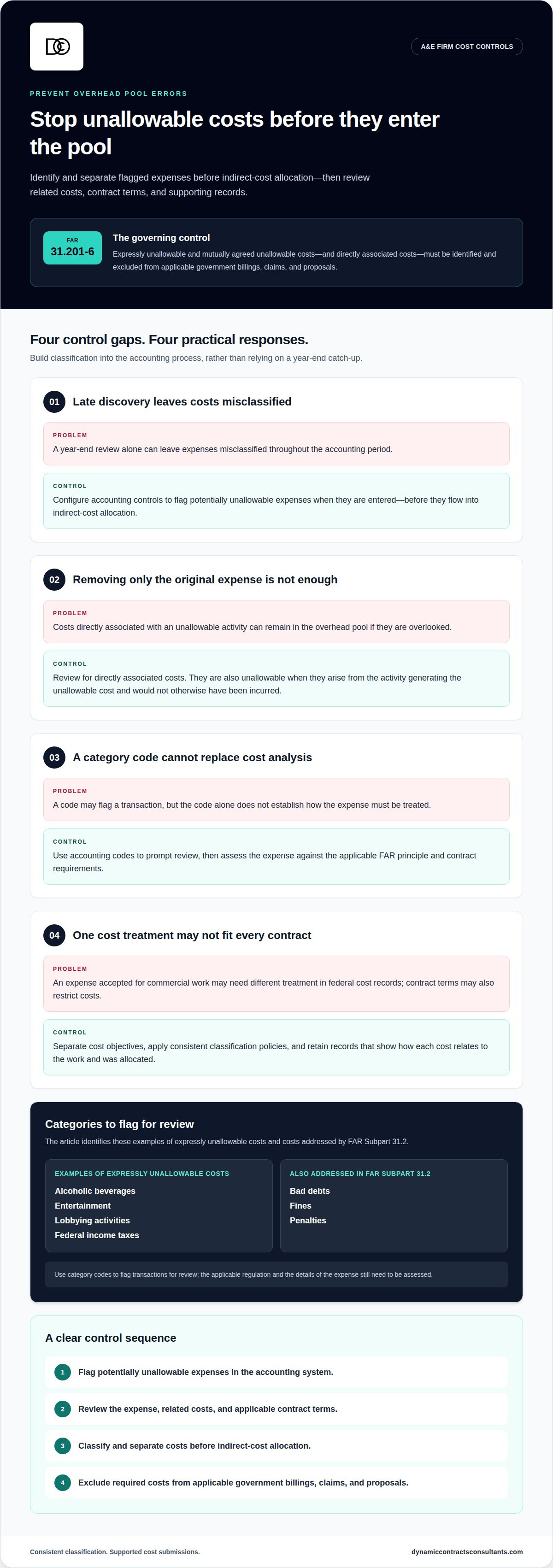
An A&E firm can reduce overhead errors by configuring accounting controls to identify flagged expenses before indirect-cost allocation. FAR 31.201-6 requires expressly unallowable and mutually agreed unallowable costs, including directly associated costs, to be identified and excluded from applicable government billings, claims, or proposals.
Expressly Unallowable Costs
An expressly unallowable cost is an expense that a FAR cost principle specifically makes unallowable. Correct identification matters because including one in an indirect cost submission can trigger penalties.
Examples include alcoholic beverages, entertainment, lobbying activities, and federal income taxes. FAR Subpart 31.2 also addresses bad debts, fines, and penalties. An accounting code for each category can flag transactions during entry, rather than leaving classification until year-end. The code should support review, not replace analysis of the expense and applicable regulation.
Directly Associated Costs
A directly associated cost arises from an activity that generates an unallowable cost. It is also unallowable if it would not have been incurred otherwise. Removing only the original expense can leave related costs in the overhead pool.
For example, alcohol served at a business meal is expressly unallowable. Sales tax and tips allocated to the alcohol are also unallowable. Internal procedures should capture these related amounts and document the allocation rationale. If accounting records combine allowable and unallowable portions, supporting detail must make the separation traceable.
What does FAR 31.201-6 require? Contractors must identify and exclude expressly unallowable or mutually agreed unallowable costs, along with directly associated costs, from applicable billings, claims, or proposals. Under FAR 31.201-6(c)(2), statistical sampling may be used to account for and present unallowable costs when its criteria are met.
For overhead control, distinguish three treatments in the accounting workflow: expressly unallowable expenses, expenses subject to a FAR limitation, and costs not classified as unallowable. Review limited costs separately because only amounts within the applicable restriction may be allowable. For example, certain public-relations and advertising costs are allowable only when specifically required by the contract or arising from government-contract requirements.
Connect transaction coding, review, and the indirect-cost calculation in one internal control. A reviewer can examine flagged accounts, confirm that directly associated costs were captured, and document reclassifications before using the pool. Keep invoices and allocation records with the decision so each submitted amount can be traced to its source and treatment.
Where firms use sampling, FAR 31.201-6(c)(4) provides for an advance agreement under 31.109 with the cognizant administrative contracting officer or Federal official on statistical sampling methods. This is distinct from simply selecting a sample internally. Clear coding and documented review help keep the overhead pool aligned with the cost treatment used in proposals and submissions.
How Can a Contractor Avoid Improperly Classifying an Unallowable Cost?
We help reduce classification errors by connecting transaction entry, review, and reporting in a documented control process. Your procedures should specify who assigns account codes, who reviews exceptions, and how corrections are approved. Controls for unallowable costs under FAR work best when staff can trace a decision from the original entry through the final cost submission.
For each cost category, maintain a written accounting rationale that explains its treatment and applicable cost objective. Records can include the transaction description, supporting documents, reviewer approval, and any later adjustment. A consistent file structure helps your team retrieve evidence without relying on memory or informal explanations.
Test the process, not just the final proposal. Select transactions from different accounts and trace them through coding, approval, allocation, and reporting. Record exceptions by type, determine whether they reflect a training gap or a system configuration problem, and document corrective action. This helps assess whether controls operate as intended.
Training is more effective when it reflects the decisions employees actually make. We can use anonymized transaction scenarios to show how an account code, project identifier, or approval record affects later reporting. Your team should know how to flag an unusual expense, route it for review, and preserve supporting detail. This promotes consistent treatment across departments and contract teams.
When reviewing unallowable costs under FAR, reconcile submitted schedules to the underlying ledger and retain a clear record of each adjustment. Explain differences between the ledger balance and the reported amount, including reclassifications and exclusions. Maintain version control by preserving the submitted schedule and supporting workpapers, so later reviewers can identify the records behind the final figures.
If a contracting officer disputes a cost, organize your response around the specific determination. Establish a chronology, identify the disputed transaction and its accounting treatment, and connect each factual point to its supporting record. A concise issue log can separate agreed facts from disputed points and show how the requested treatment follows from the contract terms and cost documentation.
Use these practices to strengthen accounting controls before preparing a submission, when responding to review findings, or while updating internal procedures. We help make cost decisions traceable and consistent, so report preparers can explain the records behind them.
Contract terms that restrict allowable costs
FAR cost principles and contract terms work together: a cost that might otherwise qualify can still be restricted by the agreement. Review the prime contract, subcontracts, and applicable agency supplements before including expenses in a proposal or indirect-cost submission.
Separating Allowable and Unallowable Costs
Segregation means recording allowable and unallowable expenses separately so they receive the correct treatment in cost submissions. This distinction matters when one accounting system captures expenses for multiple contracts or cost objectives.
Dedicated general-ledger accounts can help identify excluded costs throughout the year. Apply the accounting treatment consistently, retain the supporting transaction detail, and prevent excluded amounts from entering indirect-rate calculations. FAR 31.201-6(c)(4) also addresses advance agreements under 31.109 for statistical sampling methods used to identify and segregate unallowable costs.
Costs That Fail Allowability Criteria
A cost fails the allowability criteria if it does not meet applicable FAR principles, accounting requirements, or contract restrictions. A business purpose alone does not establish that an expense belongs in a government proposal.
For example, FAR 52.242-3 requires contractors not to include in a proposal costs unallowable under FAR subpart 2.1 or an executive agency FAR supplement. Travel or overtime may also be disallowed when contract terms designate it as unallowable, even if it might otherwise qualify under general cost principles.
Conditionally Allowable Costs
A conditionally allowable cost qualifies only when it meets the conditions imposed by the relevant cost principle or contract. Identify those conditions because the same expense category may receive different treatment depending on its purpose and supporting facts.
Travel costs for lodging, meals, and incidental expenses are generally allowable only up to applicable daily maximum per diem rates. FAR permits higher amounts in special or unusual situations only when specified conditions are met, and the amounts do not exceed higher amounts authorized for federal civilian employees.
A travel example illustrates the effect of a limit: where the applicable per diem is $150 per day and an employee expenses $200, the $50 excess must be classified as unallowable. The accounting system should separate that excess instead of treating the entire trip as either allowable or unallowable.
Generally allowable costs still require review against the contract’s terms and applicable allowability criteria. FAR 52.242-3 specifically addresses costs that a contract or agency supplement makes unallowable. Contract review should therefore inform cost accounting before proposal preparation, rather than relying solely on the expense category or prior treatment.
For each submission, connect the contract clause, cost category, and accounting entry. This makes restrictions visible during review and helps prevent a cost from being included merely because it was incurred for business. Document the classification so reviewers can see the basis for separating allowable costs from restricted amounts.
Penalties for unallowable costs
Penalties can exceed the original disallowed amount when a contractor knowingly includes unallowable costs in an indirect cost rate proposal. Under FAR 42.709, U.S. contracting officers may impose double penalties in that situation, according to the Federal Acquisition Regulatory Council. The central compliance issue is whether the contractor properly identified and excluded the cost, not merely whether it appeared in the accounting system.
FAR 52.242-3 distinguishes penalty treatment for expressly unallowable costs. For an assessed penalty, a contractor must pay a penalty equal to the disallowed cost allocated to the contract, plus simple interest on excess payments, according to the Federal Acquisition Regulatory Council. If the contractor submits a cost previously determined unallowable for that contractor, the penalty equals two times the disallowed cost allocated to the contract, according to the Federal Acquisition Regulatory Council.
These rules make prior determinations and cost treatment important. A documented classification process can show how employees identified a cost, reviewed its supporting records, and excluded it from indirect costs. For example, if an expressly unallowable expense appears in a rate proposal, reviewers need to determine whether it was isolated, whether associated costs were treated properly, and whether the submission repeated a prior disallowance.
Sampling does not automatically remove penalty exposure. Under FAR 31.201-6(c)(3), sampled indirect costs subject to the penalty provisions at 42.709 also subject the amount projected to the sampling universe to those penalties. That makes the sampling method and the classification behind sampled entries consequential. FAR 31.201-6(c)(4) provides for an advance agreement under 31.109 on statistical sampling methods used to identify and segregate unallowable costs.
Penalties and repayment are separate consequences. Paying a penalty under FAR 52.242-3 does not repay an unallowable cost already paid by the government to the contractor. A contractor may therefore need to address both the penalty and the underlying government payment. FAR 52.242-3 identifies 41 U.S.C. chapter 43 as prescribing applicable penalties, as stated by the Federal Acquisition Regulatory Council.
Contractors may also face scrutiny when cost submissions raise concerns about knowingly presented claims. A knowing inclusion may lead to penalties under the False Claims Act or a criminal investigation referral. The FAR also identifies penalties prescribed in 10 U.S.C. 3748 or 41 U.S.C. chapter 43, as applicable. These are potential consequences, not automatic results of every accounting error; the relevant facts include the cost’s classification, submission, and prior treatment.
Start a disciplined response by tracing each challenged amount from its source record into the indirect rate proposal. Preserve the cost entry, allocation support, review history, and any prior determination. Then assess whether the amount was expressly unallowable, previously disallowed for the contractor, or projected through sampling. This evidence helps establish the basis for the cost treatment and applicable penalty analysis.
For support aligning contract cost submissions with post-award compliance controls, discuss your compliance needs.
Dynamic Contracts Consultants: Post-Award Contract Administration
Dynamic Contracts Consultants LLC provides Contract Administration & Post-Award Compliance to help you manage contract requirements after award, including cost-related obligations that affect performance and reporting. This support is useful when contract terms, flow-down clauses, or compliance processes require coordination across your team.
When cost classification or accounting controls need closer alignment with federal requirements, our DCAA & Cost Support can help strengthen your compliance approach. We connect post-award administration with contract requirements through clear processes and documented oversight. This is contract administration and compliance consulting, not legal representation.
Contact Dynamic Contracts Consultants LLC to discuss your post-award contract administration needs.
Make Cost Compliance Part of Your Next Growth Decision
Build cost discipline into how your organization plans and pursues federal work, rather than treating it as a final submission review. Addressing unallowable costs under FAR as part of operational planning helps your team align proposal assumptions, accounting practices, and contract execution.
Dynamic Contracts Consultants supports this work through Proposal & Grant Writing and DCAA & Cost Support. These services help connect funding opportunity or federal contract requirements with the processes your organization uses to prepare submissions and manage compliance. Start by identifying where your approach needs clearer structure, stronger documentation, or more consistent oversight.
Contact Dynamic Contracts Consultants to discuss your organization’s priorities and determine a practical path forward. With focused planning and disciplined execution, you can pursue growth while keeping compliance in view.
Frequently Asked Questions
How Do the Terms of the Contract Impact the Allowability or Unallowability of a Cost?
Contract terms can impose restrictions beyond a cost category’s general treatment under FAR. A clause may prohibit a specific expense or make reimbursement depend on prior authorization, documentation, or a stated purpose. For example, a contract may restrict overtime or travel. Review each expense against the contract’s actual clauses and applicable agency supplement, rather than relying on its account name alone.
How Is Allocability Determined?
A cost is allocable when it is assignable to a contract based on its relationship to the work or the benefit received. For example, if a technical study supports two projects, its cost may be distributed according to each project’s benefit. The allocation record should identify the cost objective, the basis used, and the source data so a reviewer can understand why the distribution reflects the work.
What Are “Reasonable” Costs?
A reasonable cost’s nature and amount do not exceed what a prudent person would incur under the circumstances. The assessment can consider the business purpose, conditions at the time of purchase, and whether the expense supports contract performance. For example, reviewers may use contemporaneous records to examine whether a purchase was needed for the work and proportionate to that need.
What Is FAR 31.205?
FAR 31.205 contains cost principles addressing particular types of costs incurred by commercial organizations doing business with the federal government. It includes provisions that explain when specific costs are allowable, unallowable, or limited. Contractors can use the relevant provision to analyze an expense category, then consider the applicable contract terms and accounting requirements. The provisions offer examples, but do not address every possible transaction.
What are some examples of expenses that are strictly unallowable under FAR Part 31 for engineering firms?
Examples include alcohol, entertainment, lobbying, federal income taxes, fines, and penalties. For an engineering firm, a business meal that includes alcohol shows why transaction details matter: the alcohol portion is expressly unallowable, as are sales tax and tips allocated to it. An account label alone may not reveal the full treatment, so supporting detail should identify components related to the restricted expense.
What happens if an architecture or engineering firm fails to properly segregate unallowable costs?
Misclassified costs may enter an indirect cost proposal or other government submission, potentially resulting in disallowance, repayment, or penalties when applicable conditions are met. A knowing inclusion can have greater consequences than an inadvertent coding error. For example, a firm that discovers a miscoded expense during internal review can document the correction and treatment rather than leave the amount unexamined in a submitted rate.
What costs are expressly unallowable under FAR 31.205?
Expressly unallowable costs are those a specific FAR cost principle clearly identifies as unallowable. Examples include alcoholic beverages, entertainment, lobbying, and federal income taxes. The applicable provision determines the classification, including whether related expenses must also be excluded. For instance, costs directly associated with an unallowable activity may also be unallowable if they would not have been incurred without that activity.
How should contractors identify and segregate unallowable costs in accounting records?
Use distinct general-ledger accounts or transaction codes to identify restricted expenses when they are entered, then retain enough detail to support review. A useful record links the invoice, business purpose, contract or cost objective, and classification rationale. Set review procedures to flag categories such as alcohol, entertainment, or lobbying, and document corrections before preparing indirect-rate submissions. This creates a traceable audit trail from the original transaction to its final treatment.
Have a question this article didn’t answer?
Talk it through with a certified contracting professional. The first 30 minutes are free.