
When preparing for a contract performance review, our strategic guide helps you organize critical evidence, ensure compliance, and achieve mission success.
A contract performance review is strongest when the evidence tells a clear, consistent story. Preparing for a contract performance review can feel difficult when records are spread across teams, results include missed expectations, or feedback is hard to turn into next steps. A structured approach helps you present performance accurately and address concerns without letting them define the entire discussion.
You likely already know that contract records matter. The challenge is deciding which documents best support your account, how to discuss gaps constructively, and how to ensure review comments lead to meaningful follow-through. We’ll show you how to organize performance evidence around contract requirements, connect results to supporting records, and prepare for a focused discussion with government stakeholders.
This guide explains how to document concerns, clarify open questions, and translate feedback into actions with accountable owners and follow-up records. Drawing on our contract administration and post-award compliance services, we outline a practical preparation process to help you assess performance with precision and leave the review with a clear path forward.
Key Takeaways
- Distinguish a contract performance review from an employee appraisal by focusing on work performed under the specific contract.
- When preparing for a contract performance review, organize deliverables, submission records, acceptance information, and correspondence by contract requirement.
- Use a structured comparison to connect each expectation with supporting evidence, documented outcomes, open issues, and a proposed response.
- Prepare discussion roles and likely questions in advance, then record follow-up actions with owners and supporting documentation.
What a Government Contract Performance Review Examines, and What It Does Not
We define a government contract performance review as an evidence-based assessment of work performed under a specific contract. It considers your organization’s delivery against that contract’s requirements and documented expectations, rather than evaluating an employee’s career development or general workplace behavior. The review’s scope depends on the contract, the work performed, available records, and the assessment context. This overview of Government procurement in the United States places contract management and performance measures within the broader procurement process.
This distinction matters when you prepare to discuss concerns. A missed deliverable or unresolved issue calls for a clear, evidence-based explanation, assessed against the applicable requirement and records. Establish what the contract called for, what was delivered, and which documentation supports your account. Preparation can make the discussion more accurate, but it cannot guarantee a particular rating or outcome.
How a contractor performance review differs from an employee appraisal
An employee appraisal typically centers on an individual’s job responsibilities, conduct, development, and goals. A contractor performance review instead examines your organization’s delivery under contractual expectations. Its central evidence is contract-specific: requirements, deliverables, submission and acceptance records, documented communications, and other relevant performance records. These materials help establish what your organization was responsible for and what occurred.
The review process and format may vary by contract and agency. An employee-review template, or a format used on another government contract, may not capture the issues relevant to your assessment. A structured approach to post-award compliance helps keep performance monitoring and documentation aligned with contract administration practices.
Which contract expectations should frame preparation?
Start with the controlling contract documents and identify the expectations relevant to your review period. Depending on your agreement, these may include the scope of work, required deliverables, milestones, and documented changes. If your contract includes a Performance Work Statement or Statement of Work, use it to locate the specific performance requirements that apply. Tie each point you plan to discuss to a requirement or other documented expectation.
For example, if your contract calls for a recurring status report, frame the performance point around that deliverable: the expected submission, the record of what was submitted, and any documented acceptance or follow-up. If a change affected timing or scope, distinguish the original expectation from the documented change rather than relying on recollection. This gives you and the review team a shared reference point.
Build your account from specific evidence, not broad claims such as “the team performed well” or “the schedule was difficult.” Connect relevant expectations to the work and records that substantiate them, and identify uncertainties without overstating what the evidence shows. This supports a precise discussion, including when performance includes both strong results and unresolved concerns.
Build a Traceable Evidence File Before the Contract Performance Review
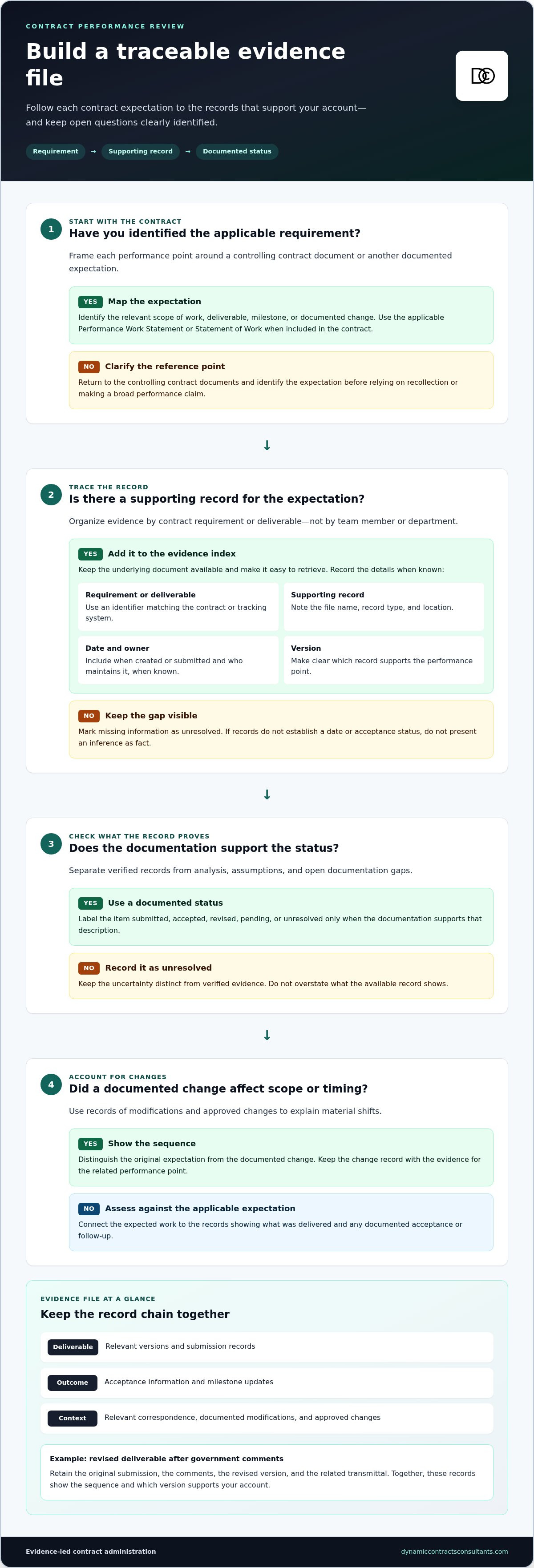
Organize evidence by contract requirement or deliverable, rather than by team member or department. This structure lets you and the review team trace how different functions contributed to a result without searching separate team folders. When we support contract administration, we focus on making the connection between each expectation and its supporting records clear.
For each relevant requirement, gather records that show the work’s history and status. These may include deliverable versions, submission records, acceptance information, milestone updates, and correspondence. Include documented modifications and approved changes that explain material shifts in scope or timing. Keep verified records distinct from your analysis, assumptions, and open documentation gaps. If the available records do not establish a date or acceptance status, label it unresolved rather than presenting an inference as fact.
Create a contract-to-evidence record
Build a concise index that maps each applicable requirement to its supporting records. Use it as a navigation aid, while keeping the underlying documents available for review. Where information is available, note the source, date, owner, and status of each item. Clear version identification helps your team and reviewers trace which record supports each performance point.
- Requirement or deliverable: Use an identifier that matches your contract or internal tracking system.
- Supporting record: Note the file name, record type, and location so your team can retrieve it.
- Date and owner: Record when the item was created or submitted and who maintains it, when known.
- Status: Label an item submitted, accepted, revised, pending, or unresolved only when the documentation supports that description.
For example, if a deliverable was revised after government comments, retain the original submission, the comments, the revised version, and the related transmittal. Together, these records establish the sequence and help reviewers understand which version supports your account. Consistent file names and version control make the evidence trail easier to follow.
Document accomplishments, issues, and dependencies fairly
Document favorable results with the same care as concerns. State what was completed, connect it to the relevant expectation, and identify the evidence that supports the outcome. For an issue, record what occurred, the relevant communications, mitigation steps, and current status. This creates a balanced account without minimizing an unresolved matter or overstating a successful result.
Document dependencies when the records show their effect on performance. Identify the relevant request, response, or schedule change, and avoid assigning cause based only on recollection. Keep open questions visible so your team can distinguish confirmed facts from matters that still need clarification.
Our team provides contract administration support to help you strengthen the process. Learn more or discuss contract administration support.
Assess Performance Against Requirements, Evidence, and Documented Outcomes
Once your records are assembled, assess performance requirement by requirement. Compare each relevant expectation with the documented delivery, its status, and any available acceptance evidence. Consider schedule, quality, deliverables, communication, or performance risks only when those topics apply to your contract and review context. This keeps your analysis tied to what was expected and supported, rather than broad impressions.
A working table can help your team distinguish substantiated results from matters requiring clarification. Adapt the categories and terminology to your contract.
| Requirement | Evidence | Outcome | Open issue | Proposed response |
|---|---|---|---|---|
| Submit a required report by the stated milestone | Submission record and dated transmittal | Submitted, based on available records | Acceptance record not located | Identify the documentation gap and clarify the status |
Link each entry to an identifiable source and avoid conclusions that go beyond what it establishes. A submission record may show that a deliverable was transmitted, but it does not by itself establish acceptance. Similarly, documentation of a mitigation step shows a response to an issue, not necessarily that the issue has been resolved.
Separate performance facts from explanations and conclusions
Label what the records show separately from stakeholder feedback, analysis, and proposed action. Dated correspondence may establish that a schedule concern was raised; an explanation of why it occurred is a separate statement that needs its own support. Use precise dates and records where available, and avoid causal claims the documentation cannot substantiate. Flag incomplete or conflicting evidence for discussion rather than filling gaps with assumptions.
Keep each issue’s status and response distinct. State what has been done and what remains uncertain. Do not present a planned corrective measure as completed or partial mitigation as proof of resolution.
Prepare a balanced account of strengths and improvement areas
Present supported strengths alongside substantiated concerns. Tie each positive point to an applicable expectation and evidence, such as a documented delivery or recorded acceptance. For an improvement area, identify the expectation, evidence of the gap, and any documented response or unresolved status. A balanced account does not require equal weight for every point; it requires an accurate representation of material performance.
CPARS may be relevant when the specific contract and assessment context involve that system. Do not assume every review follows a CPARS format or uses identical criteria. Where CPARS applies, distinguish your organization’s documented account from the assessment itself. This helps you discuss performance precisely without presenting assumptions as established facts.
Prepare the Review Discussion, Anticipated Questions, and Response Roles
A well-prepared discussion gives your team a consistent way to explain performance, address concerns, and identify matters that need clarification. The format, participants, and level of formality can vary by contract, so align preparation with the review notice and applicable contract context rather than assuming every meeting follows the same structure. Preparing for a contract performance review means planning both what your team will present and how it will respond to questions.
Use a concise agenda to focus the conversation on significant outcomes, open issues, evidence, and decisions requiring clarification. Assign participants according to the information they can support. A delivery lead, for example, may address operational status, while a compliance or documentation owner can locate relevant records. One person should coordinate the discussion so responses remain consistent and follow-up items are captured.
- Set the agenda. Identify key outcomes, unresolved concerns, supporting evidence, and questions that require clarification. Keep the sequence aligned with the review’s purpose.
- Anticipate questions. For each material performance point, consider what a reviewer may ask and identify the record that supports your response.
- Assign response roles. Confirm who will address delivery, compliance, operational details, or documentation, and who will coordinate transitions between topics.
- Confirm meeting readiness. Review the evidence file, agenda, and open items together, then designate a note-taker to record feedback, commitments, and owners.
Develop clear responses to review questions
Answer the question directly, then refer to the relevant contract record or performance evidence. If the answer is confirmed, state the supporting fact concisely. If information is incomplete, identify what is known and what requires follow-up rather than presenting an estimate as established. For a known concern, prepare a brief explanation of the corrective steps taken, their documented status, and any outstanding action. This keeps responses specific without overstating resolution.
Conduct a focused internal readiness discussion
Before the review, align participants on key messages, evidence locations, and unresolved items. If internal accounts conflict, return to source records and distinguish documented facts from recollection or interpretation. Confirm who will capture questions, feedback, commitments, and follow-up responsibilities so discussion points do not remain informal. A focused readiness discussion also helps prevent duplicate, inconsistent, or unsupported responses.
Our contract administration and post-award compliance support can help strengthen review preparation, documentation, and performance monitoring. Discuss contract performance review support with our team.
Turn Review Findings into Documented Follow-Through and Contract Support
The review’s value depends in part on what happens after the discussion. Convert findings into a controlled record of agreed actions, open questions, responsible owners, and supporting documentation. This gives your team a practical way to track commitments and distinguish completed work from items still under review.
Convert feedback into an accountable action plan
Record each follow-up item in an action log that fits your organization’s contract-management practices. For each entry, capture the action, owner, status, relevant contract context, and records that will show progress or completion. Include a deadline only when one has been established through the appropriate documented process. An assumed date can create confusion about whether a commitment was agreed.
Keep the status of each item precise. Separate confirmed commitments from proposed responses and questions that remain under discussion. For example, a request to provide additional supporting material is not the same as an agreed corrective action. Note the distinction, identify who will clarify it, and retain the communication that establishes the current understanding.
As work progresses, update the log with evidence rather than relying on status descriptions alone. If an action involves revising a deliverable, reference the applicable version or transmittal record. If later correspondence resolves a question, preserve that response with the related review documentation. Retain relevant communications and evidence in the appropriate contract documentation system, following your organization’s established controls.
Connect review preparation with post-award contract administration
Recurring review findings can reveal where routine performance monitoring, deliverable management, or documentation practices need greater consistency. Integrating those activities into post-award contract administration helps teams maintain continuity between day-to-day execution, review discussions, and follow-up. Our Post-Award Contract Administration support connects contract performance monitoring with organized documentation and compliance follow-through.
Practitioner‑Led Consulting can help your team align review actions with contract-management practices. Our Human + AI Delivery Model supports structured work, while Certified Government Contracting Professionals bring 25+ Years of Experience and Nationwide Support. As a Specialist in FAR, DFARS, and Government Contract Compliance, we help organizations strengthen administration and documentation processes without treating a review rating or outcome as guaranteed.
A disciplined closeout creates a traceable record of what was discussed, what remains open, who owns each action, and what evidence will demonstrate progress. To discuss contract administration and performance documentation for your organization, schedule a FREE Initial 30‑minute consultation.
Make the Next Review a More Disciplined Process
A contract performance review can do more than document past delivery. Used carefully, its findings can inform stronger contract administration, clearer internal accountability, and more consistent performance monitoring across the work that follows. Preparing for a contract performance review is an opportunity to improve how your organization connects evidence, decisions, and action, not simply an exercise in presenting a favorable account.
That discipline takes sustained attention: records must remain usable, commitments must have owners, and progress must be documented in line with your contract-management practices. Our work is informed by Practitioner‑Led Consulting and a track record that includes $10M - $285M Growth. We partner with government contractors to strengthen post-award administration and support a more structured approach to review readiness.
Take the next step toward a review process grounded in clear evidence and accountable follow-through. Schedule a FREE Initial 30‑minute consultation to discuss your contract administration needs. With a disciplined process and the right support, your team can approach future reviews with greater clarity and confidence.
Frequently Asked Questions
What should I bring to a contract performance review?
Bring an indexed set of records relevant to the contract and review context, including requirements, deliverable records, milestone updates, acceptance information, correspondence, and documented changes. The precise file depends on the work being assessed. For each performance point, make its supporting source easy to locate, and label analysis separately from source evidence. This helps reviewers distinguish what the records establish from your interpretation or explanation.
Who should attend a government contract performance review?
Attendance depends on the contract, the review’s purpose, and your organization’s responsibilities. Include participants who can accurately address the work under discussion and explain the records or operational context behind it. Before the meeting, confirm which topics each person can speak to and who will coordinate responses. If a question falls outside an attendee’s knowledge, identify it for follow-up rather than speculating or speaking for another function.
How should a contractor respond to a negative performance finding?
Review the finding against the applicable contract context and source records, then prepare a concise, documented response. Identify any specific factual disagreement and cite the record that supports your position. Acknowledge concerns substantiated by the evidence, and distinguish those facts from your analysis or explanation. Note corrective steps and their current status accurately. A response can clarify the record, but it cannot guarantee a change to an evaluation or rating.
Can a subcontractor prepare for a contract performance review?
Yes. A subcontractor can organize evidence covering its own scope, such as required work products, milestone records, communications, and documentation of issue resolution. Applicable obligations and review arrangements depend on the subcontract and the relationship with the prime contractor. Keep performance statements tied to documented subcontract requirements, and coordinate information through the appropriate contract channels so shared or sensitive matters are handled consistently.
What is the difference between a contract performance review and CPARS?
A contract performance review is a general term for assessing work under a contract; CPARS is a specific system associated with contractor performance assessments. A review meeting or internal discussion should not automatically be described as a CPARS evaluation. Whether CPARS is relevant depends on the contract and assessment context. Use the governing contract information and review communications to understand which process applies.
How often should a contractor review performance evidence?
Review performance records as work progresses rather than waiting until a formal assessment is approaching. An ongoing internal review can reveal a missing acceptance record, an unclear deliverable status, or a correspondence gap while the relevant source material is still accessible. Set the review rhythm according to contract needs and your organization’s management practices. The goal is a current, usable record, not an arbitrary schedule that fits every contract.
What if the review discussion raises an issue we cannot answer immediately?
State what is known, explain what information is needed to respond accurately, and record the question for follow-up. Avoid guessing or making unsupported commitments in the meeting. Afterward, assign an owner to locate the relevant record or consult the appropriate internal team, then document the response through established contract-management channels. Capture any agreed next step and its status so the question remains visible until it is addressed.
Have a question this article didn’t answer?
Talk it through with a certified contracting professional. The first 30 minutes are free.