
Master mandatory FAR flow down clauses with our expert guide. We help you streamline strategic compliance across your subcontract tiers with total precision.
A clause does not flow down simply because it appears in a prime contract. Which mandatory FAR flow down clauses apply depends on the contract and subcontract, and FAR 52.244-6 identifies required clauses for commercial subcontracts; for example, the U.S. General Services Administration states that it requires FAR 52.204-25 to flow down. The controlling clause version also matters: including the right clause number with the wrong text can leave a subcontract out of step with its governing terms.
Managing mandatory FAR flow down clauses can be challenging across commercial and noncommercial subcontracts, multiple tiers, and contract updates. This guide explains how to identify applicable flowdowns, when requirements extend to lower-tier subcontractors, and how to handle different clause versions without assuming every prime-contract clause belongs in every subcontract.
You’ll find practical ways to assess clause applicability and keep clear records of flowdown decisions. The aim is a precise approach to subcontract compliance, based on the governing contract terms and the work being performed.
Key Takeaways
- Determine flowdown applicability from the subcontract’s type, work, terms, and tier rather than copying every clause from the prime contract.
- Use the FAR clause matrix and the governing contract clauses to identify which requirements apply to the subcontract.
- Assess FAR 52.203-7’s anti-kickback flowdown by applying its threshold reference as of the subcontract award date.
- State which clause version governs in the subcontract so both parties can identify the applicable text.
- Keep a record of flowdown decisions and acceptance to support compliance reviews and resolve version questions.
Flowdown Clause: What Rolls Downhill to the Subcontractor?
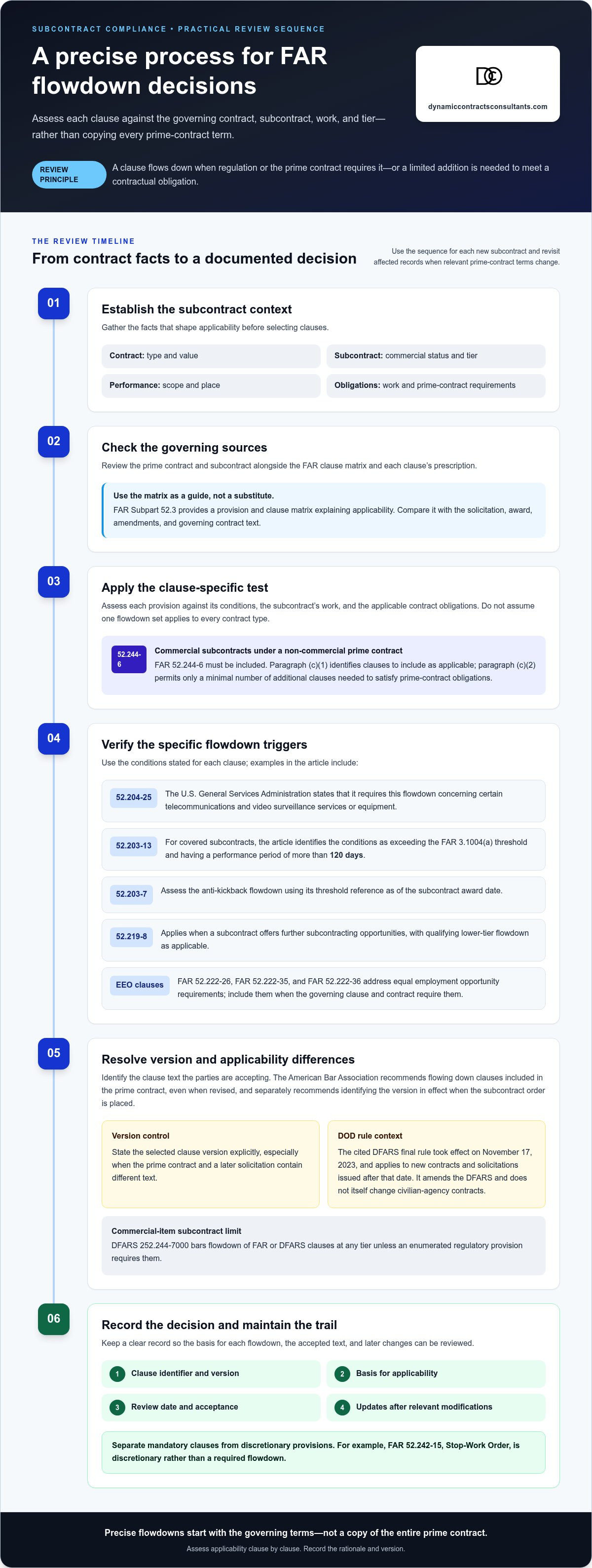
A clause belongs in a subcontract when a regulation or the prime contract requires it, or when a limited additional flowdown is needed to meet contractual obligations. Assess applicability by reviewing the clause, subcontract, and work, rather than automatically copying every prime-contract term.
To see how parties assess and negotiate flowdowns, watch this video:
Clauses Needed for Prime Contract Obligations
An additional flowdown is a clause incorporated into a subcontract to help you meet an obligation under the prime contract. For commercial subcontracts, FAR 52.212-5(e)(2) and FAR 52.244-6(c)(2) permit only a minimal number of additional clauses necessary to satisfy contractual obligations. We therefore distinguish those limited additions from clauses expressly required by regulation.
For commercial products or services, the U.S. General Services Administration states that FAR 52.244-6 requires FAR 52.204-25 concerning certain telecommunications and video surveillance services or equipment. It also requires FAR 52.203-13 in covered subcontracts exceeding the FAR 3.1004(a) threshold and having a performance period of more than 120 days.
Cost-reimbursement, fixed-price, and other contract types do not trigger one universal set of flowdowns. Assess the governing clauses and the subcontract’s circumstances, including contract type, value, and place of performance.
Prime Contract Clause Versions
The American Bar Association recommends flowing down clauses included in the prime contract, even when a clause has since been revised. It separately recommends identifying the version in effect when the subcontract order is placed. Make the selected text explicit so both parties can identify the obligations accepted.
Record each clause’s identifier and version alongside the reason it applies. This is particularly useful when the prime contract and a later solicitation contain different text. Small-business and labor-related clauses also require clause-specific analysis, not automatic inclusion based only on subcontractor status.
Effective Dates and Contract Applicability
The Department of Defense final rule became effective on November 17, 2023, and applies to new contracts and solicitations issued after that date. It affects DOD contracts because it amends the DFARS; it does not itself change civilian-agency contracts.
For commercial-item subcontracts, DFARS 252.244-7000 bars flowing down FAR or DFARS clauses at any tier unless an enumerated regulatory provision requires them. For small-business and labor clauses, check the specific clause’s conditions and exceptions against your subcontract and work.
Prime Contractor Review and Negotiation
Before you incorporate a clause, compare its conditions with the subcontract’s work, tier, and prime-contract obligation. FAR 52.219-8 applies when a subcontract offers further subcontracting opportunities, with qualifying lower-tier flowdown as applicable. FAR 52.222-26, FAR 52.222-35, and FAR 52.222-36 address equal employment opportunity requirements; include them when the governing clause and contract require them.
During negotiation, we recommend clarifying the clause text, version, and obligations the subcontractor is asked to accept. Document your review and acceptance to maintain a clear compliance record. A structured post-award compliance process can help organize flowdown decisions across the procurement lifecycle.
FAR flowdown resources and assistance
Use the FAR clause matrix, prime contract, and each clause’s prescription to assess subcontract flowdowns. This structured review helps distinguish required terms from discretionary ones and supports more precise subcontract drafting.
Keeping Up With Flowdown Changes
Keeping current means comparing the governing contract text with applicable FAR and agency supplement provisions. The U.S. General Services Administration’s FAR Subpart 52.3 provides a provision and clause matrix explaining applicability. We use it alongside your solicitation, award, and amendments, because the matrix supports contract-specific review rather than replacing it.
For each new subcontract, record the clause identifier, version, basis for applicability, and review date. Revisit affected records when a prime contract modification changes relevant terms. This helps distinguish a regulatory update from a change to existing contractual obligations.
Flowdown of FAR 52.244-6
FAR 52.244-6 itself must be included in commercial subcontracts under a non-commercial prime contract. Its paragraph (c)(1) identifies clauses to include, as applicable, while paragraph (c)(2) permits only a minimal number of additional clauses needed for prime-contract obligations.
We recommend checking your prime contract type, the subcontract’s commercial status, and each clause’s applicability conditions. That review helps your team avoid treating the entire prime contract as a subcontract template. Record why FAR 52.244-6 and each selected provision belong in the subcontract.
Generating Flowdown Clauses
Clause generation brings together subcontract terms drawn from applicable prime-contract and regulatory requirements. Before drafting, organize the agency, contract type, subcontract scope, commercial status, tier, and relevant clause conditions. These details give your team a clear basis for selecting language and tracking its source.
For example, FAR 52.242-15, Stop-Work Order, is discretionary rather than a required flowdown. We separate discretionary provisions from mandatory clauses and record the rationale for each selection. Generated language still needs a substantive applicability review before you issue the subcontract.
Which clauses apply only when relevant or above a threshold? Some flowdowns depend on conditions such as subcontract type, scope, tier, or a threshold specified in the clause. Compare those triggers with the subcontract facts before identifying required terms.
FAR reviews identify around 150 clauses with flowdown requirements, but that figure does not replace clause-by-clause analysis. Our post-award compliance support can help connect each selected clause to its source, conditions, and subcontract language.
Challenges of complying with multiple clause versions
A subcontract may sit beneath a prime contract whose clauses changed between solicitation, award, and modification. The Federal Acquisition Regulation and an agency acquisition regulation supplement may also set different applicability conditions. If the subcontract file shows only a clause number, reviewers may not know which text governed. Track the incorporated version, its prime-contract reference, and the reason for inclusion together.
A Contractor Purchasing System Review may examine flowdown accuracy. Treat clause selection and supporting records as operational controls, not just drafting details. For each subcontract, retain the clause text or version reference, applicability analysis, subcontractor acceptance, and any later amendment. This makes it possible to trace the decision from the prime contract through the subcontract and explain how it was reached.
Blanket flowdowns create a different risk: they can impose requirements unrelated to your subcontractor’s work. FAR 52.216-7, the Allowable Cost and Payment clause, may be mistakenly accepted by a subcontractor that has no prime contracts. FAR 52.203-14, concerning hotline posters, may also be flowed down unnecessarily to a commercial-product or commercial-service subcontractor. We recommend assessing each term instead of relying on a copied clause set.
Over-inclusion can create confusion about performance, records, pricing, and responsibility. Under-inclusion can leave a required subcontract term out. The U.S. government generally enforces regulatory compliance against the prime contractor with which it has privity, rather than directly against the subcontractor. A prime that omits mandated provisions may face penalties, including termination for default. Connect each flowdown decision to the obligation it addresses.
Version control requires attention to dated clause text, not just amendment history. DFARS 252.204-7012, Safeguarding Covered Defense Information and Cyber Incident Reporting, has revisions dated August 2015, September 2015, December 2015, and October 2016. If your subcontract references that clause, identify the applicable text and its contractual basis. Otherwise, you and your subcontractor may interpret different versions as controlling.
Maintain a decision record for each clause, including its source, applicability condition, tier, version, and acceptance status. If a prime contract modification changes a relevant requirement, assess affected subcontracts and document the action taken. A traceable record connects federal acquisition requirements to subcontract obligations and explains why a clause was included, revised, or excluded.
For effective control, separate required clauses from additional clauses and document the rationale for each. Purchasing teams can then compare each subcontract with its prime contract without treating every federal term as automatically applicable. Consistent records help explain flowdown decisions during a system review and clarify the accepted requirements for subcontractors.
FAR 52.203-7 Anti-Kickback Procedures
FAR 52.203-7, Anti-Kickback Procedures, addresses kickbacks connected with federal subcontracting. Its flowdown rule appears in paragraph (c)(5), which requires the clause’s substance, with specified exceptions, in qualifying subcontracts. The threshold comes from FAR 3.502-2(i), and the relevant date is the subcontract award date. That timing makes award records central to the prime contractor’s applicability review.
Apply the requirement to the subcontract, not simply to the prime contract’s value or award date. At subcontract award, compare the subcontract against the threshold referenced in FAR 3.502-2(i). If it exceeds that threshold, paragraph (c)(5) requires the clause’s substance, subject to its specified exceptions. The facts supplied here do not establish a dollar figure, so the operative reference remains the regulation’s threshold on the award date.
“Substance” is consequential. The rule calls for incorporating the clause’s substantive requirements, rather than treating its identifier alone as adequate. The subcontract should express the requirements clearly enough for the parties to understand their obligations. A prime contractor should compare the drafted language with FAR 52.203-7(c)(5), document any applicable exception, and preserve the version used for the subcontract award.
For example, a subcontract may be below a specified threshold when first discussed, then change before award. The prime contractor’s review should use the relevant facts at the subcontract award date, including the final subcontract value. A change in value or scope can alter the analysis, so the award file should show which terms were evaluated and when. Do not rely only on an earlier draft or preliminary estimate.
The clause also warrants attention during subcontract negotiations. A subcontractor should understand whether the clause’s substance is included, what language governs, and how its requirements relate to the subcontract’s work. The prime contractor can identify the paragraph (c)(5) basis and explain any tailored wording. If a proposed exception applies, document the basis rather than silently omitting the provision.
FAR 52.203-7 should also be distinguished from a general ethics statement. A company policy may address improper payments, but it does not replace a required subcontract term. Conversely, a clause number copied into a document does not establish that its substance has been incorporated. Review the actual text, the threshold analysis under FAR 3.502-2(i), and the award-date record together.
A sound file links each decision to a specific subcontract: the award date, threshold comparison, clause text, and any exception analysis. This record helps the prime contractor explain why FAR 52.203-7 was included or treated differently. It also gives the subcontractor a clear reference for its agreed obligations, rather than leaving applicability to assumptions made during later performance.
Specifying which clause version governs
A subcontract should identify the text governing each flowed-down clause, not just its number. A reference such as “FAR clause applies” may leave the parties unsure whether they accepted the prime contract’s version or later revisions. Record the clause identifier, title, revision date, and source contract in the subcontract schedule. This gives both parties a shared reference for performance and compliance reviews.
The American Bar Association recommends flowing down clauses included in the prime contract, even when a clause has since been revised. It also recommends identifying the version in effect when the subcontract order is placed. These practices make version selection clear and help distinguish an incorporated version from later government or defense updates.
Make the selection operational. For each applicable clause, document its source, edition, and any relevant paragraph or alternate. For example, if FAR 52.244-6(c)(1) is the basis for a commercial subcontract requirement, identify that paragraph and the applicable clause text. Avoid a general reference to the FAR or an acquisition regulation supplement without identifying which provisions the subcontract incorporates.
Later changes need a separate decision. A prime contract modification may revise a clause, but that alone does not establish whether the subcontract adopts the revision. State whether changes flow through automatically or require a written subcontract modification. This clarifies which terms the subcontractor must accept and records how government contract changes affect lower-tier obligations.
Use direct language rather than relying on assumptions. For example, a subcontract schedule can state: “The contractor shall comply with [clause identifier and title], [revision date], as incorporated in [identified prime contract provision].” Treat this as a drafting structure, not standard FAR text. Include the specific paragraph when only part of a clause applies, and identify the governing alternate.
Before award, compare the clause schedule with the prime contract and solicitation, then resolve mismatches in writing. Confirm that each required flowdown points to an identifiable version and that discretionary terms have a separate justification. Keep the accepted schedule and subsequent modifications in the subcontract file. This creates a traceable link between the government requirement and the obligation accepted by the subcontractor.
For complex post-award changes, a documented post-award compliance process can help keep clause versions aligned with subcontract records.
Dynamic Contracts Consultants: Proposal Writing
Dynamic Contracts Consultants LLC supports federal contractors with Proposal Writing, DCAA Compliance Consulting, and post-award flowdown compliance. When you need to turn solicitation requirements into a clear, responsive proposal, our Proposal Writing service can help organize your approach. After award, our flowdown and post-award compliance services support the management of subcontract requirements, clause applicability, and version records as part of contract administration.
These services support different stages of the procurement lifecycle: proposal development before award and compliance management afterward. If you are assessing how flowdown decisions fit into broader contract operations, contact Dynamic Contracts Consultants LLC to discuss your needs.
Make Clause Governance Part of Contract Operations
Clause version control can become a lasting part of your procurement lifecycle, rather than a task revisited only during subcontract drafting. Treat each flowdown decision as structured contract data, connecting the applicable term to its source, version, and subcontract record. This foundation can simplify future modification reviews and help teams maintain continuity as contracts change.
For organizations managing mandatory FAR flow down clauses alongside broader federal contracting priorities, the next step may be aligning compliance work with proposal and financial processes. Dynamic Contracts Consultants LLC offers Proposal Writing, Grant Writing, and DCAA Compliance Consulting to support these needs. Each service addresses a distinct part of the contracting environment, from developing submissions to strengthening compliance practices.
Identify the contract process that needs the most attention, then discuss an appropriate next step with our team. Contact Dynamic Contracts Consultants LLC to discuss your contracting needs. A thoughtful approach can help your team build clearer, more consistent contract operations.
Frequently Asked Questions
What are flowdowns?
Flowdowns are contract terms passed from a prime contract into a subcontract when a regulation or contractual obligation requires them. They convey specified federal requirements to subcontractors, and some clauses may extend to lower tiers. For example, a prime may need to include a clause’s substance rather than reproduce its full text. The clause itself determines whether it applies and how it must be incorporated.
Which FAR clauses must prime contractors flow down to subcontractors?
The mandatory FAR flow down clauses depend on the governing contract, subcontract type, work, tier, and each clause’s applicability conditions. FAR 52.244-6 and FAR 52.212-5 identify required clauses for relevant commercial subcontracts; other provisions, such as FAR 52.209-6, have their own subcontract requirements. Treat these as clause-specific obligations, not a universal checklist: compare each clause’s prescription with the subcontract’s facts and terms.
Which FAR clauses must be included in subcontracts under FAR 52.244-6?
FAR 52.244-6 specifies clauses for applicable commercial subcontracts, with the controlling list depending on the prime contract and subcontract context. FAR 52.244-6(c)(1) lists 20 clauses for commercial subcontracts under non-commercial prime contracts, and FAR 52.244-6 itself must also be included. Commercial subcontracts under commercial prime contracts use FAR 52.212-5(e)(1), which lists 22 clauses. Clause-specific conditions and exceptions still matter.
How do FAR flow-down requirements differ from mandatory DFARS clause flow-downs?
FAR requirements apply through the relevant FAR clauses and contract terms, while DFARS requirements concern Department of Defense acquisitions and can add defense-specific terms. For commercial-item subcontracts, DFARS 252.244-7000 restricts passing down FAR or DFARS clauses unless a specified regulatory provision requires them. The DOD rule effective November 17, 2023, applies to new contracts and solicitations issued after that date; it does not itself amend civilian-agency contracts.
What steps should a prime contractor use to identify and document required FAR clause flow-downs?
Start with the awarded prime contract and applicable solicitation, then assess each subcontract’s scope, type, tier, and commercial status. Compare potential clauses with their prescriptions and applicability conditions. Record each clause’s identifier, governing version, reason for inclusion, relevant exceptions, and subcontractor acceptance. When a modification changes a governing term, update the analysis and retain the resulting subcontract record. This creates traceability for purchasing reviews and later contract administration.
What are the risks and penalties for failing to flow down a required FAR clause?
A prime contractor that omits a required clause may face consequences for failing to meet its prime-contract obligations, including termination for default. Missing language may also leave subcontract performance or compliance responsibilities unclear and complicate a purchasing system review. The government generally has privity with the prime contractor, not the subcontractor, so the prime bears direct contractual exposure. Consequences depend on the contract terms and the nature of the omission.
Where can contractors find current FAR clause flow-down requirements and clause-specific exceptions?
Consult the current FAR clause text and its prescription, then compare them with the awarded contract and solicitation. FAR Subpart 52.3 provides a provision and clause matrix; the U.S. General Services Administration identifies it as a resource for understanding applicability. For defense awards, review the applicable DFARS provisions as well. Check the relevant clause paragraph for thresholds, tiers, exceptions, and whether the clause requires full text or only its substance.
What are the mandatory flow-down rules for small business, labor, and equal employment opportunity clauses?
Apply each clause’s specific conditions and exceptions rather than flowing down small-business or labor clauses based only on subcontractor status. FAR 52.219-8 applies when a subcontract offers further subcontracting opportunities, with qualifying lower-tier flowdown as applicable; include FAR 52.222-26, 52.222-35, and 52.222-36 when the governing clause and contract require them.
Have a question this article didn’t answer?
Talk it through with a certified contracting professional. The first 30 minutes are free.