
Learn how to ask questions about a solicitation with clear references, specific requests, and timely coordination to resolve requirements and improve proposals.
A vague solicitation question can leave an important requirement unresolved. Identify the exact language, explain the ambiguity, and make one direct request for clarification or a specific change. That is the basis for how to ask questions about a solicitation and get a useful response.
You may already know that wording and timing matter, especially when a requirement affects your technical approach, pricing, or ability to perform. We treat each question as part of disciplined procurement planning: a focused request makes the issue clearer, while a late submission doesn’t guarantee an answer.
This guide explains how to reference solicitation language, clarify contract terms, and state the action you are requesting. It also covers organizing team input and planning your Q&A schedule, so you can raise material questions clearly and prepare your response with greater confidence.
Key Takeaways
- Anchor each question to the relevant solicitation section or clause, then state the clarification or action you need.
- Separate ambiguous wording from its practical impact so the government can respond to the specific issue.
- Make your requested interpretation or change explicit, and keep each question focused on one decision.
- Coordinate input across relevant disciplines and track submission deadlines to organize your Q&A process.
- Raise contract terms and clause concerns early, especially when they could affect compliance, performance, or your proposal approach.
Structuring clear questions with references and requested actions
Structure each solicitation question around a precise reference and a defined request. These steps help your team prepare focused questions that are easier to review and address.
-
Identify the Relevant Solicitation Reference
We locate the section, paragraph, attachment, table, or clause that creates the uncertainty. Include its identifier and page number, then quote only the necessary wording. For example, cite “Section L, paragraph 3.2” rather than referring generally to instructions. We also compare the reference against the current solicitation version and posted amendments, so your question points to the operative text.
-
State the Requested Action
Make the requested action explicit: ask for an interpretation, whether a requirement applies, or a specific revision. Keep that request separate from the background explaining its impact. For example, ask whether a delivery requirement applies to every order, or request a defined change. Avoid combining alternative outcomes in one question, so the government can understand which decision your team is seeking.
-
Avoid Common Question Mistakes
Keep each question neutral, specific, and limited to one issue. Avoid vague references, unsupported assumptions, argumentative language, and long explanations that obscure the request. A common mistake is describing a concern without identifying the clause or stating what clarification would resolve it. Separate unrelated issues into distinct entries so your team can interpret each response clearly.
Do not assume you can ask anonymously. Government solicitation Q&A sections are almost always posted publicly for competitors to see, so leave confidential business information out of your questions.
- Coordinate review across the disciplines affected by the requirement. Contracts staff can validate the reference, while technical, pricing, and compliance reviewers can identify operational implications. Ask each reviewer to confirm that the question identifies both the issue and the requested response. Consolidate duplicates while preserving distinct concerns, so your submission stays organized without combining separate decisions.
- We check clause-specific requirements before finalizing a question. According to the Federal Acquisition Regulation (FAR), contracting officers are instructed to apply specific clauses when necessary, such as the directive stating:
Insert the provision at 52.211-6, Brand Name or Equal, when brand name or equal purchase descriptions are included in a solicitation.
If a brand-name description appears unclear, identify the item and wording, then request clarification about the acceptable interpretation or response.Compare each drafted question with the solicitation and amendments. Confirm that the reference, requested action, and quoted wording align, then remove details that do not help resolve the issue. Your team can use the response to refine its technical and pricing approach.
Clarifying confusing solicitation language
Use a structured review to distinguish unclear wording from a requirement that affects your approach. These steps help turn ambiguity into a focused question and clarify what the answer needs to resolve.
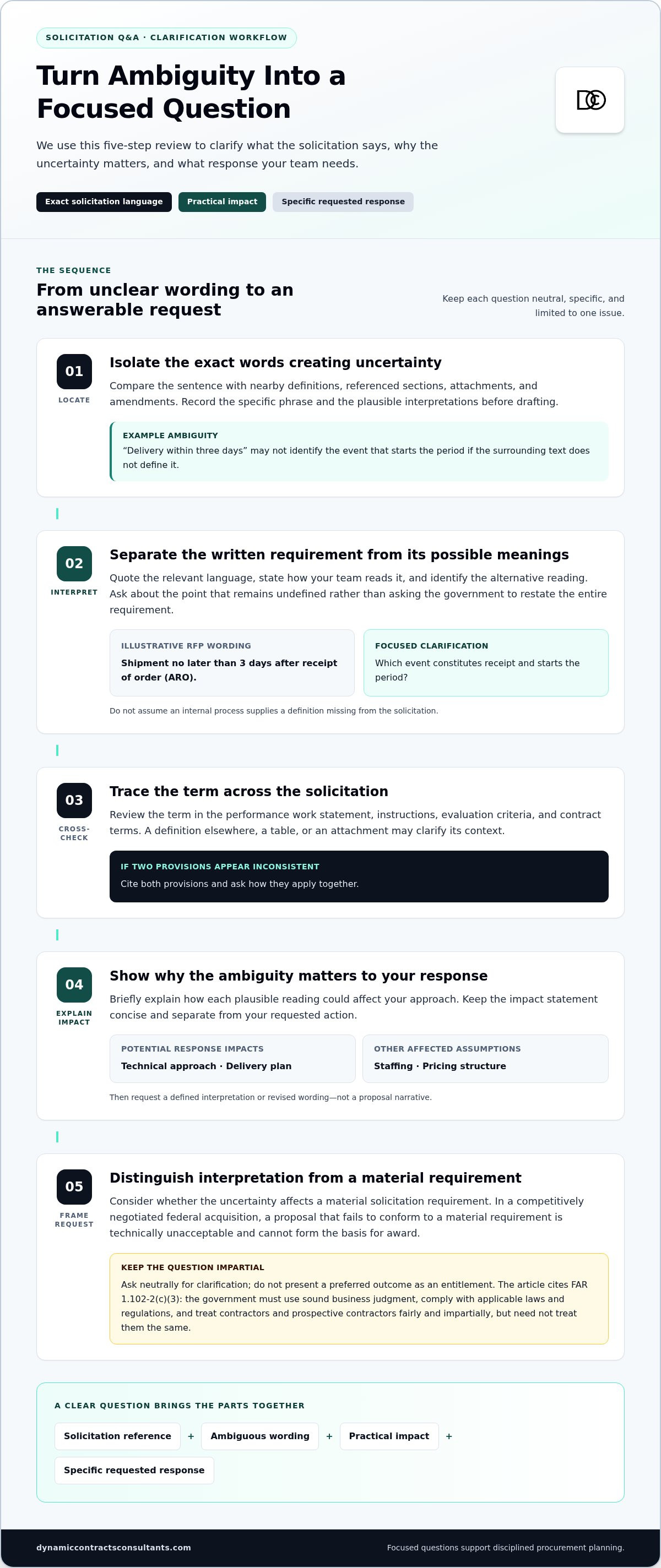
- First, isolate the exact words creating uncertainty. Compare the sentence with nearby definitions, referenced sections, attachments, and amendments. For example, “delivery within three days” may leave the starting point unclear if the surrounding text does not define it. Record the plausible interpretations before drafting, so your question addresses a specific ambiguity rather than asking the government to restate an entire requirement.
- We separate the written requirement from each possible interpretation. Quote the relevant language, then explain how your team reads it and what alternative reading appears possible. In an illustrative RFP, the government requires shipment no later than 3 days after receipt of order (ARO). If the solicitation does not clarify which event constitutes receipt, we ask which event starts the period. We avoid assuming an internal process supplies a missing definition.
- Trace the disputed term across the solicitation before framing your question. A definition elsewhere may clarify its meaning, while a table or attachment may establish a different context. Compare the term in the performance work statement, instructions, evaluation criteria, and contract terms. If two provisions appear inconsistent, cite both and ask how they apply together. This review helps distinguish a genuine conflict from language clarified by context.
- Explain the practical effect of each plausible reading. Identify whether the difference changes your technical approach, delivery plan, staffing assumptions, or pricing structure, without turning the question into a proposal narrative. For a deadline tied to “receipt,” explain how competing starting events affect the schedule. Then request a defined interpretation or revised wording. A concise impact statement shows why the ambiguity matters to your response.
- We assess whether the uncertainty concerns interpretation or a material requirement. In a competitively negotiated federal acquisition, a proposal that fails to conform to a material solicitation requirement is technically unacceptable and cannot form the basis for award. FAR 1.102-2(c)(3) states that the U.S. government must use sound business judgment and comply with applicable laws and regulations when dealing with contractors and prospective contractors, treat them fairly and impartially, but need not treat them the same. We therefore ask neutrally for clarification, without presenting a preferred outcome as an entitlement.
Clarification can address timing as well as meaning. The page recommends clarifying when the fundraiser will follow up if a prospect defers a decision. A useful question identifies what is unresolved and asks about it directly, rather than assuming what a deferral means. In solicitation review, the same focus keeps a timing question narrow: ask what event or interval governs the next step when the wording leaves it unsettled.
A question can also expose an assumption without presenting it as fact. The post says people often clarify or correct a guess someone makes about their situation. Accordingly, frame competing interpretations as possibilities and invite a precise correction. This avoids treating an inference as an established requirement and keeps the response anchored to the language at issue.
Making a direct ask
A direct solicitation question identifies the decision you need from the government. To understand how to ask questions about a solicitation, make one specific request and check that the wording leaves little room for competing interpretations.
- Lead with the requested decision, not a lengthy explanation. State whether you seek confirmation, clarification, or a specific revision. For example: “Will the agency revise the delivery requirement from 3 days to 7 days after receipt of order (ARO)?” This wording identifies both the requested change and the relevant requirement. Put supporting context after the ask, so reviewers can quickly see what response you need.
- Make your proposed alternative precise. If you request a change, name the current condition and the replacement you propose. In the illustrative RFP example, the requirement is shipment no later than 3 days ARO, and the question proposes changing it to 7 days ARO. Avoid asking the government to “make the schedule more flexible.” That phrase supplies no measurable alternative and leaves the requested action open to interpretation.
- Connect the request to a specific performance consideration. Briefly explain how the requirement affects your approach, such as coordinating equipment, preparing materials, or aligning subcontractor activities. For instance, state that the proposed delivery period would allow the team to coordinate shipment with order processing. Avoid unsupported claims about industry standards or implying that the government must accept your preferred approach.
- Use a neutral question that permits a clear response. “Will the agency revise the requirement to 7 days ARO?” is more direct than “Could the agency consider whether a longer period might be appropriate?” The first asks for a defined action. If you need clarification rather than a change, ask which interpretation applies and identify the alternatives. Teams deciding how to ask questions about a solicitation should avoid combining a request for revised wording with unrelated questions about evaluation or invoicing.
- Review the question as if you were preparing the official answer. Remove background that does not affect the decision, define any abbreviation, and ensure the requested action appears explicitly. A focused draft might read: “Section [reference] requires shipment no later than 3 days ARO. Will the agency revise this period to 7 days ARO to allow coordination of order processing and shipment?” Confirm the reference and values match the solicitation before submitting.
These principles also apply when asking for support: a direct fundraising ask should name a specific gift amount and purpose. The page recommends making a fundraising ask as a clear question, then pausing to let the prospect respond. A clear question states the request, and the pause gives the prospect room to answer.
The post describes solicitation as asking directly for something and elicitation as creating conversational space for someone to share. When asking questions, it recommends curiosity, genuineness, and common ground. Distinguish the direct request from the conversational invitation: name what you are asking for when making the solicitation, and leave room for someone to share when eliciting a response.
Planning a Q&A submission schedule
Build your Q&A schedule from the solicitation’s stated deadline, submission method, and proposal milestones. Four review steps help your team submit questions in time and track any resulting changes.
-
Find the Question Submission Instructions
Start with the solicitation’s instructions and locate the section on questions, communications, or the procurement schedule. Record the question deadline, required format, submission method, and any file or subject-line rules. Compare those instructions with the solicitation cover page and amendments, where revised dates may appear. To find the submission instructions, search the solicitation and attachments for terms such as “questions” and “communications,” then follow the directions for that procurement.
-
Identify the Question Recipient
Use the recipient and submission channel named in the solicitation. This may be a contracting point of contact or a designated procurement portal; follow the specified route rather than sending questions to an unrelated agency employee. Send questions to the contact or destination identified in the communication instructions. If the document gives no process, review its contact details and procurement platform for an official channel, and keep a record of your submission.
-
Plan When to Submit Questions
Set an internal review date before the solicitation’s deadline, allowing time to consolidate input from contracts, technical, pricing, and compliance reviewers. Submit material questions as soon as the team can state the issue clearly, rather than waiting until the final day. A late question does not guarantee an answer. Can questions lead to an amendment or deadline change? Yes, the government may issue an amendment to revise solicitation terms or dates; a question alone does not change them. Track posted updates and adjust your proposal schedule when an amendment appears.
-
Find Out How Answers Are Shared
Check the solicitation for instructions on where responses and amendments will appear. Government solicitation Q&A sections are almost always posted publicly for competitors to see. Answers are commonly made available through the stated procurement channel or solicitation posting, so monitor that source for responses and updates. If the solicitation gives no separate answer process, use its official posting channel and communication instructions to follow updates. Keep each response with the related solicitation reference, then assess whether it affects your proposal assumptions or schedule.
Raising terms and conditions or contract clauses
Review contract terms for language that could affect performance, compliance, or your proposed approach. Use these steps to frame clause questions around the specific interpretation or change you need.
- Identify the clause or term and its location before describing the concern. Record the clause number, section, and relevant sentence, then compare it with related solicitation language. For example, a transition requirement may affect a separate certification deadline. Cite both provisions if their interaction creates uncertainty. This helps the contracting office assess the issue in context, rather than treating a broad objection as a request to review the entire contract.
- State whether you need an interpretation, confirmation, or revision. Keep those requests distinct. If a term appears to require certification before transition completion, ask what timing the government intends. An illustrative solicitation question proposes allowing contractors to become FEDRAMP certified within 60 days after award and before the end of the transition period. Frame any similar request with the exact milestone and timing at issue.
- Explain the operational effect without presenting your preferred interpretation as fact. Identify what the term changes about your implementation sequence, staffing, subcontractor coordination, or compliance planning. For instance, distinguish a requirement completed before award from one completed during transition. Then ask whether the solicitation reflects the intended sequence. A concise impact statement gives context while keeping the requested government action clear.
- Raise proposed alternatives carefully when specifications restrict acceptable materials. If a federal solicitation does not permit alternative materials, approving one would change or depart from the solicitation requirements. The solicitation would need to be amended so all bidders or quoters can compete on an equal basis. Ask whether the government will consider revising the requirement rather than assuming an individual response can waive it.
- Before finalizing the question, assess whether the answer could affect your proposal or contract administration. Note the affected deliverable, clause, or compliance obligation, and ask for a response that can guide a consistent approach. Avoid combining separate issues, such as liability language and a technical specification, in one question. If the resulting terms require post-award coordination, structured contract administration and flow-down clause management can help translate obligations into controlled performance processes.
- Track the response against the solicitation version your proposal team used. If the government changes a term through an amendment, evaluate the revised text and update affected assumptions, commitments, and compliance records. A Q&A response and a formal amendment may have different effects, so distinguish the answer from revised solicitation language. Preserve the clause reference and related response together in the procurement record.
Dynamic Contracts Consultants: Proposal Writing
Dynamic Contracts Consultants LLC provides Proposal Writing to help government contractors turn solicitation requirements and Q&A responses into a clear, compliant submission. Our work can help align your response with the solicitation’s instructions, evaluation criteria, and clarifications while keeping technical and management content consistent.
Consider proposal support when your team needs to incorporate amendments, resolve competing interpretations across draft sections, or coordinate specialized input into one cohesive response. We also provide DCAA Compliance Consulting and Capture Management to address distinct needs in government contracting and acquisition strategy.
For help aligning your proposal with solicitation requirements, contact Dynamic Contracts Consultants LLC or visit dynamiccontractsconsultants.com.
Turn Clarification Into a Stronger Pursuit
Clear questions do more than resolve uncertainty. They help your team make informed bid decisions, align its response with the solicitation, and carry clarified requirements into contract planning. Knowing how to ask questions about a solicitation is part of disciplined pursuit preparation, not merely an administrative task.
When you need support developing a compliant response, Dynamic Contracts Consultants LLC offers Proposal Writing. Its Grant Writing and DCAA Compliance Consulting services address other funding and compliance needs, distinct from proposal development. Choose support according to the work your organization needs to advance, whether strengthening a submission or addressing a specific compliance challenge.
Contact Dynamic Contracts Consultants LLC to discuss support for your next government contracting pursuit. A deliberate next step can help your team move forward with greater clarity and focus.
Frequently Asked Questions
What is the deadline for asking questions about a solicitation?
The solicitation sets the deadline, so no single date applies to every procurement. Check the procurement schedule and any amendments, then plan backward from the stated cutoff. For example, set an internal review milestone before the deadline to leave time to resolve disagreements or consolidate specialist input. A question submitted after the cutoff may not receive an answer, so do not make a late response part of your proposal plan.
How should I format and submit solicitation questions?
Follow the solicitation’s required format and submission channel, and make each entry easy to process. A practical format includes a question identifier, the relevant reference, the issue, and the response requested. If a spreadsheet is required, use its fields rather than substituting an email or attachment. Before sending, remove confidential business details and confirm that each question is complete, readable, and assigned to the correct solicitation.
Have a question this article didn’t answer?
Talk it through with a certified contracting professional. The first 30 minutes are free.