
Master navigating the federal procurement process with our 2026 lifecycle guide. Optimize bids, ensure strategic compliance, and drive scalable growth today.
A bid deadline is rarely where federal procurement success is decided. Earlier choices, from assessing an opportunity to interpreting solicitation requirements and confirming delivery capacity, shape whether a bid is viable and whether performance can remain compliant. For your team navigating the federal procurement process, understanding how these decisions connect is essential. Acquisition terminology and handoffs between teams can make the full lifecycle difficult to manage.
That complexity is understandable. Opportunity research, proposal development, compliance, and contract administration each demand focused attention. Treating them as isolated tasks, however, can leave requirements unaddressed or delivery plans misaligned. We take a lifecycle view, connecting each stage to the next so decision points are clearer and your organization can plan with greater discipline.
In this guide, we explain the purpose of each key stage and share a practical framework for evaluating opportunities, organizing solicitation requirements, and preparing for performance. We also outline where practitioner-led expertise and AI-assisted support can help with complex acquisition and compliance work. The goal is to help you make informed decisions, coordinate effectively, and understand responsibilities from planning through post-award administration.
Key Takeaways
- Approach navigating the federal procurement process as a connected lifecycle, from preparation and opportunity pursuit through performance and closeout.
- Assess mission fit, solicitation requirements, organizational capacity, timing, and strategic value before committing resources to a bid.
- Use market research to clarify agency needs and the competitive landscape, then map each solicitation requirement to evidence and an accountable owner.
- Treat award as the start of performance responsibilities: understand the awarded terms, assign ownership, track deliverables, and retain records.
- Connect acquisition planning, proposal development, and compliance with Practitioner‑Led Consulting and FARify.ai’s Human + AI Delivery Model.
What navigating the federal procurement process involves
Federal procurement is the structured process an agency uses to acquire goods and services, from identifying a need and planning a purchase to selecting a contractor and administering the resulting contract. For a contractor, navigating the federal procurement process means managing a connected set of decisions: preparing the organization, assessing opportunities, developing a response, transitioning into performance if awarded, and completing closeout responsibilities.
These stages are related, but requirements and accountable parties change as the procurement advances. Early in the process, a company may focus on understanding agency needs and its own readiness. After award, attention shifts to contract terms, deliverables, records, and performance. The broader Government procurement in the United States context includes federal, state, and local purchasing, while this guide focuses on the federal contractor’s lifecycle.
The following video offers an additional overview of the process:
How the FAR fits into federal acquisition
The Federal Acquisition Regulation (FAR) is the primary framework for federal executive agency acquisition. It establishes government-wide acquisition rules, while agency supplements may add requirements for particular agencies or procurements. For defense acquisitions, the Defense Federal Acquisition Regulation Supplement (DFARS) supplements the FAR when applicable. Which provisions apply depends on the acquisition and its documents, so use current regulatory text and the solicitation rather than relying on a general overview. This information is educational, not legal advice or a substitute for reviewing solicitation requirements.
The solicitation translates the acquisition into instructions for a specific competition. It may specify what to submit, how the agency will evaluate responses, and what conditions apply. Treat those instructions as the working basis for bid preparation, and verify current FAR or DFARS details against authoritative sources when they affect your response.
Who participates and when responsibilities shift
Agency acquisition teams define needs and support the procurement. The contracting officer manages the acquisition and has authority assigned to that role. Prime contractors submit offers and, if selected, take responsibility for contract performance. Subcontractors support a prime under their agreements, with relevant requirements flowing through the prime. As the process advances, your team’s priorities shift from market awareness and bid decisions to accountable delivery and administration.
Federal procurement connects agency planning and competition to award, then carries those decisions into contract administration and performance. A practical lifecycle map makes the handoffs visible:
- Preparation: Understand organizational capabilities, agency needs, and the market.
- Opportunity pursuit: Assess fit, interpret the solicitation, and prepare a responsive offer.
- Award and transition: Review the awarded terms and assign internal ownership.
- Performance and administration: Track obligations, deliverables, communications, and records.
- Closeout: Complete applicable remaining responsibilities and organize contract records.
Each stage informs the next. Connecting planning, proposal development, and compliance helps your organization make decisions with the full procurement lifecycle in view.
How to assess opportunities before investing in a federal bid
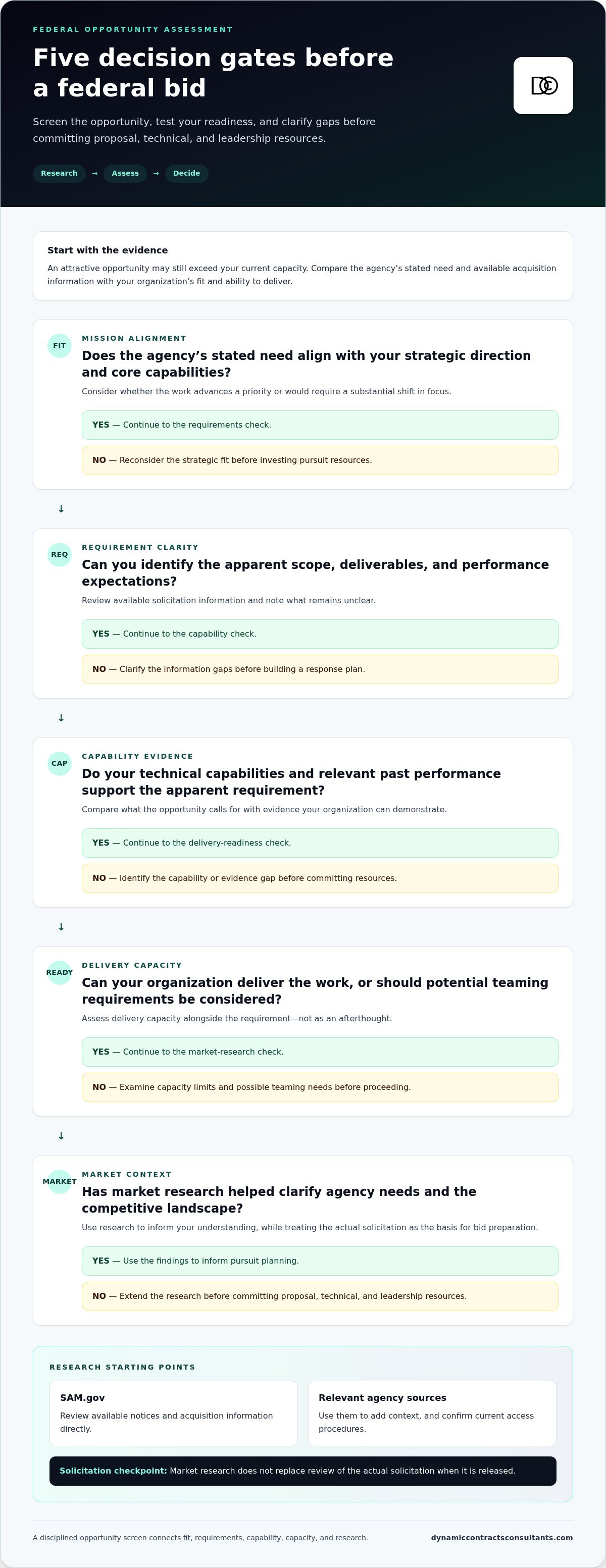
An opportunity can look attractive on paper and still exceed your organization’s current capacity. Before committing proposal, technical, and leadership resources, assess both the requirement and your ability to deliver it. A disciplined screen helps distinguish strategic fit from an appealing headline. Market research adds context about agency needs and the competitive landscape.
Use SAM.gov and relevant agency sources as research starting points. Review available notices and acquisition information directly, and confirm current access procedures. For broader pursuit planning, connect your findings to a government contract capture plan. Acquisition planning and bid/no-bid analysis can also give your team a structured way to evaluate the opportunity.
What to examine during opportunity and market research
Begin with the agency’s stated need, anticipated scope, and available solicitation information. Compare those details with your technical capabilities, relevant past performance evidence, delivery capacity, and potential teaming requirements. Market research can inform your understanding of agency priorities and the competitive environment, but it does not replace review of the actual solicitation when it is released.
- Mission fit: Determine whether the agency’s stated need aligns with your organization’s strategic direction and core capabilities. Consider whether the work advances a priority or would require a substantial shift in focus.
- Requirements: Identify the apparent scope, deliverables, performance expectations, and information gaps in the opportunity materials. Separate stated facts from assumptions that need further validation.
- Capacity: Evaluate whether your team can provide the required technical expertise, management attention, and delivery resources. Identify where a teaming arrangement may be needed and assess whether it is feasible.
- Timing: Compare known opportunity milestones with internal proposal workload and delivery commitments. A strong fit can still be impractical if your organization cannot prepare a credible response or support performance.
- Strategic value: Consider how the pursuit supports your longer-term positioning, customer relationships, and growth priorities. Weigh the potential value of the work against the resources and compliance effort it would require.
When a bid/no-bid decision is useful
A formal bid/no-bid review is useful before a pursuit consumes significant organizational effort. Compare strategic fit, compliance burden, resource commitment, and credible differentiation. Record assumptions, material gaps, and the rationale for the decision so leadership can understand what supports the go or no-go recommendation. Review the Federal Acquisition Regulation (FAR) as needed for regulatory context, while grounding each pursuit decision in the applicable acquisition information and solicitation.
Disciplined screening aligns pursuit effort with organizational capacity, so your team can focus on opportunities it can credibly pursue and perform. If the opportunity is complex or key assumptions remain unresolved, structured acquisition planning and bid/no-bid analysis can help clarify the decision. We provide tailored planning and capture support. Discuss your opportunity with our team.
How solicitation requirements shape a compliant federal response
A strong technical solution is only one part of a competitive federal response. Your proposal must also address what the solicitation asks for, follow its instructions, and satisfy applicable submission conditions. When navigating the federal procurement process, treat each as a separate review area. That makes it easier to catch a missing form, unsupported claim, or overlooked instruction before submission.
Start by distinguishing four elements: instructions explain how to prepare and submit; requirements describe the agency’s need; evaluation factors explain how responses will be assessed; and submission conditions specify required formats, representations, or other conditions. Their content and arrangement vary by solicitation, so use the documents for the specific opportunity as your working authority.
Turning solicitation language into a response plan
Review the complete solicitation package and amendments, then extract each instruction and requirement into a compliance matrix. RFPs, RFQs, and IFBs can structure a competition differently, while an RFI or Sources Sought notice generally gathers market information rather than requesting a proposal for award. Read each document according to its stated purpose and verify the instructions in the notice itself.
- Requirement: Capture the requested action, capability, deliverable, or information.
- Response location: Identify where the proposal will address it and what evidence supports the response.
- Owner and status: Assign an accountable lead, track completion, and flag gaps for resolution.
This traceability connects solicitation language to response content and evidence, helping writers and reviewers identify omissions or conflicting commitments. Where applicable, Section L commonly contains offeror instructions and Section M evaluation criteria. Check the solicitation directly rather than assuming its organization or directions.
Managing compliance, evaluation, and submission risk
Map each evaluation factor to specific, substantiated proposal content. A capability claim is more useful when the response makes its relevance clear and supports it with appropriate evidence. Our federal proposal review services can help assess whether your response is organized around the solicitation’s stated requirements and evaluation approach.
Control the working process as carefully as the content. Maintain a designated source version, establish review ownership, and route changes so edits in one section do not create inconsistencies elsewhere. Before submission, compare the assembled response with the solicitation’s current instructions, required components, format, and delivery method. Do not rely on an old checklist if an amendment or updated document changes the request.
Technical merit does not replace responsiveness. Evaluators need to find clear answers to the stated requirements in the requested form. Connect proposal development and capture support with disciplined requirement extraction and evidence review so your team can present its solution clearly while managing compliance and submission risk.
What changes after award: transition, compliance, and performance
An award changes the work, but it doesn’t conclude it. Your organization must move from proposal commitments to controlled delivery, with clear ownership of contract obligations, deliverables, records, and performance monitoring. Responsibilities depend on the awarded terms, applicable clauses, and circumstances of the contract, so use the executed agreement and related documents as the operational reference.
Award marks the start of contract performance and administration, not the end of procurement responsibility. Maintaining a deliberate link between what your team proposed and what it delivers helps reduce avoidable gaps during transition.
Building an accountable award transition
Begin by aligning the awarded contract with the proposal and the team’s implementation plans. Confirm which commitments became part of the agreement, identify responsible owners, and establish how the organization will track delivery and communicate internally. Transition activities should reflect the contract terms, the work, and the parties involved.
- Confirm the baseline: Organize the executed contract, incorporated documents, and relevant modifications so the delivery team works from current terms.
- Assign ownership: Identify leads for contract administration, technical delivery, compliance, finance, and subcontract coordination as applicable.
- Track performance: Set up a practical method to monitor deliverables, acceptance or review points, communications, and open actions based on contract requirements.
- Manage change: Route potential changes for appropriate review and document modifications through the applicable contract process. Keep subcontract administration aligned with relevant prime contract obligations and flow-down terms.
These controls translate commitments into operating responsibilities. For example, a proposal promise about a recurring deliverable needs a clear internal owner and a way to monitor its status against the contract’s terms. Our post-award contract administration support connects contract requirements with practical administration, tailored to the engagement.
Maintaining compliance and preparing for closeout
Compliance continues throughout performance. Maintain organized records of relevant decisions, deliverables, communications, and approvals, and monitor progress against the contract’s stated requirements. Determine retention obligations, reporting, and other compliance responsibilities from applicable contract clauses and requirements rather than assuming they are identical across awards.
Closeout planning also benefits from early attention. Track outstanding deliverables, unresolved actions, records, and other contract-specific matters so the team can address them as performance proceeds. The applicable process and timing depend on the contract and agency procedures. Use the governing documents rather than relying on a generic timeline.
We help organizations connect transition planning, compliance oversight, and administration so responsibilities remain visible beyond award. Discuss post-award contract administration support to strengthen ownership and oversight across your contract’s performance phase.
How Dynamic Contracts Consultants supports the procurement lifecycle
Navigating the federal procurement process requires decisions that remain connected across acquisition planning, opportunity pursuit, proposal preparation, compliance, and post-award administration. Dynamic Contracts Consultants LLC provides Practitioner‑Led Consulting tailored to these needs, helping your organization connect each stage rather than treating planning, response, and performance as isolated activities.
Our team includes Certified Government Contracting Professionals and is a Specialist in FAR, DFARS, and Government Contract Compliance. With 25+ Years of Experience, Nationwide Support, and a Human + AI Delivery Model, we combine practitioner judgment with AI-assisted support. Our stated experience includes $10M - $285M Growth.
Matching expert support to the stage of procurement
Early in the lifecycle, acquisition planning and market research can help frame requirements, develop procurement documents, and inform a disciplined bid/no-bid decision. As an opportunity advances, proposal development and compliance support help teams organize responses around the solicitation and maintain traceability between requirements, evidence, and accountable owners. Our government contracting advisory services can be tailored to the stage and complexity of your work.
After award, the focus shifts to administration, performance, and ongoing compliance. Connecting those responsibilities to earlier planning and proposal decisions supports continuity as commitments move into delivery. The right support depends on your organization’s acquisition objectives, response needs, and contract responsibilities.
Moving from a process overview to a practical next step
FARify.ai provides AI-assisted support for acquisition planning, proposal development, and post-award compliance. It is part of our Human + AI Delivery Model: the platform supports the work, while practitioners apply review and judgment. This approach can help organize complex information and support operational efficiency, but it does not replace solicitation review, establish compliance automatically, or guarantee an award.
We work with you to identify where added expertise or AI-assisted tools may fit your procurement lifecycle, whether your priority is planning, proposal readiness, or post-award administration. This tailored approach connects immediate requirements with longer-term compliance and delivery considerations.
Discuss your acquisition or contracting needs with our team through a FREE Initial 30‑minute consultation.
Make your next procurement decision deliberate
Use this guide as a basis for a repeatable internal decision practice. Before your next pursuit, identify who will evaluate fit, resolve requirement questions, approve proposal resources, and prepare for delivery if the work is awarded. Clear ownership makes navigating the federal procurement process more manageable and helps your organization carry sound decisions from opportunity assessment into execution.
That practice should evolve with your organization. As capabilities, priorities, or resources change, revisit how you assess opportunities and prepare to perform. A consistent framework can help leadership make informed choices about where to invest attention, while expert support can add perspective on complex acquisition and compliance needs.
Dynamic Contracts Consultants brings Practitioner‑Led Consulting and a Human + AI Delivery Model to federal acquisition work. Our experience, certified professionals, and Nationwide Support can help you identify practical next steps without implying a guaranteed award or outcome. Discuss your procurement priorities with our team and move forward with clarity and purpose.
Frequently Asked Questions
Is SAM.gov registration required to pursue federal contracts?
SAM.gov registration is commonly a foundational part of doing business directly with the federal government, but requirements can depend on the opportunity and your role. Before pursuing a specific notice, consult current official government instructions and the solicitation itself. Check that your entity information and registration status are accurate and active where required, and review any opportunity-specific eligibility conditions. This helps prevent reliance on outdated registration details.
What is the difference between the FAR and DFARS?
The Federal Acquisition Regulation (FAR) provides the central framework for federal acquisition, while DFARS supplements it for Department of Defense acquisitions. The provisions that apply depend on the agency, contract, and solicitation, so don’t assume two federal opportunities carry identical terms. For a particular bid, identify the clauses and instructions included in the solicitation, and review the awarded contract for the requirements that govern performance.
Can a small business participate in federal procurement as a subcontractor?
Yes. A small business can pursue federal work through a subcontracting relationship with a prime contractor. Before accepting a role, assess whether your team can meet the defined scope, schedule, and delivery commitments, and understand which requirements are included in the subcontract. Responsibilities vary with the agreement and its relationship to the prime contract. A clear understanding of the assigned work helps your organization plan resources and manage compliance obligations.
What is an Independent Government Cost Estimate?
An Independent Government Cost Estimate (IGCE) is an agency planning estimate associated with an acquisition. It is separate from a contractor’s proposed price and should not be treated as a bid target or a promise of contract value. If your team develops a proposal budget, build it from the solicitation’s requirements and your own cost basis rather than assuming an agency estimate defines the appropriate offer.
What is a Sources Sought notice in federal procurement?
A Sources Sought notice generally gathers information about potential suppliers and their capabilities to inform agency market research. It isn’t automatically a request for a priced offer or an indication that an award will follow. Respond according to the notice’s instructions, emphasizing relevant capabilities and experience clearly. For organizations navigating the federal procurement process, treating this as market research rather than a guaranteed opportunity helps set appropriate pursuit expectations.
Does receiving a federal contract award end the procurement process?
No. Award begins performance and administration. A practical handoff can start by comparing the awarded documents with the commitments and assumptions in the final proposal, then assigning owners to open tasks and recurring obligations. If a change arises, route it through the applicable contract process and retain the relevant records. Closeout preparation also benefits from tracking unresolved items during performance rather than waiting until delivery work is complete.
Can AI prepare federal procurement documents without human review?
AI-assisted tools can support document development and workflow efficiency, but a qualified human review remains important for accuracy, completeness, and alignment with current solicitation requirements. FARify.ai supports acquisition planning, proposal development, and post-award compliance. Within the Human + AI Delivery Model, practitioners review the work and apply judgment. AI assistance should not be treated as automatic compliance or a guarantee of an award.
Have a question this article didn’t answer?
Talk it through with a certified contracting professional. The first 30 minutes are free.