
Master teaming agreements for government contracts. Our guide shows how to align partner roles, ensure compliance, and scale your procurement lifecycle.
A teaming agreement can strengthen a federal pursuit and still leave partners unprepared to perform together after award. The value of teaming agreements for government contracts depends on more than aligning around a proposal: partners need clear roles, responsibilities, and a plan for moving from pursuit to performance.
The right partner can add capabilities, experience, or capacity to strengthen a bid. But unclear proposal roles, workshare, or partner contributions can create gaps before submission and friction after award. A prime-subcontractor team also differs from a joint venture, so selecting and documenting the right arrangement matters.
This guide explains the role of a teaming agreement in a federal pursuit, the terms and responsibilities to align before proposal submission, and how to manage the transition into performance. It also offers a practical process for evaluating partners and connecting agreement development with capture, proposal development, and post-award administration. We support contractors across these stages with coordinated, operational guidance.
Key Takeaways
- Use teaming agreements for government contracts to document how partners will coordinate the pursuit, contribute to the proposal, and prepare for potential performance.
- Align proposed roles, workshare, deliverables, and other commitments with the solicitation and each partner’s actual capabilities.
- Distinguish a prime-subcontractor arrangement from a joint venture before selecting a structure; they serve different purposes.
- Manage the relationship deliberately, from opportunity assessment and proposal reviews to a controlled post-award handoff.
- Connect agreement development with capture, proposal planning, and contract administration to support continuity across the procurement lifecycle.
Role of Teaming Agreements in Federal Pursuits
We use a teaming agreement as a written framework for prospective partners coordinating around a specific government-contract opportunity. It can document anticipated roles, planned contributions, proposal responsibilities, and information-sharing processes. This gives each partner a common reference as capture and proposal work advances. For broader context on the contracting environment, see this overview of a Government contract.
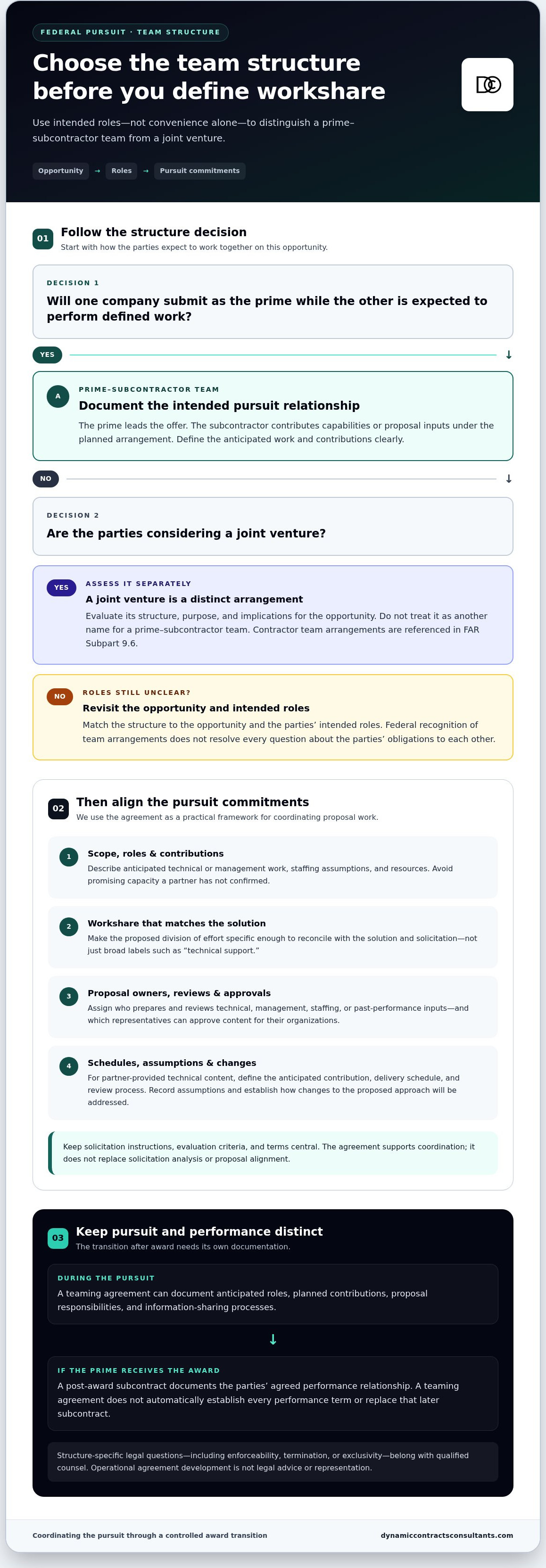
A teaming agreement coordinates prospective partners during a pursuit; a post-award subcontract documents the parties’ agreed performance relationship if the prime receives the award. Keeping these documents distinct helps you plan what the team commits to during the pursuit and what may require further agreement later. A teaming agreement can guide proposal coordination, but it doesn’t automatically establish every term needed for performance or replace a later subcontract.
How a teaming agreement fits into the procurement lifecycle
We place the agreement within the broader procurement lifecycle. During capture planning, you and prospective partners assess the opportunity and identify complementary capabilities. During proposal preparation, the team coordinates solution development, partner inputs, review schedules, and the representations each party is prepared to support. If the proposal is selected, the team can move from pursuit assumptions to performance documentation and administration through a controlled transition.
Document assumptions before committing proposal resources to surface gaps early. If a prospective subcontractor is expected to provide technical content, for example, define the anticipated contribution, delivery schedule, and review process instead of relying on informal expectations. The agreement can also establish how the team will address changes to its proposed approach as the response develops.
Keep the solicitation and applicable requirements central throughout the pursuit. Its instructions, evaluation criteria, and terms shape what your offer needs to demonstrate and how the team should coordinate. We treat the agreement as a management tool, not a substitute for analyzing the solicitation or aligning the proposal with its requirements.
Prime-subcontractor teams and joint ventures are not interchangeable
In a prime-subcontractor team, one company proposes as the prime contractor and anticipates subcontracting defined work to another company if it receives the award. The prime leads the offer, while the subcontractor contributes capabilities or proposal inputs under the planned arrangement. The agreement can document that intended relationship during the pursuit.
A joint venture is a distinct team arrangement referenced in FAR Subpart 9.6. Evaluate its structure, purpose, and implications for the opportunity separately rather than treating it as another name for a prime-subcontractor team. Federal recognition of contractor team arrangements does not, by itself, resolve every question about the parties’ obligations to one another.
When selecting a structure for teaming agreements for government contracts, match it to the opportunity and the parties’ intended roles rather than choosing for convenience alone. Direct structure-specific legal questions to qualified counsel. We support operational agreement development and proposal alignment, not legal advice or representation.
What to Address When Drafting a Government Contract Teaming Agreement
Start with the opportunity, not a generic template. Treat potential provisions as topics for deliberate negotiation rather than clauses that belong in every agreement. Each proposed commitment should reflect the solicitation, the team’s solution, and what each party can actually provide. FAR Subpart 9.6 - Contractor Team Arrangements provides the federal acquisition context; the agreement translates the parties’ intent into a practical pursuit framework.
For teaming agreements for government contracts, the operational test is whether the documented expectations can guide proposal work now and inform post-award administration later. Distinguish commitments the parties are making during the pursuit from matters that require a separate subcontract or further negotiation. Refer questions about enforceability, termination, exclusivity, or other legal effects to qualified counsel; operational planning is not a substitute for legal review.
Define scope, roles, and anticipated contributions
Describe the contribution each party expects to make to the proposed solution. Identify relevant technical or management work, staffing assumptions, and other resources without promising capacity the partner has not confirmed. Define workshare in terms that can be reconciled with the solution and solicitation, rather than relying on broad labels such as “technical support.”
Assign owners and decision points for proposal responsibilities. Specify who prepares technical, management, staffing, or past-performance inputs; who reviews them; and which representatives can approve content for their organizations. For example, a partner providing a technical approach might prepare an initial draft and conduct a technical review, while the prime integrates content and makes final proposal decisions. Clear assignments help prevent late gaps and conflicting versions.
Workshare descriptions should match the proposed division of effort. If the solution changes during development, establish a process for recording the revised assumption and assessing its effect on proposal content and anticipated performance. Where a commitment depends on a resource, approval, or capability, identify that dependency rather than presenting it as settled fact.
Set expectations for information, schedule, and contingencies
A workable agreement can establish how partners will exchange proposal inputs, manage sensitive information, and coordinate questions or revisions. Set pursuit milestones, review windows, and escalation paths that fit the solicitation schedule. The aim is to make owners, deadlines, and working-level decisions visible, not to add process for its own sake.
- Information: Identify the materials each party will provide and the agreed channels and handling expectations for proposal development.
- Schedule: Map contributions and review periods to the proposal calendar, including time to incorporate comments.
- Issues: Name working-level contacts and a path for resolving disagreements that could delay coordinated work.
Identify term, withdrawal, award, and subcontract-negotiation topics for counsel review. Operationally, the team should understand which pursuit activities depend on the agreement and what steps it anticipates if the opportunity changes or an award occurs. These points connect proposal planning to later subcontract administration without treating the pursuit document as a complete performance contract.
We align agreement development with capture and proposal workflows so responsibilities remain usable as the pursuit advances. To structure these operational elements, discuss your teaming agreement and proposal planning with Dynamic Contracts Consultants.
How to Compare Teaming Structures and Assess Partner Fit
Select a structure based on the work and the relationship your team intends to establish, not simply as a way to present a larger team. Choose the arrangement that matches how you will organize responsibility and how each participant will contribute to the proposed solution. This keeps your structure connected to the opportunity instead of treating it as a label added after partner selection.
Use the comparison below as an initial decision aid. Assess each option against the solicitation, applicable requirements, and any structure-specific questions for qualified counsel.
| Arrangement | Relationship purpose | Pursuit considerations |
|---|---|---|
| Prime-subcontractor team | One company leads the offer as prime and anticipates assigning defined work to a subcontractor if awarded. | Assess whether a prime-led model reflects your proposed responsibility allocation and whether the subcontractor’s contribution is clear and supportable. |
| Joint venture | Companies pursue an opportunity through a distinct joint arrangement rather than relying on a standard prime-subcontractor relationship. | Assess the proposed structure, each party’s role, and eligibility or compliance considerations relevant to your opportunity. |
The U.S. Small Business Administration’s Prime and Subcontracting overview provides context for the roles in a prime-subcontractor relationship. For either structure, compare your proposed allocation of responsibility with the work the government seeks and your team’s actual delivery model.
Match the structure to the work and intended roles
We start by mapping the opportunity’s requirements to the capabilities and responsibilities each party expects to carry. If one company will lead and manage the offer while another supplies a defined portion of the solution, a prime-subcontractor model may reflect that intent. Because a joint venture is distinct, we assess it separately. We also flag eligibility and compliance questions for review against the current solicitation and with qualified counsel.
Evaluate partner contribution and pursuit risk
Assess partner fit by looking beyond capability statements or existing relationships. Consider whether each company can substantiate its proposed contribution, provide useful proposal inputs on schedule, and support the anticipated delivery model. Identify who can approve submissions and resolve dependencies. If stated workshare assumptions diverge from proposed responsibilities, treat the mismatch as a risk to analyze before committing.
- Capability: Connect each partner’s experience and resources to specific elements of the proposed solution.
- Proposal readiness: Assess whether partners can provide relevant inputs on schedule and participate in reviews.
- Delivery alignment: Compare the proposed work allocation with who will manage and perform the work if awarded.
Use this assessment to identify gaps, not merely to rank partners. A partner may bring relevant technical experience but lack an identified role in proposal development or delivery planning. Clarify the expected contribution or reconsider whether the structure fits. Our capture and proposal work connects partner roles to the offer’s execution logic, supporting a coordinated pursuit.
How to Manage the Agreement from Capture Through Award Transition
A teaming agreement is most useful when the team manages it throughout the pursuit, rather than treating signature as the end of coordination. A repeatable workflow connects partner selection to capture strategy, proposal production, review, and, if the offer succeeds, transition planning. These steps help keep commitments visible as the opportunity develops.
- Assess the opportunity. Review the solicitation and capture strategy to determine whether partner capabilities support the requirements and planned solution. Identify work that may require partner contributions, the proposal schedule, and assumptions to resolve before committing resources.
- Select partners for defined contributions. Connect each prospective partner to specific work or proposal inputs. Consider relevant experience, capability, availability for the planned schedule, and ability to support the anticipated delivery model. A general association without a clear role can leave tasks unowned and assumptions unsupported.
- Document and assign commitments. Align the agreement with the pursuit plan, then translate its operational commitments into a responsibility matrix. For each input, record the owner, due date, reviewer, approval point, and status of unresolved assumptions. For example, a partner lead may draft a technical contribution, the prime may integrate it, and both may work to a shared review date tied to the proposal schedule.
- Coordinate proposal development and review. Use the matrix to track progress and surface dependencies early. Confirm that technical and management volumes reflect the contributions partners agreed to provide, and route changes to the appropriate decision-makers. If an input is late or the proposed approach shifts, document the impact and resolve ownership before finalizing affected content.
- Plan a controlled award transition. If an award occurs, compare proposal commitments and teaming assumptions with the work that must now be administered. Identify open commercial or operational matters for post-award discussion, assign transition owners, and preserve relevant decisions and inputs. Do not treat the teaming agreement as the final subcontract; subsequent documentation and administration need to account for the actual award and agreed performance relationship.
This handoff is a connection point in the procurement lifecycle, not an administrative afterthought. Maintaining consistency between what the team proposed and how it organizes performance supports clearer coordination. For a deeper look at the next phase, review post-award contract administration.
Our acquisition and contract support connects pursuit planning with proposal alignment and post-award administration. To discuss support across these stages, talk with Dynamic about acquisition and contract support.
How Dynamic Supports Teaming Agreements for Government Contracts
Effective teaming support connects the agreement to the work around it. Dynamic Contracts Consultants supports government contractors with teaming agreement development and negotiation, proposal alignment, capture management, and post-award contract administration. We organize the operational side of the relationship so proposed roles and contributions can carry through proposal development and into lifecycle planning.
We have served as a prime contractor on Department of Defense, Department of State, EPA, and NOAA contracts. That experience informs practical coordination across pursuit and performance planning, without implying that any particular teaming approach guarantees an award or a specific outcome.
Connect teaming strategy with proposal development
An agreement is most useful when its responsibilities appear in the proposal plan. We align partner contributions with the capture strategy, solicitation response, and assigned proposal tasks, so the team can see who provides each input, who reviews it, and how it supports the proposed solution. This can surface gaps before submission, such as a technical volume that relies on a contribution without an identified owner or review path.
We connect agreement commitments to proposal working documents, including compliance matrices, technical-volume planning, and submission-readiness reviews. A compliance matrix helps the team track solicitation requirements and proposal responses. Mapping partner inputs makes it easier to identify where supporting content is needed and who owns it. For another perspective on structured review, see our discussion of government proposal review services.
We provide consulting support for agreement development and negotiation, not legal representation or legal advice. Our focus is operational alignment, proposal coordination, and administration. Address questions about legal interpretation or the legal effect of specific terms with qualified counsel.
Coordinate acquisition and contract lifecycle support
Teaming arrangements sit within a broader procurement lifecycle. Our support connects acquisition planning and capture activities with agreement development, proposal execution, and post-award administration. This continuity helps teams carry forward responsibilities and assumptions established during a pursuit, while distinguishing planning documents from the agreements and processes used to administer performance after award.
For example, we can trace an identified partner contribution from the pursuit plan into proposal inputs and then into post-award coordination planning. The focus is maintaining a clear operational record of roles, deliverables, and open transition matters. Learn more about our contract lifecycle consulting services and their role in coordinated acquisition and contract support.
If your team is evaluating a partner, developing an agreement, or aligning teaming commitments with a federal proposal, discuss your teaming agreement requirements with Dynamic Contracts Consultants.
Build a Stronger Foundation for Your Next Pursuit
Make your teaming approach operational before proposal deadlines compress decisions. Use the opportunity’s requirements to test whether partner roles, planned contributions, and review processes align with the solution you intend to offer. Keep those decisions visible as the pursuit advances, so you can address unresolved assumptions deliberately rather than carrying them into performance planning.
Well-managed teaming agreements for government contracts can give your team a clearer basis for coordinating proposal work and preparing for the next phase. The agreement should support your strategy, while qualified counsel reviews legal questions about its terms.
We can connect agreement development with capture, proposal planning, and contract administration. Discuss your upcoming federal pursuit with our team and take a deliberate next step toward a more coordinated approach.
Frequently Asked Questions
Are teaming agreements required for government contracts?
No, you don’t need a teaming agreement for every federal pursuit. A solicitation may, however, direct offerors to identify team members, describe their roles, or disclose the relationship in the offer. Review the specific opportunity before deciding how to document your team. For teaming agreements for government contracts, start with the solicitation and applicable requirements rather than assuming one approach applies to every pursuit.
Can a teaming agreement guarantee that a subcontract will be awarded?
No. A teaming agreement can’t guarantee that the prime will receive an award or that the parties will execute a subcontract. Distinguish commitments made for the pursuit from terms that may require further negotiation. If you’re unsure about a provision’s intended legal effect or the consequences of nonperformance, have qualified counsel review it. Our operational guidance can help clarify expectations, but it can’t promise an award or future subcontract.
What happens if a teaming partner does not provide proposal inputs on time?
Use the team’s agreed coordination process and raise the delay promptly with the assigned partner contact. Record which input is missing, how it affects dependent proposal work, and any revised delivery date or decision. Your proposal lead can then assess whether to adjust the work sequence or response plan. Don’t silently replace missing material with unsupported content or assume the agreement provides a particular remedy.
Is a teaming agreement the same as a subcontract?
No. A teaming agreement generally addresses coordination between prospective partners during a pursuit, while a subcontract sets out a prime contractor’s relationship with a subcontractor for performance. Treat them as distinct documents and review later performance arrangements separately. If you receive an award, compare proposal commitments with the award and address outstanding performance terms through the appropriate process, with qualified counsel reviewing legal questions as needed.
Can a small business team with another contractor for a federal opportunity?
Yes, a small business can pursue an opportunity with another contractor, but the appropriate structure and its implications depend on the opportunity and the parties’ roles. For a set-aside, assess eligibility, proposed performance allocation, and applicable small-business requirements against current solicitation information. Don’t assume a partner’s status or capabilities automatically transfer to your company. Direct structure-specific legal questions to qualified counsel.
Should a teaming agreement include workshare commitments?
It can be useful to document anticipated workshare when the allocation relates to the proposed solution and each partner’s commitment. Describe the work in terms that can be compared with the delivery plan, rather than relying on a percentage detached from assigned tasks. For example, identify the work package your partner expects to support and the assumptions behind that allocation. Have qualified counsel review the legal effect of any commitment.
When should contractors discuss a teaming agreement?
Discuss a teaming agreement during capture, after you understand the opportunity and potential partner contributions but before proposal responsibilities or resource commitments become difficult to coordinate. This gives your team room to align its approach with the solicitation, assign proposal inputs, and identify open questions for review. As the solution or schedule changes, revisit working assumptions and address material differences before finalizing the offer.
Have a question this article didn’t answer?
Talk it through with a certified contracting professional. The first 30 minutes are free.