
Navigate government contracting for beginners with our 2026 guide. Learn how we help you assess solicitations, master compliance, and win federal contracts.
An open solicitation is not automatically a sound opportunity. For businesses exploring government contracting for beginners, the first strategic decision is often whether a pursuit fits their capabilities, experience, capacity, and risk tolerance, not how quickly they can submit a bid. Procurement terminology and formal requirements can make the process seem difficult to navigate, but a structured review helps you make each decision with clearer evidence.
This guide explains the government procurement lifecycle, the roles of key participants, and how to assess an opportunity before committing resources. We’ll also cover how to turn solicitation instructions into a proposal plan, what compliance considerations to carry into performance, and what changes after award. Use it to decide where to focus, prepare a disciplined bid, and identify the proposal, capture, or post-award support that can help your business pursue contract work responsibly.
Key Takeaways
- Understand how federal procurement moves from an agency need through solicitation, evaluation, and award, and use each solicitation’s instructions as the guide for your response.
- Use a documented bid/no-bid assessment to compare an opportunity’s scope with your capabilities, capacity, experience, and available resources.
- For government contracting for beginners, reading the full solicitation and building a compliance matrix helps organize requirements, supporting evidence, and ownership.
- Plan for performance from the outset by organizing contract documents, deliverables, milestones, communications, and assigned responsibilities after award.
What Government Contracting Means for a New Business
Government contracting is how businesses supply goods or services to public entities through procurement processes. A government customer is an agency or other public-sector organization acquiring products or services for public operations or programs. A commercial customer, by contrast, buys to meet private business objectives. Treat public procurement as its own business-to-government market, with distinct acquisition processes and opportunity-specific instructions.
This guide focuses primarily on U.S. federal contracting. State, local, and other public-sector markets have distinct purchasing processes, so an approach that suits a federal opportunity may not transfer directly. We frame government contracting for beginners as a connected business process: research the market, assess whether an opportunity fits, prepare a responsive submission, and plan for performance if awarded. For a general reference on the term, see What is a Government Contractor?
For a visual introduction to the subject, watch this overview:
How Government Buyers Acquire Products and Services
Agencies use different purchasing approaches, and an opportunity may be communicated through a solicitation or another procurement process. Do not assume every purchase follows the same path. The agency’s need and chosen acquisition approach shape the opportunity. When a solicitation is issued, its instructions explain how to respond, what information to provide, and how to submit it.
Market research helps agencies understand their needs and the marketplace, including available solutions and existing competition. Your own market research can help identify agency priorities and opportunities that align with your capabilities. Compare the work described in an opportunity with the services your team can deliver, the evidence you can provide, and the capacity you have available. That comparison can distinguish a genuine market fit from a notice that is simply attractive at first glance. Our acquisition planning support helps structure research and pursuit decisions.
Who Participates in a Government Contract
As you assess an opportunity, identify the organizations and businesses involved. Their roles affect how the work is procured, awarded, and delivered:
- The agency buyer represents the public organization’s need for a product or service.
- Contracting personnel manage procurement activities and communicate the process and requirements through opportunity documents.
- A prime contractor submits an offer directly to the government and, if selected, holds the contract with the agency.
- Subcontractors provide defined goods or services to a prime contractor as part of its delivery approach.
A subcontract may give your business a route to contribute to government work through a prime contractor, supporting a larger project while developing relevant delivery experience. Before pursuing that role, clarify the expected scope, your responsibilities, and how your work fits the prime’s delivery plan. Choose a position your team can credibly execute. The goal is not simply market entry, but a considered role in the procurement process that aligns with your capabilities and business priorities.
How the Federal Procurement Lifecycle Moves from Need to Award
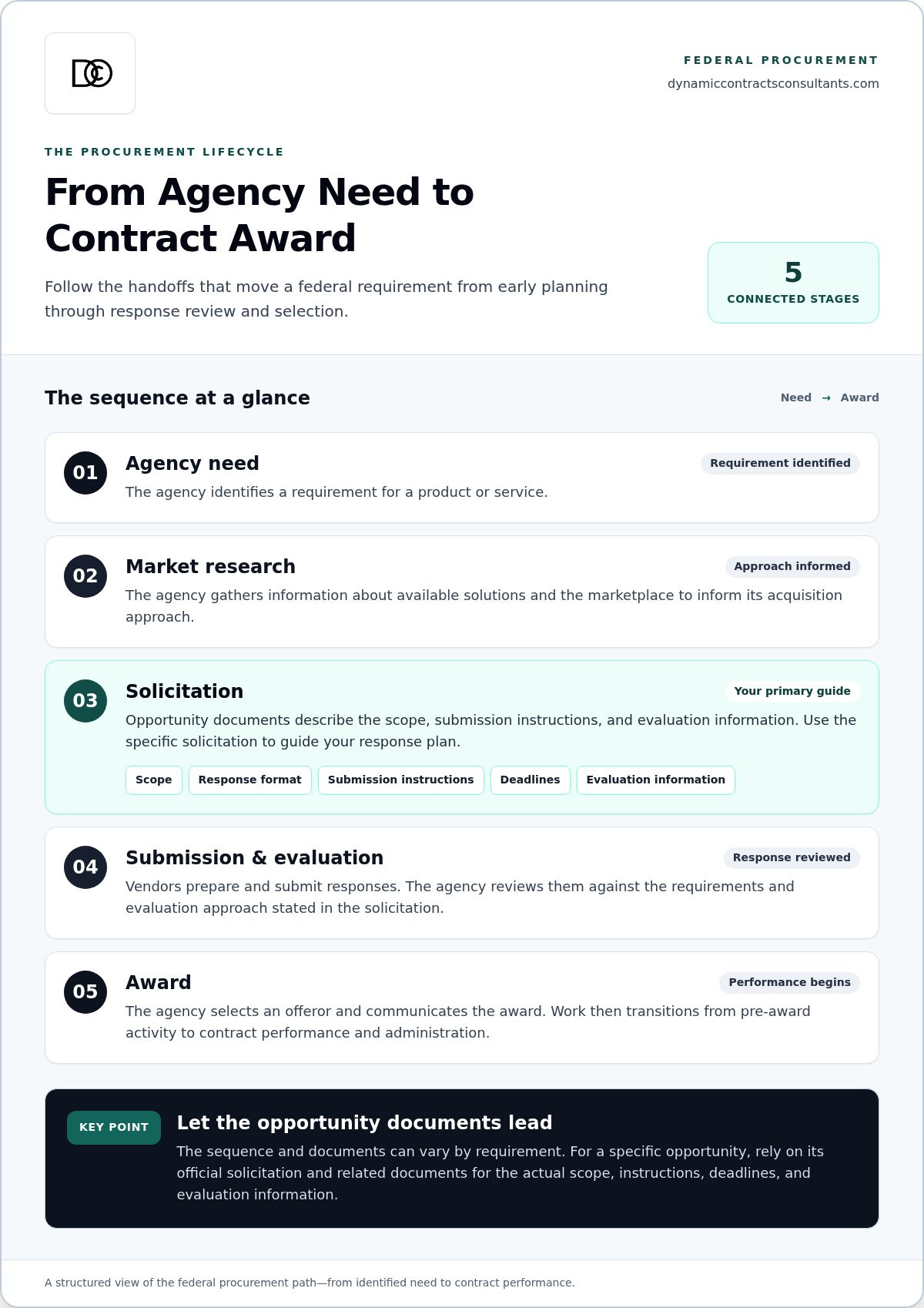
A federal procurement moves through connected stages, although the sequence and documents can vary by requirement. A useful way to review an opportunity is to follow the handoffs: an agency defines a need, develops its acquisition approach, invites responses, evaluates submissions, and makes an award. For a specific opportunity, the solicitation is your primary guide because it describes what the agency seeks and how vendors must respond.
Use this practical sequence to orient your review:
- Agency need: The agency identifies a requirement for a product or service.
- Market research: The agency gathers information about available solutions and the marketplace to inform its approach.
- Solicitation: The agency issues opportunity documents describing the scope, submission instructions, and evaluation information.
- Submission and evaluation: Vendors prepare and submit responses, which the agency reviews against the solicitation’s stated requirements.
- Award: The agency selects an offeror and communicates the award. The work then transitions from pre-award activity to contract performance and administration.
From Agency Need to Published Solicitation
Before a solicitation appears, an agency defines its need and conducts market research to better understand potential approaches and available suppliers. This stage can shape the procurement, but not every opportunity follows the same path. For your pursuit planning, use the published opportunity to examine the actual requirement instead of relying on assumptions about what the agency wants.
Use the official solicitation and related documents as your authoritative sources for opportunity details. They describe the scope, response format, submission instructions, deadlines, and evaluation information for that procurement. The Federal Acquisition Regulations and Procurement Lifecycle reference provides federal acquisition information, while the solicitation sets out the instructions for your specific opportunity. Build your response plan around those instructions rather than reusing a template from an unrelated bid.
From Submission Review to Contract Award
After submission, the agency evaluates responses against the requirements and evaluation approach stated in the solicitation. We help teams make requested information easy to locate and show how the offer addresses the stated need. A polished response that overlooks an instruction may not communicate its strengths effectively, which is why proposal development and compliance review should work together.
An award marks a transition, not the end of the procurement lifecycle. Your team moves from competing for work to performing and administering the contract. Documents, deliverables, milestones, communications, and assigned responsibilities become operational priorities. We connect proposal development support with disciplined planning across the contracting lifecycle.
Lifecycle summary: Pre-award work moves from agency need and market research through solicitation, response, and evaluation; award marks the handoff to contract performance and administration. If you need structured support assessing an opportunity or preparing for that handoff, discuss your contracting objectives with our team.
How Beginners Assess an Opportunity Before Deciding to Bid
A visible opportunity is not automatically a suitable one. You do not need to pursue every solicitation. Committing to a bid requires staff time, capacity, and evidence that your business can address the stated need. A disciplined bid/no-bid decision helps protect those resources and keeps attention on opportunities your team can credibly pursue.
Assess the work described in the solicitation, not just its apparent appeal. A prominent agency name or attractive contract value does not establish that the scope matches your capabilities, that the schedule is manageable, or that your business can support performance if selected. Separate what you know from what you still need to validate before approving the pursuit.
Match the Opportunity to Your Business Capabilities
Break the requirement into its major tasks, deliverables, and stated qualifications. Compare each item with services your business actually provides, resources available during the performance period, and relevant past performance you can substantiate. Distinguish demonstrated strengths from capabilities that are aspirational or dependent on outside support.
- Scope: Identify the core work and determine whether it aligns with your established expertise.
- Evidence: Map relevant experience, methods, and qualifications to what the solicitation requests.
- Capacity: Consider whether your team can prepare a response and carry out the work without undermining existing operations.
- Gaps: Identify missing skills, resources, or experience, then assess whether a qualified teaming or subcontracting approach could address them.
For example, if a requirement combines technical delivery with specialized support your business does not provide, assess whether a credible partner could fill that gap. Define the proposed roles and responsibilities before counting on a partnership to resolve a capability gap. Our capture management support helps structure opportunity decisions around business fit and pursuit readiness.
Use a Disciplined Bid-or-No-Bid Assessment
Apply consistent internal criteria rather than relying on enthusiasm or one attractive feature. A simple rating scale can make comparisons clearer, but scores should support informed judgment, not disguise uncertainty. Record the evidence behind each assessment and flag unanswered questions before authorizing proposal development.
- Strategic fit: Does the work support your business priorities and intended market position?
- Eligibility and requirements: Can you meet the solicitation’s stated conditions, based on documented information?
- Evidence and competition: Can you support your claims with relevant examples, and what does your research indicate about the competitive environment?
- Capacity and schedule: Can the team prepare a complete response on time and support the proposed work?
- Effort and risk: Is the proposal workload proportionate to the opportunity, and are significant assumptions or gaps unresolved?
Decision rule: Pursue when fit, readiness, and resources align. A documented government contract capture plan can connect market intelligence, stakeholder responsibilities, and pursuit decisions. If you need structured support evaluating an opportunity, discuss your bid-or-no-bid process with our team.
What to Prepare Before Submitting a First Government Proposal
A credible proposal begins with careful reading, not drafting. Review the complete solicitation and related documents before assigning sections or reusing prior material. Identify the required response structure, sections, deliverables, submission method, deadlines, and evaluation information. For beginners, this first pass helps prevent a common problem: a polished response that misses an instruction or leaves a requested item unaddressed.
Build a Requirement-to-Response Plan
Convert the solicitation into a working compliance matrix. For each requirement or instruction, record where the response will address it, who owns the supporting information, and whether the item is complete. This makes gaps visible early and gives proposal contributors a shared source of direction.
Depending on the solicitation, assign responsibility for technical, management, past-performance, and cost inputs. Track open questions separately and assign an owner to resolve each one. Before submission, review the matrix against the final response and verify that every requirement has a corresponding answer, evidence, and location.
- Requirement: Record the instruction or deliverable in clear, workable language.
- Response location: Identify the section, attachment, or form where the answer will appear.
- Evidence owner: Name the person responsible for supplying or validating the supporting material.
- Status and questions: Track progress, unresolved issues, and the final verification step.
The matrix is a control tool, not a substitute for reading the solicitation. If the agency issues updates or clarifications, add them to the working plan and assess whether they change response content or responsibilities.
Develop a Clear, Evidence-Based Proposal
Build each answer around the agency’s stated requirement and evaluation language. Explain the proposed approach in specific terms, then support claims with documented capabilities, relevant experience, and credible examples. Generic statements about being innovative, experienced, or highly qualified do not show how your team will perform the requested work. Avoid claims you cannot substantiate.
Proposal specialists can organize the response, align content with solicitation instructions, and coordinate inputs across contributors. Our proposal writing services support structured development and compliance alignment, using AI-driven proposal development and customized templates where they fit the work. Human review remains an important part of the process. The goal is to make your evidence and approach clear to evaluators, not to replace solicitation-specific answers with broad marketing language.
Before finalizing, conduct a requirement-by-requirement review, account for every attachment and deliverable, and confirm that the response follows the stated submission instructions. Discuss proposal preparation with our team to bring structure and focused expertise to your next bid.
How to Prepare for Performance After a Government Contract Award
An award marks the transition from proposal activity to contract performance and administration. The work is not complete when a selection is announced: your team must organize the awarded documents, understand deliverables and milestones, coordinate communications, and assign responsibility for ongoing tasks. For businesses new to government contracting, preparing these controls early helps turn the award into a manageable operating plan.
Establish Controls for Contract Performance
Start with the awarded contract documents and translate their terms and deliverables into a practical internal tracking process. Assign an owner to each task, record relevant dates and milestones, and establish how progress and questions will be communicated within your team. Keep source documents and supporting records organized so people responsible for oversight can find current information and understand the status of the work.
- Contract records: Maintain an organized set of the award documents and related correspondence.
- Deliverables and milestones: Track what is due, when it is due, and who is coordinating each item.
- Responsibilities: Clarify who manages performance activities, reviews progress, and communicates internally.
- Subcontract coordination: Identify relevant flow-down clauses and organize how applicable contract information is communicated to subcontractors.
These controls should reflect the awarded documents and the work itself. They are not a substitute for reviewing the contract, but they make responsibilities and records more visible as performance proceeds. Our post-award contract administration support helps organizations manage administration and compliance considerations after award, including flow-down clause management.
Coordinate Expert and Technology-Enabled Support
Proposal preparation, compliance planning, and contract administration are distinct activities, yet decisions made during the pursuit can affect how a team organizes performance. We support organizations across these stages, structuring proposal and acquisition work alongside post-award administration. This continuity helps your team carry relevant plans, responsibilities, and records from the pursuit into performance.
AI-driven automation can support document workflows. FARIFY is an AI-driven document generation platform with human-in-the-loop review. Generated material requires review and should not be treated as compliant solely because it was produced through automation. With accountable human oversight, technology can support more organized document processes while preserving the need to review contract-specific information carefully.
For a broader view of our government contracting services, consider how proposal, compliance, and administration support align with your organization’s needs. Discuss your government contracting objectives with our team to identify a structured next step.
Make Your Next Pursuit a Deliberate Step Forward
Government contracting for beginners is best approached as a long-term business capability, not a single bid. Each pursuit can sharpen your understanding of agency needs, reveal where your evidence is strong, and identify operational systems to strengthen before taking on more complex work. The objective is sustainable growth built on informed decisions and disciplined execution.
Our experience as a prime contractor includes work for the Department of Defense, Department of State, EPA, and NOAA. We bring that procurement perspective to proposal development, capture, compliance, and post-award administration. FARIFY adds AI-driven document generation with human-in-the-loop review, keeping technology within a process that values accountable judgment.
Your next step can be a focused assessment of your contracting priorities, current readiness, and the support needed to pursue work responsibly. Discuss your government contracting objectives with our team and move forward with a clearer, more deliberate strategy.
Frequently Asked Questions
Is government contracting only for large companies?
No. Organizations of different sizes may participate in public procurement. Whether a business can pursue a particular opportunity depends on the solicitation and any applicable program requirements, and small-business status by itself doesn’t ensure selection. Review the stated eligibility conditions before investing in a response, and distinguish eligibility to compete from the agency’s evaluation of competing offers. Meeting an eligibility condition is not a promise of award.
Can a small business win a government contract without federal past performance?
Possibly, depending on what the solicitation asks offerors to provide. An agency may request evidence of experience relevant to the work, and federal contract history is only one kind of experience. Commercial projects or subcontract work may be relevant context, but don’t assume they will substitute for a specific requested record. Describe your role, scope, and results accurately, and address any stated experience requirement directly rather than implying a federal contract history you don’t have.
What is the difference between a prime contractor and a subcontractor?
A prime contractor holds the direct contract relationship with the government for the awarded work; a subcontractor performs an agreed portion under a prime. For a subcontract opportunity, clarify the proposed scope, deliverables, points of contact, and how your work connects with the prime’s overall project. The applicable agreements and contract structure determine the parties’ arrangements, so don’t assume that roles, decision-making processes, or responsibilities are identical across projects.
How long does it take to win a first government contract?
There is no dependable standard timeframe. Timing varies with the opportunity, procurement process, business readiness, and proposal preparation, and portions of the process are outside your control. Rather than setting an assumed date for a first award, plan for a continuing market-entry effort: maintain visibility into relevant opportunities, learn from each pursuit, and prepare your internal processes to respond when a suitable solicitation appears. Avoid making one bid the sole measure of progress.
Do beginners need a GSA Schedule to pursue federal work?
No. A GSA Schedule is not a universal prerequisite for every federal opportunity. Whether a particular purchasing route applies depends on the solicitation and the agency’s approach. Read the opportunity documents for any stated vehicle or eligibility conditions, then consult current official guidance for the applicable process. Holding a schedule alone does not establish that a business qualifies for, or is a strong match for, every federal requirement.
Can a business pursue federal and state or local government contracts at the same time?
Yes, a business may pursue opportunities in more than one public-sector market. To manage parallel pursuits, keep separate records for each opportunity, including the buyer, source documents, deadlines, submission requirements, and internal decision owners. This helps prevent assumptions from one procurement from carrying over to another. Set priorities based on your business strategy and the time available for research, proposal development, and ongoing opportunity management.
What happens if a proposal misses a solicitation requirement?
An omission may affect how a submission is handled or evaluated, but the effect depends on the solicitation and applicable procurement rules. No specific outcome should be assumed without reviewing the opportunity and circumstances. Before submission, use a reviewer who was not responsible for drafting the relevant content to look for overlooked instructions, inconsistent statements, missing attachments, or mismatches between the final files and the solicitation. Professional proposal support can strengthen process discipline, but it cannot guarantee an award.
Have a question this article didn’t answer?
Talk it through with a certified contracting professional. The first 30 minutes are free.