
Master how to build a proposal compliance matrix for government RFPs. Track requirements, assign owners, eliminate gaps, and drive scalable compliance with us.
A technically strong proposal can still fall short if it misses an instruction: evaluators may assess compliance before considering the solution. Knowing how to build a proposal compliance matrix means more than compiling a checklist. It means creating a traceable system that connects each solicitation requirement to a source, a response, an owner, and a review status.
Dense instructions, attachments, and amendments can make requirements difficult to locate and interpret. Gaps between the solicitation and proposal content may surface only during a late review. A structured matrix helps your team maintain a complete record, assign responsibility, and monitor response development.
In this guide, we explain how to extract requirements in the solicitation’s exact language, record their sources, assign accountable owners, map response locations, and track completion and compliance risks. Our Practitioner‑Led Consulting and FARify.ai support requirement extraction and matrix creation through a Human + AI Delivery Model, with human review central to the process. You’ll learn how to use the matrix to guide development, structure reviews, and assess submission readiness.
Key Takeaways
- Learn how to build a proposal compliance matrix by capturing requirements and preserving precise references to their solicitation sources.
- Use core fields such as requirement, category, owner, and response location to make responsibilities and proposal coverage visible.
- Keep the matrix current as amendments, interpretations, and response assignments change.
- Use focused reviews and gap analysis to identify requirements that need attention before submission.
- Use FARify.ai to assist with requirement extraction and matrix creation, with practitioner review supporting sound proposal decisions.
What a Proposal Compliance Matrix Does in a Government RFP
A proposal compliance matrix links solicitation requirements to planned proposal responses and accountable owners. It creates a traceable path from the government’s instructions to the content your team intends to submit. At a glance, the team can see what must be addressed, where the response will appear, and who is responsible for developing it.
A matrix is a control mechanism, not a guarantee of compliance or award. It can reveal unassigned requirements, missing response locations, and incomplete work, but it cannot determine by itself whether an interpretation is correct or a response is persuasive. Requirement tracking is also distinct from capture strategy, which informs whether and how to pursue an opportunity, and proposal evaluation, which assesses the submitted response against the solicitation’s stated criteria.
The solicitation remains the governing source for required content, format, and submission instructions. Your matrix organizes those obligations for the proposal team; it does not replace the source language or authorize the team to change it. This distinction is central to how to build a proposal compliance matrix that supports strategic compliance without confusing internal planning with government instructions.
Which solicitation requirements belong in the matrix?
Include requirements that affect what the team must address, produce, format, or submit. Depending on the solicitation and your proposal team’s scope, these may include mandatory instructions, evaluation factors, requested technical or management content, required forms, and submission directions. Review the complete solicitation package, including referenced attachments and amendments, so the matrix reflects the documents that govern the response.
Preserve each item’s exact source reference, such as its section, subsection, attachment, or other precise identifier. Keep explicit solicitation requirements distinct from internal planning notes. For example, put a stated instruction in the requirement field, and put a proposed outline location or drafting reminder in a separate planning field. This separation helps the team trace decisions to the source instead of mistaking assumptions for solicitation language.
How does a matrix support proposal control?
Traceability connects three practical elements: the source requirement, the planned response, and the proposal location where that response will appear. This resembles the broader concept described in a Requirements traceability matrix, which links requirements to corresponding outputs. In an RFP response, these links help the team check that each item has a destination and that the draft addresses the instruction it is meant to answer.
Assigning an accountable owner makes coordination explicit. A technical lead may develop a solution response, while a management contributor prepares staffing or oversight content. The matrix gives each contributor a defined responsibility and proposal leadership a shared view of response development. Ownership supports coordination; it does not transfer responsibility for interpreting the solicitation away from the team.
Use the matrix to structure reviews, identify gaps, and direct attention to unresolved items. Human review of the solicitation remains essential, particularly when instructions are ambiguous or depend on context elsewhere in the package. The discipline of tracking obligations also supports post-award contract administration, addressed in our post-award compliance work, though proposal requirements and contract obligations are not interchangeable.
How to Extract and Organize Requirements from the Solicitation
Accurate extraction starts with the solicitation, not a generic checklist or assumptions about what an RFP usually requires. Review the complete package and amendments before finalizing your requirement set. For solicitations using negotiated procedures, Federal Acquisition Regulation (FAR) Subpart 15.2 provides relevant context, but the specific solicitation and its incorporated documents remain the working sources for your matrix. A disciplined process for how to build a proposal compliance matrix preserves that source trail as requirements move into response planning.
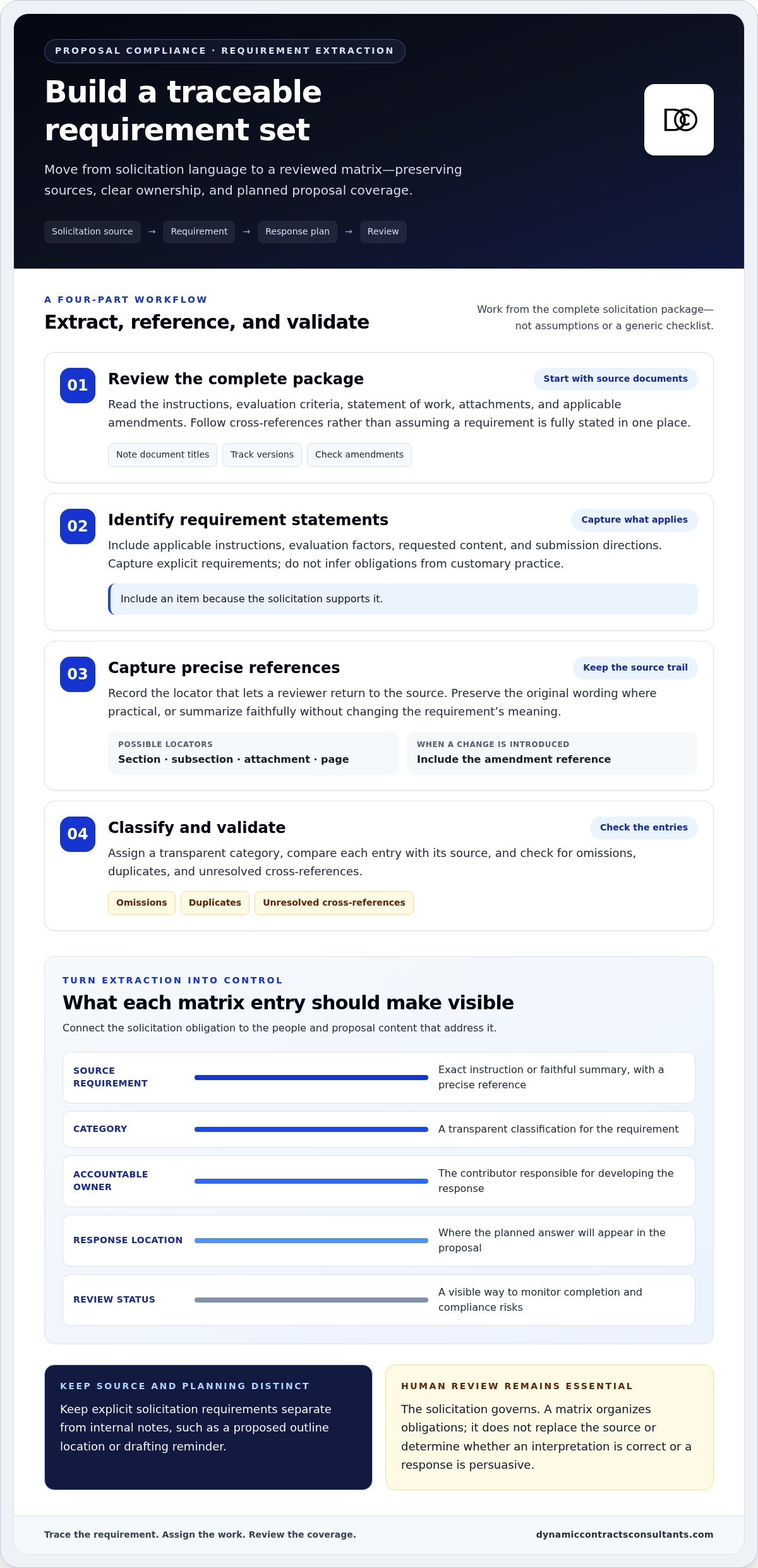
- Review the solicitation package. Read the instructions, evaluation criteria, statement of work, attachments, and applicable amendments. Note document titles and versions so the team can distinguish current source material from superseded content. Follow references to other sections or attachments rather than assuming a requirement is fully stated where it first appears.
- Identify requirement statements. Capture instructions, evaluation factors, requested content, and submission directions that apply to your response. Look for explicit language, such as a required deliverable or a direction to describe a proposed approach. Do not infer obligations from customary practice; include an item because the solicitation supports it.
- Capture precise references. Record the section, subsection, attachment, page, or other locator that lets a reviewer return to the source. Include the amendment reference when an amendment introduces or changes an item. Preserve the original wording where practical, or write a faithful summary that does not narrow, expand, or alter the requirement’s meaning.
- Classify and validate. Assign a transparent category, then compare each entry with its source and check for omissions, duplicates, and unresolved cross-references. Validate the organized set against the full solicitation package, including applicable amendments, before assigning or monitoring response work.
How to identify and capture each requirement
Keep each requirement traceable to its original location, even when it points to another document or section. If one statement contains multiple obligations, split it into separate rows when the parts need different responses, owners, or review decisions. For example, an instruction might request both an explanation of an approach and supporting evidence. Track each response separately while retaining the shared source reference and relationship.
How to classify requirements without losing context
Use clear categories, such as submission instruction, evaluation criterion, or response content, and apply them consistently. When an item depends on another section, record the cross-reference without replacing its original source location. Keep solicitation language separate from team interpretation and response planning, using distinct fields or labels. This helps reviewers distinguish what the government stated from what the team intends to do.
Requirement extraction and validation can be demanding when source documents are extensive or interconnected. Our practitioner-led proposal support helps translate solicitation language into a traceable response plan. Discuss your proposal requirements with our team.
What to Include in a Proposal Compliance Matrix
Start with fields that make each requirement traceable and help your team develop and review its response. The matrix should connect the solicitation source to an accountable contributor and a planned proposal location. Add columns only when they support a clear decision, coordination step, or review control. A matrix that is difficult to maintain can obscure the information it is meant to clarify.
The illustrative row below shows a basic structure. Replace the placeholders with details from your solicitation and workflow; this example is not a government requirement.
| Source reference | Requirement | Category | Owner | Response location |
|---|---|---|---|---|
| Solicitation section reference | Concise statement of the source requirement | Response content | Assigned contributor | Planned volume or section |
Which columns make requirements traceable?
Use source reference to identify the precise solicitation location and requirement to capture its language or a faithful summary. The category identifies the item type; owner names the contributor accountable for preparing the response; and response location points to its planned volume, section, or other destination. These fields help your team distinguish solicitation facts from internal assignments and make response coverage easier to examine.
Ownership and review serve different purposes. If a reviewer field will help your workflow, record who will examine the response, but do not imply that this person has approval authority unless your team’s process grants it. Add a response approach field when contributors need concise drafting direction, and label it as internal planning so it is not mistaken for solicitation language.
How should response status be recorded?
Use a small, consistent vocabulary, such as “not started,” “drafting,” “review,” and “complete.” Define what each label means in your workflow. For example, “complete” might mean the assigned draft exists, while a separate review or approval step remains. These labels help your team monitor progress; they are internal controls, not government-approved determinations that a response is compliant.
Use notes to capture unresolved interpretations, dependencies, or decisions that need follow-up. Keep each note concise and distinguish your team’s judgment from the underlying requirement. This gives you a practical way to identify an issue and route it through your established process without altering the source record.
Set columns according to solicitation complexity, contributor workflow, and review needs. For a straightforward response, core traceability fields may be sufficient. A more complex effort may benefit from status, reviewer, response approach, or notes, provided your team defines each field’s purpose and keeps it current. This helps make the matrix a useful review tool rather than a collection of fields no one uses.
How to Use the Matrix Through Drafting and Review
Once requirements and owners are established, treat the matrix as a working control document, not a static record created at kickoff. Its value depends on whether it stays aligned with the current solicitation, team assignments, and proposal files. Set a clear update responsibility, such as having a proposal manager maintain the central matrix while requirement owners report changes that affect their responses.
Establish regular team checkpoints to review items that are overdue, blocked, or unassigned. Each checkpoint should produce a specific action: confirm the owner, revise the planned response location, resolve a dependency, or record the next step for an open interpretation. Consistent updates give proposal leadership a reliable view of progress instead of a status snapshot that may already be stale.
How proposal teams maintain ownership and progress
Use an established process to record changes when amendments affect requirements, the team adopts a different interpretation, or response assignments shift. Preserve the original source reference and note what changed, why, and who is responsible for follow-up. If a response moves to another proposal section, update the matrix and verify that the new location appears in the draft structure. This change discipline keeps the relationship between requirement and response intact as the proposal evolves.
How to conduct a traceability review
During review, compare each matrix entry with the actual draft, not just the outline or writer’s status report. Confirm that the cited proposal location exists and addresses the full requirement. A section that mentions the right topic may still omit a requested element, supporting detail, or part of a compound instruction. Record the review disposition and any unresolved gap in the matrix, then assign a contributor and next action.
Reviewers should check traceability in both directions. Start with each requirement and locate its response, then scan proposal content for claims or sections that appear to answer requirements but have no corresponding matrix entry. This can reveal missed extraction or an outdated response map. Resolve findings through the assigned owners, and update status only when its defined condition has been met.
Before submission, reconcile the matrix against the current solicitation package, including applicable amendments, and the proposal files that will actually be submitted. Confirm that every tracked response location matches the final file structure and that production changes have not displaced, duplicated, or omitted content. The matrix supports this final review, but it does not replace examination of the complete submission against the solicitation’s instructions.
Our proposal review and compliance matrix support can help structure this control process. Request support for your proposal review to strengthen traceability from requirement through final draft.
How Practitioner-Led and AI-Assisted Support Can Strengthen Matrix Development
Specialist support can be valuable when a solicitation has extensive requirements, interconnected attachments, amendments, or response responsibilities spread across multiple contributors. Experienced proposal professionals can help extract and organize requirements, generate a traceable matrix, identify response gaps, and review draft content against solicitation instructions. The aim is stronger process control, not a substitute for your team’s accountability or interpretation of the solicitation.
Our Practitioner‑Led Consulting applies experienced analysis to the specific procurement and your response plan. Certified Government Contracting Professionals, including a Specialist in FAR, DFARS, and Government Contract Compliance, can help distinguish source requirements from internal assumptions, clarify ownership, and align response planning with the solicitation. This support complements our proposal writing services by connecting requirement control to proposal development.
Where practitioner-led proposal support adds value
Practitioners can examine how requirements relate across instructions, evaluation criteria, and work statements, then help your team resolve ambiguities through its established review process. Their role is especially useful when a requirement needs careful interpretation, an amendment affects existing assignments, or a gap review finds that a draft addresses a topic without answering every requested element. This judgment strengthens the matrix as an accountable response plan.
Practitioner review also helps keep the control process proportionate. Teams can focus on significant dependencies and open questions instead of adding fields or workflow steps that do not improve oversight. A disciplined approach to how to build a proposal compliance matrix connects source analysis, response ownership, and review decisions in a way that reflects the solicitation and your team’s working process.
How AI-assisted tools fit into matrix workflows
FARify.ai supports RFP requirement extraction and compliance matrix creation as part of proposal development. AI-driven automation can help organize source material and structure repeatable administrative work, supporting operational efficiency while leaving contextual judgment and final review to people. Our Human + AI Delivery Model combines technology-assisted workflow with practitioner oversight. AI supports the process, but it does not independently establish that a requirement has been interpreted correctly or fully answered.
For a controlled workflow, use AI-assisted outputs as working records: review extracted items against their sources, confirm references, and route uncertain interpretations to the appropriate proposal lead or subject-matter contributor. Then compare the matrix with the draft during review, recording gaps and follow-up actions. This approach applies scalable intelligence without treating an automated result as a compliance determination. Our approach to government proposal review services likewise emphasizes structured examination of proposal content.
When requirement extraction, matrix generation, or gap analysis is placing pressure on your workflow, we can align practitioner analysis and AI-assisted support with your proposal process. Consider our FREE Initial 30‑minute consultation to discuss how to strengthen matrix development and review control for your next response.
Strengthen the Control Behind Your Next Proposal
Your next opportunity is a chance to make requirement traceability a repeatable part of proposal operations, rather than a task completed once and set aside. Apply what you’ve learned about how to build a proposal compliance matrix to establish a process your team can sustain as proposals and workflows evolve.
We can help you assess how matrix development and review fit your organization’s proposal process, then identify practical ways to strengthen control and coordination. We provide Nationwide Support for organizations seeking disciplined proposal development.
Discuss your proposal compliance matrix needs and take a considered next step toward a more disciplined proposal workflow.
Frequently Asked Questions
What is a proposal compliance matrix?
A proposal compliance matrix is a structured record that helps a proposal team control how solicitation requirements are handled. Beyond listing instructions, it can serve as a shared reference for identifying unanswered items, coordinating contributors, and checking whether planned responses remain aligned as the draft changes. For example, when a response moves to a different volume, the matrix can point reviewers to its current location and preserve a clear record of the assignment.
How do you create a compliance matrix for an RFP?
To understand how to build a proposal compliance matrix, begin with the complete, current solicitation package and create a traceable entry for each applicable requirement. Include a precise source reference, then organize entries so the team can coordinate ownership and proposal locations. Validate the record against attachments and amendments, and confirm that cross-references have been considered. Before drafting advances, use a team review to identify unclear items, duplicate entries, and requirements with no accountable contributor.
What columns should a proposal compliance matrix include?
At minimum, use fields that let a reader identify the requirement, locate its source, and understand how the response is assigned and placed in the proposal. Depending on your workflow, add a response status, reviewer, or notes field to record open questions and review actions. Avoid columns that no one maintains or uses. A concise matrix is more useful when each field has a defined purpose and supports a specific control decision.
Should a compliance matrix be submitted with a proposal?
Submit a compliance matrix only when the solicitation’s instructions require it as part of the offer or submission package. Otherwise, it can remain an internal proposal-management document used to coordinate development and review. Before submission, check the solicitation’s required deliverables and file instructions rather than relying on general practice. If the matrix is required, verify its final content and format against those instructions, as you would for other requested proposal materials.
Who is responsible for maintaining the proposal compliance matrix?
A designated proposal manager or matrix custodian should coordinate the master record, while each assigned contributor provides timely updates about their response. This division keeps overall document control clear without making one person responsible for every technical answer. For example, a contributor can report a changed response location, while the custodian updates the central matrix and flags affected review assignments. The team should establish who records decisions and who resolves interpretation questions.
Can AI create a proposal compliance matrix?
AI can assist with extracting RFP requirements and generating a draft matrix, but the entries need review against the solicitation. FARify.ai supports requirement extraction and compliance matrix creation for proposal development. A human reviewer should validate source references, distinguish actual requirements from contextual material, and address ambiguity through the team’s review process. AI-driven assistance can support operational efficiency, but it should not be treated as an independent compliance determination or a substitute for accountable human judgment.
How often should a proposal compliance matrix be updated?
Update the matrix whenever a change could affect its accuracy or usefulness, rather than waiting for a scheduled review. Triggers include a solicitation amendment, a revised interpretation, a reassigned contributor, or a change to the proposal’s structure. Regular team checkpoints also help surface stalled work and unresolved questions. Before submission, reconcile the latest matrix with both the current solicitation and the proposal files being prepared, so the record reflects the actual response package.
Have a question this article didn’t answer?
Talk it through with a certified contracting professional. The first 30 minutes are free.