
Learn how to write a grant proposal for federal funding with measurable objectives, a compliant budget, and required materials that strengthen your application.
To understand how to write a grant proposal for federal funding, start with the funding opportunity’s instructions, then connect the project’s need, measurable objectives, activities, evaluation plan, and itemized budget. The budget must comply with the cost principles in 2 CFR Part 200, and every proposed cost should support an activity described in the narrative. A clear proposal shows reviewers what you plan to do, how you’ll measure progress, and why the requested resources are necessary.
For beginners, writing a grant proposal for federal funding can feel complex: a strong application must be persuasive and meet detailed program requirements. Sound project planning alone is not enough if the sections, budget, or supporting materials fail to follow the funding opportunity’s instructions.
This guide explains how to develop a focused proposal, set measurable objectives, prepare a justified budget, and avoid common application errors. It also covers the federal policies and submission requirements that shape the process, helping you build a clear, compliant application from planning through final review.
Key Takeaways
- Build an itemized budget that connects each requested cost to a planned activity and follows applicable federal cost principles.
- Translate broad project goals into measurable objectives, then identify how performance data will demonstrate progress.
- Make the summary clear and focused so reviewers can quickly understand the need, approach, and intended outcomes.
- Organize application materials in the sequence required by the funding opportunity, including all required forms and attachments.
- Account for federal registration and submission requirements early, since compliance issues can affect whether an application advances to review.
Developing a budget and budget justification
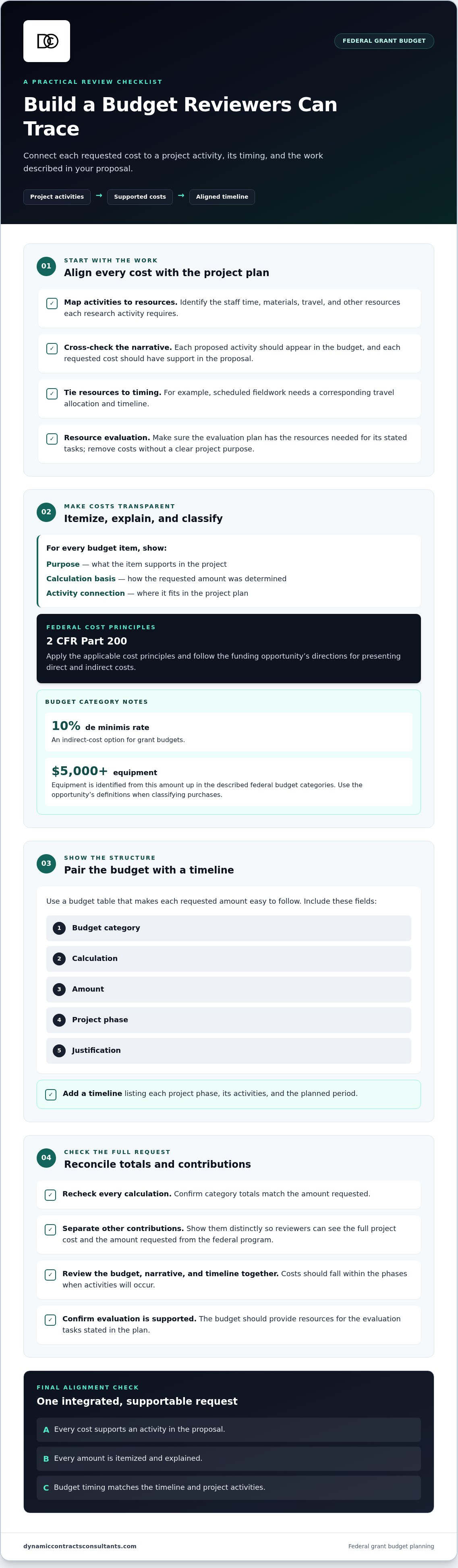
When planning how to write a grant proposal for federal funding, build the budget from the project’s activities rather than estimating a total first. A detailed budget format should connect resources, timing, evaluation, and the narrative. Federal grant budgets must comply with cost principles in 2 CFR Part 200.
-
Align the Budget With the Research Plan
Map each research activity to the staff time, materials, travel, or other resources it requires. Compare every budget line with the work plan and narrative: each proposed activity should appear in the budget, and each requested cost should be supported in the proposal. For example, scheduled fieldwork needs a corresponding travel allocation and timeline. Remove costs without a clear project purpose, and make sure evaluation activities have the resources required to carry them out.
-
Prepare a Transparent Project Budget
Itemize costs and explain each item’s purpose, calculation basis, and connection to project activities. Apply the cost principles in 2 CFR Part 200, and follow the funding opportunity’s directions for presenting direct and indirect costs. The 10% de minimis rate is an indirect-cost option for grant budgets. Equipment is identified as equipment from $5,000 up in the described federal budget categories. Use the opportunity’s definitions when classifying purchases, and explain assumptions clearly in the justification.
-
Use Sample Budget and Timeline Formats
Use a table with columns for budget category, calculation, amount, project phase, and justification. These figures illustrate how to reconcile a request, not standard funding levels. Pair the budget with a timeline that lists each phase, its activities, and the planned period.
- Reconcile every total before submission. Apply the same calculations to your figures and check that category totals match the amount requested. Show other contributions separately so reviewers can distinguish the full project cost from the amount requested from the federal program.
- Review the budget alongside the narrative and timeline as one integrated plan. A simple research project’s timeline can be summarized in a table to help reviewers assess its planning and feasibility. Confirm that costs fall within the phases when activities will occur and that the evaluation plan has resources for its stated tasks. This alignment is central to writing a grant proposal for federal funding with a clear, supportable request.
What common mistakes should I avoid when writing a grant application?
Prevent avoidable errors by treating the funding notice as the controlling document for your application. Use its criteria, section order, forms, and submission instructions to guide each step.
-
Review Application Guidance and Requirements
Read the funding notice and application guidance before drafting. Identify eligibility terms, review criteria, required sections, and submission instructions. Use the notice’s terminology consistently, distinguishing, for example, project activities from intended outcomes. Federal applications are usually checked against the instructions before assignment to a review panel. Reviewers assess proposals against the published criteria, and their comments may include section scores and summaries of strengths and weaknesses.
-
Organize Application Materials and Sections
Prepare a source file with project details, key personnel, methods, milestones, and supporting documents. Arrange the application in the order required by the funding notice. Keep each section focused on its purpose: place methodology in the relevant narrative section, not in an unrelated attachment. Use active language to identify who will perform each task, and spell out acronyms on first use in each narrative section.
-
Check Proposal Length and Required Forms
Compare each response with the notice’s page, word, or character limits before finalizing the written application. Portal fields can impose character limits, so draft directly against each stated constraint and preserve space for required information. Federal submissions may include mandatory SF-424 forms. A Unique Entity Identification (UEI) assigned through SAM.gov is a 12-character alphanumeric identifier; the federal government replaced the DUNS number with the UEI as its entity identifier.
-
Follow Submission Steps and Deadlines
Build a submission schedule from the deadline and sequence specified in the funding notice, allowing time to complete registrations, forms, attachments, and final package review. Submit through the method named in the notice; federal applicants risk rejection if an application arrives late or ignores instructions. There is no single deadline for every opportunity. Many federal grant programs use September 30 as a general deadline for notifying applicants of an award or rejection.
- Assess the completed application against the review criteria in the funding notice before submission. Confirm that the project information is consistent across the narrative, forms, and attachments, and that each requested document appears in the required order. Reviewers may include agency staff or volunteers with relevant professional expertise. For focused help organizing proposal materials, use application planning support.
Writing a cover letter and executive summary
Use the funding notice’s criteria to connect the documented need, project goals, and measurable objectives. Support the need statement with current data from sources such as the Census, a state agency, or a school district.
- Draft the need statement before the cover letter, using evidence that defines the problem and affected population. Identify the data source and explain how the evidence supports your proposed response. Distinguish the project’s general goal from its measurable objectives, which describe outcomes that can be tracked over time. For example, an objective can specify a target change and measurement period rather than simply promise improvement.
- Write the executive summary after the project plan, so it accurately reflects the full application. State the problem, the approach, the intended outcomes, and how the project will be evaluated. Keep the abstract within the funder’s format; a grant proposal abstract is almost always limited to one page. If the notice provides a required template or character limit, follow that over a general format.
- Prepare a cover letter only when the funding opportunity requests one. Use it to identify the applicant, project, and requested consideration. Keep its role distinct from the summary: the letter introduces the submission, while the executive summary explains the project. Check names, award titles, and other identifiers against the funding notice and application forms. Mismatches can make an otherwise clear submission harder to assess.
- Write the project narrative in a logical sequence: need, approach, activities, expected outcomes, and evaluation. Use each section to answer the relevant review criteria, with specific explanations of who will act and how progress will be assessed. NIH advises applicants to keep sentences clear, simple, and short; sentences of 20 words or less are easier to read. Define specialized terms before relying on them.
- Use AI and other writing tools to organize, check consistency, and edit, not as substitutes for project knowledge or evidence. Verify each factual statement against its source and ensure generated text reflects the actual plan. During grant writing, compare the final narrative with the notice’s criteria and required sections. Remove unsupported claims, repeated explanations, and wording that obscures the problem or proposed method.
Setting measurable goals and objectives
Translate your organization’s priorities into outcomes that fit the funding opportunity and can be assessed. On Grants.gov, search for opportunities and follow each notice’s instructions. The Grants.gov Introduction to Grants.gov Video Series covers registration, account creation, finding opportunities, and completing an application package.
-
Set Clear and Realistic Project Goals
Start with your organization’s existing programs and identify the problem the proposed project will address. Match the opportunity’s purpose to that need rather than reshaping your mission around an unrelated funding priority. State one broad goal, then define objectives that describe observable changes. A goal may describe improved access to services, while an objective specifies which group will experience a measurable change.
-
Define Measurable Outcomes and Performance Measures
Turn each objective into an indicator, data source, and review schedule. For example, a proposal could target increasing the number of children in school by 20% over 5 years. Explain how programmatic and financial data will validate progress, and assign responsibility for collecting and analyzing each measure. SMARTIE goals add inclusive and equitable considerations to specific, measurable, achievable, relevant, and time-bound planning.
- Check that each objective is realistic within the project period and available resources. Compare the proposed activities, staffing, and timeline with the outcome target. If a community program aims to improve access to services, define the population, service measure, and intended change. Avoid objectives such as “raise awareness” unless the application explains how awareness will be measured and what evidence will demonstrate progress.
- Align performance measures with the funding opportunity’s priorities and review criteria. Each measure should show whether the project is delivering its planned work and contributing to its stated outcome. Separate outputs, such as services delivered, from outcomes, such as measurable changes for participants. This helps reviewers understand what the program will do and how your organization will evaluate its effect.
- Build a feedback cycle into the evaluation approach. Identify who will review results, how often findings will inform project decisions, and how your organization will document adjustments. For instance, if participation falls below the project’s target, explain how staff will examine access barriers and revise outreach. Connect each adjustment to an objective so feedback supports accountable implementation without changing the project’s purpose.
- Review the final objectives against the narrative, work plan, and budget. Confirm that each measure has a corresponding activity, responsible role, and data source. Use consistent terms throughout the application and remove targets without a practical measurement method. This alignment gives reviewers a clear line from organizational need to planned action, measurable outcome, and evaluation.
Federal grant policies and regulations
Federal grant compliance begins with understanding the specific opportunity, its purpose, and the rules governing the proposed work. Treat policy requirements as design inputs, not final edits.
- Identify the governing requirements before shaping the project. Review the funding opportunity’s eligibility conditions, allowable activities, submission instructions, and award terms. Federal grant budgets must comply with the cost principles in 2 CFR Part 200. Use those principles alongside the notice’s specific instructions, then align the project plan, budget, and requested outcomes accordingly.
- Determine whether your organization meets the opportunity’s eligibility criteria. Some applications may require documentation such as a 501(c)(3) determination letter. Match each criterion to an organizational record or project detail, then resolve gaps before drafting. Do not assume that eligibility for one program establishes eligibility for another; each opportunity defines its own applicant requirements and purpose.
- Assess how the award structure affects project delivery and cash flow. Federal formula grants may provide a set amount per participant and reimburse grantees after services are delivered. Organizations therefore need funds available in advance. Model the timing of service delivery and reimbursement against planned expenses so the implementation schedule reflects the program’s funding mechanism.
- Build the evaluation plan around evidence expectations and program outcomes. Federal grant evaluation plans should align with OMB standards for evidence. Explain how the selected measures will assess progress toward the opportunity’s objectives, and connect data collection to planned activities. Identify who will collect and analyze the data, how it will be stored compliantly, and how findings will inform project decisions.
- Account for preliminary review stages and agency-specific processes. Some federal agencies assess a one- or two-page concept paper before an applicant prepares a formal proposal. The paper should state the problem, proposed approach, and fit with the opportunity’s purpose. Since some grants are offered only once for a given project, distinguish a one-time opportunity from programs with recurring application cycles.
- Plan for the review process described by the agency. Federal grant panels may include agency staff or volunteers with professional expertise related to the agency’s work. The National Science Foundation, for example, may use volunteer panels of scientists, mathematicians, or engineers. Use the published review criteria to explain the project’s significance, feasibility, and evidence plan in language suited to those reviewers.
Dynamic Contracts Consultants LLC: Proposal Writing
Dynamic Contracts Consultants LLC provides Proposal Writing and Grant Writing support to help you address complex federal requirements. We can help connect your project’s objectives, narrative, and supporting materials while incorporating strategic compliance considerations into proposal development.
When your team is also managing government-contract requirements across the procurement lifecycle, our DCAA Compliance Consulting addresses that distinct need. We can help you consider where structured proposal development and AI-driven automation may support operational efficiency and scalable intelligence, while keeping your project’s specific requirements central.
Discuss your proposal needs with us to identify a practical next step for your organization.
Build Your Next Funding Decision on a Clear Strategy
A federal funding pursuit can shape more than a single application. Use the planning process to clarify who owns key decisions, how project responsibilities fit your organization’s capacity, and what information your team will need to manage the work. These decisions can strengthen future program development, whether this opportunity proceeds or informs a later funding strategy.
Learning how to write a grant proposal for federal funding also means building a repeatable approach to complex submissions. Dynamic Contracts Consultants LLC offers Proposal Writing and Grant Writing for organizations seeking structured support with proposal development. Our DCAA Compliance Consulting addresses a separate need for businesses managing federal contracting requirements.
Consider where your team needs focused writing or compliance support, then set a practical next step. Contact Dynamic Contracts Consultants LLC to discuss your proposal needs and move forward with a well-defined plan.
Frequently Asked Questions
How do I write a simple grant proposal for beginners?
Start with one funding opportunity and organize your draft around its instructions. State the problem, explain who is affected, describe the activities, and identify the intended results. For example, a community program might describe a service gap, its planned response, and how participation will be tracked. Add the required forms and supporting documents, then review the complete package against the opportunity’s criteria before submission.
What is the difference between a grant proposal and a grant application?
A grant proposal makes the case for a project; a grant application is the complete submission package. The proposal generally explains the need, approach, objectives, evaluation, and budget justification. The application may also include agency forms, certifications, attachments, and required organizational information. A well-developed narrative can still be incomplete if a required form is missing or materials are submitted in the wrong order.
How do I tailor a grant application to a specific funder?
Use the funding notice to identify the funder’s priorities, eligibility criteria, review standards, and preferred terminology. Connect your project’s purpose to those priorities without changing it into something your organization cannot deliver. For example, if an opportunity emphasizes measurable community outcomes, explain which activities address the need and what evidence will show progress. Adapt the narrative and summary to the notice’s requirements.
What are the most important elements to include in a grant application?
Include every item required by the funding notice, and make sure the core application explains the need, project design, objectives, work plan, evaluation, and budget. Supporting materials may include forms, organizational records, or letters, depending on the opportunity. For a useful quality check, trace an objective through its planned activities, responsible staff, measurement method, and related budget request. This helps reviewers understand how the project will operate.
What is the most common reason grant proposals are rejected?
No single rejection reason applies to every federal opportunity. A preventable risk is failing to follow the funding notice, because applications are usually checked for compliance before panel review. A missing attachment, overlooked section, or ignored limit can prevent reviewers from fully assessing the project. Treat the notice as the controlling checklist, and review the final package against it before submission.
What are the main sections of a federal grant proposal?
Section names and order depend on the specific funding opportunity, so follow its instructions rather than a universal template. A proposal commonly explains the project’s need, goals and objectives, methods or activities, timeline, evaluation approach, and budget. The application package may also require forms and supporting documents. Before drafting, create a section map from the notice and assign each requirement to its designated part of the submission.
How do I check eligibility requirements for a federal grant?
Read the opportunity’s eligibility section and compare its applicant categories, organizational conditions, and project restrictions with your organization’s records. Check whether the opportunity limits participation by organization type or requires supporting documentation. For example, a program may request a 501(c)(3) determination letter from an eligible charitable organization. Record each criterion and the corresponding evidence, then resolve any mismatch before preparing the full application.
How do I prepare a federal grant budget and budget justification?
Build the budget from the activities and resources in your project plan, documenting the assumptions behind each requested cost. For personnel, specify the role and project responsibility; for other expenses, explain their planned use and timing. Reconcile category totals with the overall request and clarify other funding sources. Keep calculations traceable and give reviewers enough context to assess how each cost supports the proposed work.
Have a question this article didn’t answer?
Talk it through with a certified contracting professional. The first 30 minutes are free.