
Learn what is an incurred cost submission, how it reconciles provisional rates, what DCAA reviews, and how to meet deadlines with accurate cost schedules.
The billed indirect rate is provisional; the incurred cost submission reconciles it with the contractor’s actual indirect costs for a single fiscal year. For U.S. government contractors, understanding what an incurred cost submission is also means knowing when it applies: it is generally required when a contract includes FAR 52.216-7, Allowable Cost and Payment.
Reconciliation takes place after the fiscal year closes, when the contractor calculates final indirect rates and supports the costs claimed. For contracts subject to the applicable clause, the submission is due within six months after the fiscal year ends. Both accuracy and timeliness matter.
This guide explains what an incurred cost submission covers, how its schedules present direct and indirect costs, and how DCAA reviews the information. It also describes what may happen if a submission is late or inadequate, so you can understand the compliance work involved and the decisions that affect contract closeout.
Key Takeaways
- Understand how provisional indirect rates are reconciled with actual costs for the contractor’s fiscal year.
- Identify the six-month submission deadline and what to consider when requesting an extension before it expires.
- See how key schedules organize indirect rates, direct contract costs, subcontract information, and supporting details for DCAA review.
- Learn why reconciling claimed costs to accounting records and excluding unallowable expenses supports an adequate submission.
- Recognize how late or inadequate submissions can affect rate determinations and recoverable costs, and where DCAA compliance consulting may help.
What is Incurred Cost Submission?
To understand what an incurred cost submission is, we can start with its central purpose: reconciling provisional indirect costs billed during a contractor’s fiscal year with actual costs recorded after year-end. It generally applies to government contracts containing FAR 52.216-7, Allowable Cost and Payment. For you, that means connecting rate calculations, accounting records, and contract costs within a strategic compliance process.
Provisional and Actual Indirect Cost Reconciliation
An incurred cost submission reconciles the provisional indirect costs billed during your fiscal year with the actual indirect costs recorded after the year closes. It supports calculating final indirect rates, which replace provisional rates for that period. A provisional rate is an estimate used for billing; a final rate reflects actual costs and allocation bases. If actual pool spending differs from the estimate, the final rate may change the amount allocable to covered contracts. This reconciliation connects billing activity with year-end cost results and serves as an important procurement lifecycle control.
Direct and Indirect Cost Review
DCAA reviews direct and indirect costs to assess whether amounts charged to government contracts are supported and treated consistently. Direct costs are traced to a particular contract; indirect costs support multiple activities and are allocated through established pools and bases. Your records should link claimed totals to source transactions and show how shared costs were distributed. Prime contractors with cost-reimbursement or time-and-material contracts may need to prepare a submission. Subcontractors may also have requirements when relevant clauses flow down to them. Clear classifications help explain how each cost relates to contract performance.
Indirect Cost Pools and Rate Calculations
An indirect cost pool groups shared expenses, while an allocation base distributes those expenses across benefiting work. Schedules A through E present pool and base components; standard schedules A through F also cover indirect rates, fringe benefits where applicable, allocation bases, and facilities capital cost of money. The contractor relates pool costs to the applicable base, then applies the rate to eligible contract activity. FAR requires provisional billing rates to be as close as possible to final indirect cost rates. Consistent classifications and documented bases help your team support operational efficiency without obscuring how a rate was calculated.
Incurred Cost Submissions and Annual Rate Proposals
“Incurred cost submission,” “Incurred Cost Electronically” (ICE), “Incurred Cost Proposal” (ICP), and “Final Indirect Rate Proposal” are names used for this annual filing. They commonly refer to a package of schedules and supporting information, rather than only the proposed rates. Contractors generally need to submit when their contract includes FAR 52.216-7; prime contractors with cost-reimbursement or time-and-material work are among those affected. Schedule N certifies final indirect costs. Understanding the distinction helps you assess the full submission’s role in strategic compliance, rather than treating it as a standalone rate calculation.
Six-month submission deadline and extension requests
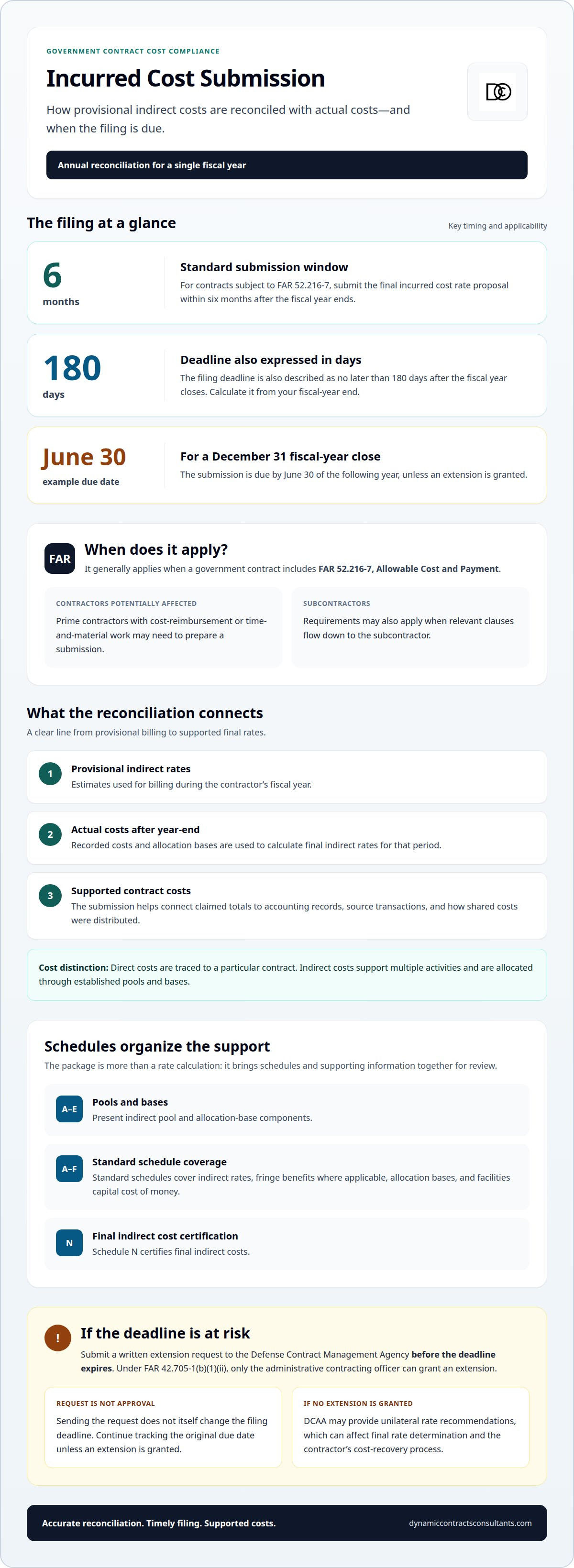
For contracts subject to the Allowable Cost and Payment clause, you must submit the final incurred cost rate proposal within six months after each fiscal year ends. The filing deadline is also described as no later than 180 days after the fiscal year closes. We use your fiscal-year end as the starting point for calculating the due date, rather than assuming every contractor follows a calendar year.
If your fiscal year ends on December 31, the submission is due by June 30 of the following year. For another fiscal-year end, calculate the deadline from that closing date. FAR 52.216-7 governs the Allowable Cost and Payment requirement, so we first connect your filing calendar to the clause in the applicable contract. That step helps your team identify which fiscal period and proposal the deadline concerns.
Plan the filing around your fiscal-year close rather than treating the final weeks as the only preparation period. Allow time to complete the rate proposal, assemble its schedules, and resolve differences in billing records. Internal milestones can flag incomplete reconciliations early enough to address them. They also give accounting and contracts personnel a shared view of outstanding tasks.
If you cannot meet the due date, submit a written extension request to the Defense Contract Management Agency before the deadline expires. Under FAR 42.705-1(b)(1)(ii), only the administrative contracting officer can grant an extension for submitting a final incurred cost rate proposal. We distinguish a request from an approval: sending the request does not itself change your filing deadline.
Begin planning for an extension as soon as your team identifies a likely delay. Document why the proposal cannot be completed on time, identify unresolved schedules or reconciliations, and submit the written request before the original due date. A clear explanation helps the contracting office assess the request. Continue tracking the original deadline unless and until the administrative contracting officer grants the extension.
For a December 31 fiscal-year close, June 30 remains the due date unless an extension is granted. If your request is not granted, the Defense Contract Audit Agency may provide unilateral rate recommendations. That outcome can affect how final rates are determined and the contractor’s cost-recovery process. We therefore treat deadline tracking and extension decisions as part of the same filing control.
If you need support aligning your contracting processes with filing requirements, you can discuss your contracting needs with our team.
How Does DCAA Use the ICS to Audit a Contractor’s Costs?
DCAA uses the schedules to assess whether reported contract costs are accurate, supported, and compliant with applicable requirements. Think of them as connected views of your fiscal-year cost information, each providing details auditors use to evaluate a different part of the submission.
ICS Schedules and Required Information
FAR 52.216-7(d)(2)(iii) lists the required incurred cost submission schedules. Together, they present indirect rates, cost pools, allocation bases, direct contract costs, and supporting information needed to evaluate your proposed final indirect cost rate. Keeping these details connected helps you show how reported amounts relate across contracts and records.
Schedules A through F cover indirect cost rates and pools, allocation bases, fringe benefits where applicable, and facilities capital cost of money. Schedules G through L provide reconciliations and contract-level details. Schedule G reconciles accounting records and claimed direct costs by major cost elements. Schedule L reconciles total payroll with IRS Form 941.
Schedule H summarizes direct and indirect costs by contract and contract type. Its H, H-1, and Summary H formats present direct contract costs at the funding or billing level. Direct non-labor costs are generally grouped into travel, materials, other direct costs, and subcontracts. These categories help you connect reported costs to contract activity.
Schedule J reports subcontract information for flexibly priced projects with subcontract costs. It records subcontract and prime contract numbers, contractor and subcontractor details, values, performance periods, fiscal-year incurred amounts, and award types. Schedules M through O report accounting or organizational changes, certify final indirect costs, and provide contract closing information.
Common Schedule Deficiencies
A schedule deficiency occurs when required information is missing, incomplete, or unreconciled against related records. DCAA checks for schedules identified in FAR 52.216-7(d)(2)(iii); omissions or unresolved differences could lead the agency to report your submission as inadequate.
For example, Schedule H direct-cost totals should reconcile to your accounting books. Schedule G should also connect claimed direct costs to accounting records by major cost elements. A mismatch can make it difficult for reviewers to trace an amount from the proposal to its source. Subcontract details in Schedule J should likewise match the contracts and incurred amounts being reported.
Another cited deficiency is failing to fully burden independent research and development and bid and proposal costs in Schedule B. These expenses affect indirect pools and rate calculations, so incomplete treatment can distort the supporting rate information. Review pool components and allocation bases across schedules as a connected set, rather than assessing each schedule in isolation.
DCAA auditors should assess a proposal upon receipt and complete the assessment within 60 days. That assessment evaluates adequacy, not necessarily final audit resolution. Clear schedule links, complete subcontract reporting, and reconciled totals help you present how the claimed costs were developed.
Reconciling direct costs to accounting records
Before submitting an incurred cost proposal, reconcile total claimed costs with the contractor’s trial balance. Schedule G connects claimed direct costs to accounting records by major cost elements, while Schedule H presents direct contract costs. The totals should agree with the books of record. If a contract ledger shows a different amount from Schedule H, identify the transaction causing the difference and resolve it before filing.
FAR 31.201-2(d) requires records and supporting documentation that demonstrate costs are allowable and allocable. FAR Part 31 also provides cost principles used to assess proposed charges. DCAA reviews whether costs charged to government contracts are allowable, allocable, reasonable, and consistently treated. These tests address distinct questions: whether the cost is permitted, whether it benefits the contract, whether its amount is reasonable, and whether the accounting treatment is applied consistently.
Review cost transactions before submission, not only after an auditor identifies a discrepancy. Trace each material direct cost from the accounting entry to its supporting record and contract assignment. For example, an invoice charged directly to a contract should be identifiable in the books and supported by documentation tied to that purchase. FAR 31.205 requires particular documentation for certain cost elements, so the evidence needed depends on the expense category.
- Entertainment: FAR Part 31 identifies entertainment as unallowable.
- Lobbying: Lobbying expenses must not be included in government contract billings or indirect cost pools.
- Fines and penalties: These are also identified as unallowable under FAR Part 31.
Exclude identified unallowable expenses from claimed costs and indirect pools. Keep the accounting treatment consistent: removing an unallowable item from a billing calculation should not obscure its original entry or its effect on related totals. Document adjustments between the ledger, trial balance, and submission schedules, including how each adjustment affects the amount claimed.
Provisional billing rates create another reconciliation point. Compare costs billed during the fiscal year with actual costs recorded for that period, then establish final claimed amounts from reconciled records. If billing details and accounting totals differ, determine whether timing, classification, or an adjustment explains the gap. DCAA reviews supporting evidence and compliance, not just whether the final figures balance. A clear trail from source record to contract claim shows how the amount was derived.
Consequences of late or inadequate submissions
A late or inadequate incurred cost submission can affect how final indirect rates are determined and how much a contractor recovers. The consequences depend on the contract clause, the submission’s status, and the costs claimed. Late and inadequate filings are distinct problems: one misses the required deadline, while the other lacks information needed to assess the proposal.
When a submission becomes six months delinquent, DCAA will recommend a decrement factor for the Contracting Officer to make a unilateral determination. A decrement factor reduces recoverable costs by applying a reduction to the contractor’s claimed amounts. This process can affect indirect cost settlement even while the contractor’s actual records remain under review, with potential financial consequences for contract closeout.
An inadequate proposal can cause a different kind of delay. DCAA checks whether required schedules are present and reconciled; missing or unreconciled schedules could lead the agency to report the submission as inadequate. For example, a mismatch between claimed indirect costs and supporting schedules may prevent reviewers from evaluating the proposed rates. The contractor is then left with unresolved questions about the proposal’s completeness and support for its claimed costs.
Cost treatment also matters. Penalties may apply when a contractor claims expressly unallowable indirect costs in a final indirect rate proposal, including an incurred cost proposal. According to the Federal Acquisition Regulation, FAR 42.709 addresses penalties for expressly unallowable costs. Separately, costs that cannot be supported or meet allowability requirements may be disallowed, reducing amounts available for recovery. These outcomes are not interchangeable: a decrement factor affects a unilateral rate determination, while a penalty concerns the claim of expressly unallowable costs.
Reduce avoidable submission risks by building controls into your annual processes. Before filing, reconcile each schedule to accounting records, confirm that required schedules are complete, and review indirect cost pools for unallowable items. Keep documentation explaining adjustments between amounts billed and actual fiscal-year costs. If a discrepancy remains, identify its source and correct or explain it in the submission rather than leaving the reviewer to infer the reason.
If you need an extension, request it in writing before the deadline and retain the administrative contracting officer’s decision. A pending request does not extend the due date. A filing calendar tied to the fiscal year, along with assigned responsibility for schedule reviews, can help your team address gaps earlier. These practices support accurate indirect rates and reduce the risk that a late or inadequate proposal delays final cost resolution.
Dynamic Contracts Consultants: Proposal Writing
Dynamic Contracts Consultants LLC provides DCAA & Cost Support for government contractors managing incurred cost submission requirements. This support can help when your team needs to assess submission adequacy, reconcile cost information, or strengthen compliance practices for contract administration. It complements your internal accounting and contracts teams; the contractor remains responsible for its records, cost decisions, and certification.
For contractors preparing broader federal submissions, Proposal Writing can help structure proposal content around solicitation requirements. The appropriate support depends on the task: DCAA compliance needs call for compliance consulting, while a bid submission calls for proposal development. Contact Dynamic Contracts Consultants LLC to discuss the support that fits your contracting needs.
Build a More Disciplined Compliance Process
Understanding what an incurred cost submission is can inform more than a single filing. Treating year-end reconciliation as part of contract management connects accounting practices, documentation, and post-award oversight. A consistent approach also gives your team a clearer basis for strengthening internal controls before the next fiscal-year close.
Dynamic Contracts Consultants LLC offers DCAA & Cost Support, Proposal & Grant Writing, and Contract Administration & Post-Award Compliance to support federal contracting objectives. The right focus depends on your immediate need, whether you are preparing for compliance reviews or developing a funding or contract proposal. These services support distinct parts of your work while your team remains responsible for its financial records and certifications.
Consider which process would benefit most from structured support, then contact Dynamic Contracts Consultants LLC to discuss your needs. A deliberate next step can help your organization strengthen its compliance practices and move forward with greater clarity.
Frequently Asked Questions
How Should Contractors Prepare to Submit an Accurate ICS?
Establish an internal review process that brings accounting, contracts, and compliance personnel together before submission. Assign owners for schedule preparation, supporting records, and final review. Reconcile ledger balances and contract-level data as information becomes available instead of waiting until year-end. For example, a quarterly variance review can flag inconsistent cost coding while source documents are easier to retrieve. Keep explanations for adjustments with the records that support them.
What Are the Most Common ICS Mistakes That Create Audit Risk?
Common audit risks include missing schedules, unreconciled totals, unsupported costs, and incomplete treatment of indirect expenses. Contractors may also overlook unallowable items or apply inconsistent accounting practices to comparable costs. For example, a cost classified as indirect in one period but direct in another needs a documented basis. Review the submission as a connected package: a discrepancy in one schedule can undermine related amounts elsewhere.
What are Schedules H and J in the ICS?
Schedule H summarizes direct and indirect costs by contract and contract type, while Schedule J reports subcontract details for flexibly priced projects with subcontract costs. Schedule H relates costs to contract activity; Schedule J identifies the subcontract relationship and reported amounts. For example, a reviewer can use Schedule J’s prime and subcontract identifiers to understand which subcontract supports a reported contract cost and fiscal-year incurred amount.
What are the Top 5 Issues in an ICS Audit?
Five recurring risk areas are incomplete schedules, unreconciled accounting totals, weak supporting documentation, unallowable costs included in claims, and mismatched indirect pools or allocation bases. These are practical review categories, not an official ranking. Use them to structure an internal audit-readiness review. For example, trace a claimed amount from its source record through the ledger and into the schedule where it appears.
What is the DCAA ICE model, and why does it matter?
The DCAA ICE Model is an Excel spreadsheet designed to help contractors prepare timely and adequate incurred cost submissions. Its schedules provide a structured format for organizing cost and rate information. The model supports preparation, but contractors remain responsible for accurate entries, reconciliations, and supporting documentation. A spreadsheet cannot resolve inconsistent accounting classifications or supply missing evidence, so review the underlying records alongside the completed workbook.
What quarterly steps should government contractors take to prepare for the ICS deadline?
Each quarter, contractors can reconcile ledger activity to contract records, review direct-cost coding, and examine indirect pools for unusual changes. They can also collect invoices and other cost support, track subcontract activity, and compare provisional billing with recorded costs. Use the quarterly payroll reconciliation to connect payroll records with IRS Form 941 reporting. These are useful internal practices, not a separate quarterly filing requirement for the ICS.
What is an incurred cost submission (ICS) in U.S. government contracting?
An incurred cost submission is the contractor’s fiscal-year package supporting final indirect cost rates and reconciling actual costs with amounts billed using provisional rates. It is generally associated with contracts containing FAR 52.216-7, Allowable Cost and Payment. The package includes schedules and cost information for review, rather than only a proposed rate. Contractors may also call it an Incurred Cost Proposal or Final Indirect Rate Proposal.
What are the FAR requirements and deadlines for an incurred cost submission?
For contracts subject to FAR 52.216-7, contractors generally submit the final indirect rate proposal within six months after fiscal year-end, also described as 180 days after the close. FAR 52.216-7(d)(2)(iii) identifies required schedules. A written extension request must reach the Defense Contract Management Agency before the deadline expires; under FAR 42.705-1(b)(1)(ii), only the administrative contracting officer can grant the extension.
Have a question this article didn’t answer?
Talk it through with a certified contracting professional. The first 30 minutes are free.