
Compare meridian strategic services vs gdi consulting by industry, services, locations, and testimonials to find your best fit with practical insights.
The right consulting fit depends on more than a company name. A useful comparison of Meridian Strategic Services vs GDI Consulting examines each firm’s stated industries, services, and relevant client or employee experiences. These details can help clarify differences in focus and working relationships.
Choosing a consulting firm involves more than comparing service lists. Industry experience can show how closely a firm’s work aligns with your organization, while client and employee testimonials may add context about the experience behind that work.
This comparison looks at the industries associated with both firms and what their testimonials may reveal, without assuming either is right for every organization. It offers a structured way to assess differences in focus and consider which firm may better match your needs.
Key Takeaways
- Compare each firm’s stated services with the specific support your organization needs, rather than relying on broad industry labels.
- Use client and employee testimonials as context for understanding service experience, while distinguishing personal accounts from verifiable company details.
- Assess headquarters and operating locations separately to understand each firm’s geographic footprint.
- Review leadership, employee count, and revenue information as separate indicators of organizational structure and scale.
- If your priority is developing a government-contract proposal, consider how proposal writing support fits into your procurement objectives.
What services does Meridian Strategic Services provide?
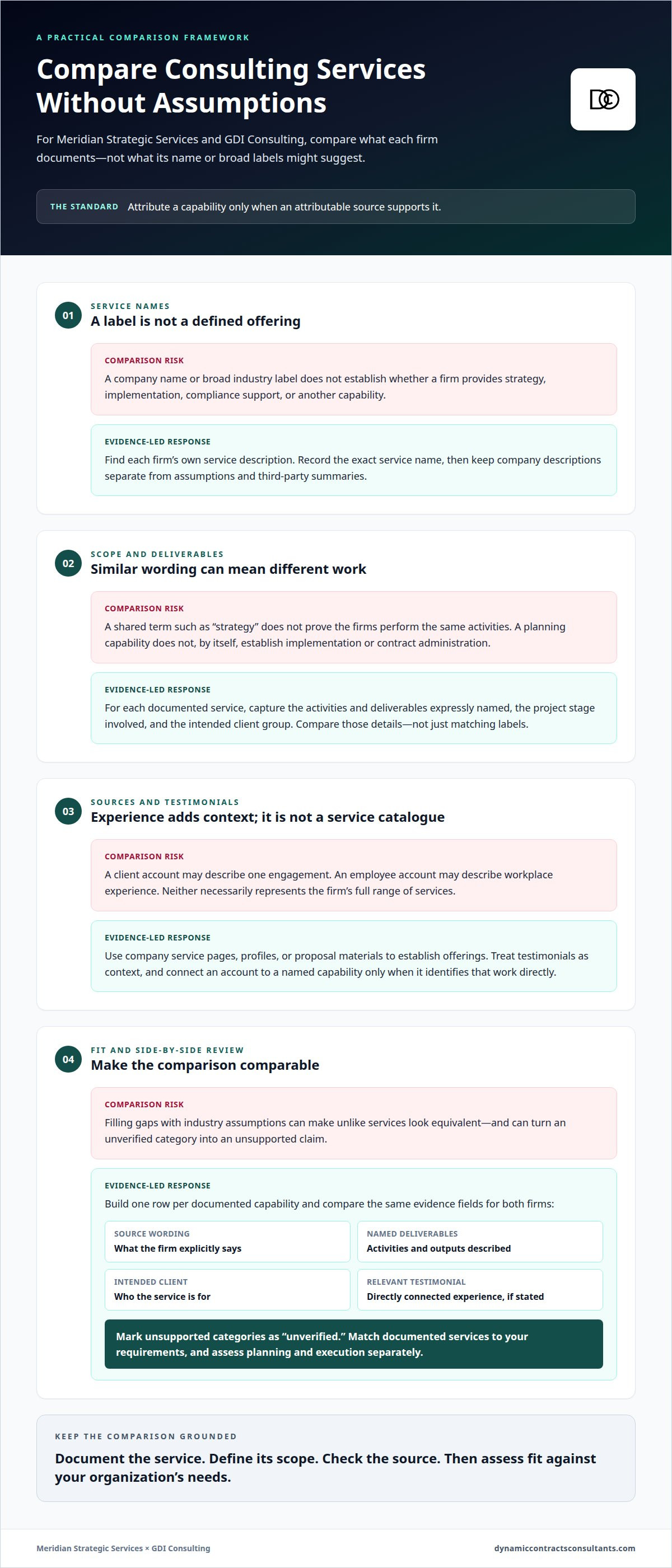
Start with Meridian Strategic Services’ own descriptions of its work. The company name alone does not establish whether it provides strategy, implementation, compliance support, or another capability. Record each service Meridian explicitly names, then separate those descriptions from assumptions based on its name or industry. This keeps your assessment grounded in attributable information.
A practical review follows three steps: find a company-authored description of Meridian’s services, record the service names and activities described, then distinguish those activities from adjacent work not identified in the description. For instance, a stated planning capability does not establish that a firm also manages implementation or contract administration.
- Service name: Record the exact label Meridian uses in its own materials.
- Scope: Capture the activities and deliverables expressly described.
- Client need: Note the organizational task the service addresses.
- Evidence: Keep company descriptions distinct from testimonials and third-party summaries.
This process supports a more precise comparison with GDI Consulting. Similar terms, such as “strategy,” can refer to different activities at different firms. Compare stated deliverables, project stages, and intended client groups instead of treating matching labels as equivalent. If one description covers planning and another execution, record the distinction without inferring additional capabilities.
Testimonials provide useful context, but they serve a different purpose from service descriptions. A client account may describe a particular engagement, while an employee account may reflect workplace experience. Neither necessarily represents the full range of services. Connect a testimonial to a named capability only when it identifies that work directly.
To assess fit, match a documented service to your organization’s requirements. If you need a defined deliverable, compare it with Meridian’s stated scope. If your project involves both planning and execution, assess each stage separately. This helps you evaluate fit without treating an unsupported capability as an offering.
For a structured way to group consulting capabilities, our services framework provides a reference point. Use it as a comparison aid, not as evidence of Meridian’s offerings. We attribute a capability to Meridian only when the company’s own materials support that description.
What services does GDI Consulting provide?
To understand GDI Consulting’s services, begin with the firm’s own descriptions of its work. In a comparison of Meridian Strategic Services vs. GDI Consulting, attributing an offering without company-specific evidence risks confusing GDI with a similarly named organization. Treat a service as established only when an attributable source supports it.
This distinction supports a fair comparison. A shared phrase such as “strategic consulting” does not establish that Meridian Strategic Services and GDI Consulting do the same work. A general business profile also does not establish specific deliverables, industries served, or project responsibilities. Assess each claimed capability as a separate item requiring direct support.
To assess a GDI service description, follow this sequence:
- Identify the source: Start with GDI Consulting’s own service pages, company profile, or proposal materials.
- Capture the exact wording: Separate a named service from broad language about expertise or business goals.
- Define the work: Record the activities and deliverables the description actually names.
- Attribute testimonials carefully: Connect a client account to a service only if it identifies that work.
For example, a statement that GDI Consulting supports organizational growth does not establish whether it provides strategic planning, technology implementation, or operational management. These are distinct activities. Name a specific one only when GDI’s description or a reliable account supports it.
Testimonials can help you understand a client’s or employee’s experience, but they are not a service catalogue. A client may discuss communication or a project outcome without defining the firm’s full range of services. An employee may describe internal responsibilities without identifying what clients can obtain. Treat these accounts as evidence of experience, not proof of every possible offering.
For a side-by-side service assessment, build a matrix with one row for each documented capability. Include the source wording, named deliverables, intended client, and any directly relevant testimonial. Mark unsupported categories as unverified instead of filling gaps with industry assumptions. The comparison of Meridian Strategic Services vs. GDI Consulting is more useful when the descriptions are comparable.
The practical point is that a specific list of GDI Consulting services requires attributable evidence. Assess each description by distinguishing explicit deliverables from general positioning, and company services from individual experiences. This standard keeps the comparison factual and helps you avoid basing a business decision on unsupported claims.
Where are Meridian Strategic Services and GDI Consulting headquartered, and where do they operate?
A company’s headquarters and operating footprint answer different questions. The headquarters is its central business location; the operating footprint describes where it serves clients or performs work. For Meridian Strategic Services and GDI Consulting, keep these details separate rather than inferring service coverage from an office address.
For Meridian Strategic Services, record a city and state as its headquarters only when the company identifies them that way. Assess its geographic reach independently. An office address does not establish whether Meridian serves clients nationally, regionally, or in a narrower area. Base your comparison on the firm’s stated scope, not assumptions drawn from its location.
Apply the same standard to GDI Consulting. A directory entry, employee profile, or testimonial may mention a place without identifying the company’s headquarters. A project example in one state also does not demonstrate service coverage elsewhere. Separate each location claim according to what it describes, distinguishing company-wide reach from an individual office or engagement.
- Headquarters: Record the city and state the company identifies as its central location.
- Office locations: Separate named offices from mailing addresses or individual employee locations.
- Operating footprint: Note the regions or markets the company expressly says it serves.
- Project evidence: Treat a client example as evidence of work in that location, not proof of wider coverage.
For example, if Meridian names an office in one state and describes serving clients across several states, record those as distinct facts. If GDI Consulting identifies a headquarters and describes remote delivery, note the office and delivery model separately. These examples show how to organize location evidence; they do not establish either firm’s actual footprint.
Geography can matter when a project requires on-site coordination. Remote delivery may suit work managed through virtual meetings and shared deliverables. When comparing Meridian Strategic Services and GDI Consulting, match each firm’s stated operating footprint to your project’s location and delivery requirements instead of assuming its reach from the headquarters.
Keep a source note beside each location claim. Record the company name, location as written, and claim type, such as headquarters, office, or client market. This helps prevent mistaking a city mentioned in a testimonial for a corporate base and gives you a consistent basis for comparing the firms’ operating footprints.
Keep those records company-specific: White Wolf began operations in late 2011. CSI is headquartered in Tallahassee, Florida. These details identify White Wolf’s operating start and CSI’s headquarters, respectively; they do not supply a headquarters or operating footprint for Meridian Strategic Services or GDI Consulting. In a comparison, preserve the distinction between a start-of-operations date and a headquarters location, and avoid transferring either detail to another company. Where a location or timing detail is absent, leave that field unfilled rather than infer it from a different organization’s information.
Who owns and leads Meridian Strategic Services and GDI Consulting
Ownership and executive leadership are separate questions for Meridian Strategic Services and GDI Consulting. An owner holds an ownership interest; a chief executive or managing partner leads operations. One person may hold both roles, but a title alone does not establish that. This comparison does not attribute a specific owner or executive to either firm.
For Meridian Strategic Services, distinguish a founder’s biography from evidence of current ownership. A company profile may identify a founder without showing whether that person still owns or leads the business. Likewise, a named president or managing partner at GDI Consulting indicates a leadership role, not necessarily an ownership stake. Keep these claims separate.
A disciplined review records the person, title, relationship to the company, and supporting statement. Use these categories:
- Owner or member: Record only an explicit ownership description.
- Founder: Treat founding history as distinct from present ownership.
- Executive: Capture the stated title, such as president or chief executive.
- Practice lead: Attribute responsibility to a function, not company-wide leadership.
For example, if Meridian Strategic Services names a founder in a company biography, that supports identifying the founder but does not establish current ownership unless the description says so. If GDI Consulting names a practice lead, that supports describing the person’s stated function, not their authority over the entire company.
Source type matters. A company leadership page may describe current executives, while an older announcement may reflect a past appointment. A testimonial mentioning an individual can document a client interaction, but it cannot establish ownership. For both firms, note the publication date and exact role wording alongside each name to avoid presenting an outdated title as current.
When comparing Meridian and GDI, present ownership and leadership in separate columns. Include a person only when a reliable, company-specific statement supports the role. If a source identifies an executive but says nothing about ownership, report only the executive role. This avoids turning inference into fact, particularly when search results include similarly named consulting businesses.
Leadership evidence is most useful when connected to the work you are considering. An executive’s stated responsibilities may clarify who sets company direction; a practice lead may indicate who oversees a function. Neither detail alone demonstrates project quality or client outcomes. Pair leadership information with service descriptions and relevant client or employee accounts for a more balanced assessment.
This comparison does not attribute a specific owner or executive to either firm.
How large are the companies by employee count and annual revenue
Employee count and annual revenue measure different aspects of Meridian Strategic Services and GDI Consulting. Headcount describes the workforce at a particular point or during a period; revenue describes business income over a defined reporting period. Neither measure alone establishes service quality, project capacity, or financial stability. A useful comparison treats each metric separately and identifies its date and scope.
An employee figure can vary depending on whether it includes full-time staff, part-time staff, contractors, or affiliated personnel. Compare Meridian Strategic Services and GDI Consulting using the same workforce definition. A directory estimate and a company-reported count may use different methods, so presenting them as equivalent can create a misleading size ranking.
Revenue also requires consistent definitions. Annual revenue may come from reported financial results, a third-party estimate, or a database model; these figures are not interchangeable. A credible comparison for Meridian and GDI identifies the source, period covered, and whether the figure represents the named legal entity or a wider corporate group.
- Headcount: Record the source date and whether employees, contractors, or affiliates are included.
- Revenue: Identify the reporting period and distinguish reported results from estimates.
- Entity scope: Confirm that the figure applies to Meridian Strategic Services or GDI Consulting, not a similarly named business or parent organization.
- Comparison basis: Use the same definitions for both firms before drawing a size conclusion.
These checks matter because consulting businesses may organize work through employees, subcontractors, or project-based teams. A smaller headcount does not necessarily reveal how a firm staffs a particular engagement. Annual revenue likewise does not show how much capacity is available for a new project. Connect size metrics to the scope and staffing model described for the work.
For example, if Meridian Strategic Services reports its headcount while a profile estimates GDI Consulting’s workforce, label each figure by source type instead of declaring a winner. If a revenue figure covers a wider corporate group, distinguish that scope from revenue attributed to the consulting firm itself. Clear labels separate comparable company data from estimates.
Avoid ranking Meridian Strategic Services and GDI Consulting by size unless comparable, dated figures are available. Assess headcount alongside relevant team structure, and consider revenue only with its reporting period and entity scope. This provides a more useful basis for evaluating organizational scale than an unsupported number or unqualified estimate.
The practical conclusion is that outside benchmarks can frame, but cannot replace, verified company-level reporting. CSI's acquisition criteria include companies with revenue of 10 million to $100 million. White Wolf seeks investment opportunities in companies with revenues of $20 million to $200 million and up to $20 million in EBITDA. These criteria describe investment screens, not confirmed revenue or employee counts for Meridian Strategic Services or GDI Consulting.
Such information should not be treated as evidence that either firm falls within those ranges. Dated, entity-specific disclosures are the basis for comparing scale and assessing whether reported figures match the proposed engagement. Separating investment criteria from company results keeps the comparison grounded in information about the firms themselves.
Dynamic Contracts Consultants: Proposal Writing
Dynamic Contracts Consultants LLC supports government contractors with proposal writing, translating solicitation requirements into clear, responsive submissions. Its work can align proposal development with capture management, while grant writing supports organizations pursuing grant opportunities. For contractors managing financial and administrative requirements, DCAA Compliance Consulting is another relevant area of support.
Your immediate objective determines where to start: developing a proposal, pursuing a grant, strengthening capture activity, or addressing DCAA compliance needs. These services offer practical support for government contracting, beyond comparing company size or leadership profiles. To discuss proposal writing, contact Dynamic Contracts Consultants LLC or visit dynamiccontractsconsultants.com.
Turn your comparison into a focused next step
A comparison of Meridian Strategic Services and GDI Consulting is most useful when it clarifies your organization’s actual requirements. Move from firm profiles to a defined objective: identify the opportunity, the work your team needs to complete, and the capability gap that could affect execution. This gives your next decision a practical foundation, rather than relying on company size or broad descriptions alone.
For government contractors, Dynamic Contracts Consultants LLC can support this work through Proposal Writing, Grant Writing, and DCAA Compliance Consulting. The right focus depends on your immediate need, whether you are preparing a submission, pursuing grant support, or addressing compliance processes. A clear scope helps make the discussion about the work required more productive.
Share your objectives and where your team needs support. Contact Dynamic Contracts Consultants LLC to discuss a practical next step and move forward with greater clarity.
Have a question this article didn’t answer?
Talk it through with a certified contracting professional. The first 30 minutes are free.