
Execute a successful post-award compliance audit. We guide you to map obligations to evidence, eliminate risks, and ensure strategic federal compliance.
An obligation you can’t trace to evidence is difficult to assess and harder to defend. A post-award compliance audit gives your team a structured way to compare contract requirements with the records that support performance, identify gaps, and decide what needs follow-up.
Federal contract obligations and flow-down clauses can be spread across multiple documents, while supporting evidence may sit with different teams and systems. The practical challenge is to establish who owns each requirement, which records demonstrate how it was handled, and how the team will address any gaps. A consistent review process connects those pieces.
In this guide, we explain how to identify applicable obligations, assign accountable owners, organize supporting evidence, and prioritize potential risks. We also cover how to document findings, define corrective actions, and set follow-up and escalation processes. At Dynamic Contracts Consultants LLC, we support post-award compliance and contract administration, helping you connect obligations, records, and oversight throughout the procurement lifecycle.
Key Takeaways
- Distinguish an internal compliance review from contract administration, a financial audit, and a DCAA-focused review so you can define the right scope.
- Use a post-award compliance audit framework to connect each obligation with its source, accountable owner, supporting evidence, and follow-up.
- Classify evidence gaps, control weaknesses, missed obligations, and documentation inconsistencies before prioritizing findings.
- Document each finding with clear criteria, evidence, impact, ownership, due date, and status to support disciplined corrective action.
- Separate immediate containment from root-cause analysis and effectiveness review to make corrective actions traceable and measurable.
What a Post-Award Compliance Audit Examines in a Federal Contract
A post-award compliance audit is a structured, contract-centered review of applicable obligations and the records used to demonstrate performance against them. It compares defined requirements with available evidence, identifies documented gaps or risks, and clarifies what needs further review. Set the scope based on the contract and the review’s purpose, rather than applying a generic checklist without regard to the award.
A post-award compliance audit evaluates whether requirements established by an awarded contract are supported by relevant, traceable evidence. It can be conducted as an internal assessment, but it is not the same as administering the contract day to day or conducting a financial audit.
For context on the agency’s role in contract auditing, see this overview of the Defense Contract Audit Agency (DCAA). A DCAA-focused review may examine specific areas within its remit, while an internal compliance review can address the contractor’s broader set of obligations.
To see how federal acquisition terms relate to contract administration, watch this overview of DFARS Part 201:
Which obligations belong within the review scope?
Start with the executed contract, modifications, incorporated terms, and relevant internal procedures. Identify applicable subcontract flow-downs, then map each requirement to the responsible party, including who communicates it, monitors it, and retains evidence. This creates a contract-specific basis for review. Keep confirmed requirements separate from assumptions. If applicability or interpretation is uncertain, verify it against authoritative sources before treating it as an obligation.
How is a compliance audit different from routine oversight?
Routine oversight tracks ongoing performance, deliverables, and contract administration activities. An audit is a systematic, documented assessment against defined criteria, with records supporting each conclusion. Financial audits and DCAA-focused reviews may overlap with this work, but their objectives and scope are not automatically identical. Define the review boundary before testing evidence so everyone understands what is being assessed and what is outside the review.
Scope can vary with the awarded contract, incorporated terms, applicable flow-downs, and the question the review is intended to answer. For example, a review of subcontract flow-downs would trace relevant terms into subcontract records and examine how responsibility for administration is assigned. A broader internal review may assess several obligation areas, while a financial or DCAA-focused review may address a distinct set of criteria. The label alone does not establish the scope.
Document the basis for each requirement and the evidence used to assess it. If a term’s applicability or interpretation is uncertain, record the uncertainty for authoritative verification rather than presenting an assumption as a confirmed obligation. Our post-award compliance support connects contract administration, compliance monitoring, and flow-down clause analysis. Findings can inform corrective action, but an internal review cannot guarantee a particular outcome in a later audit.
Build an Evidence-Based Post-Award Compliance Audit Framework
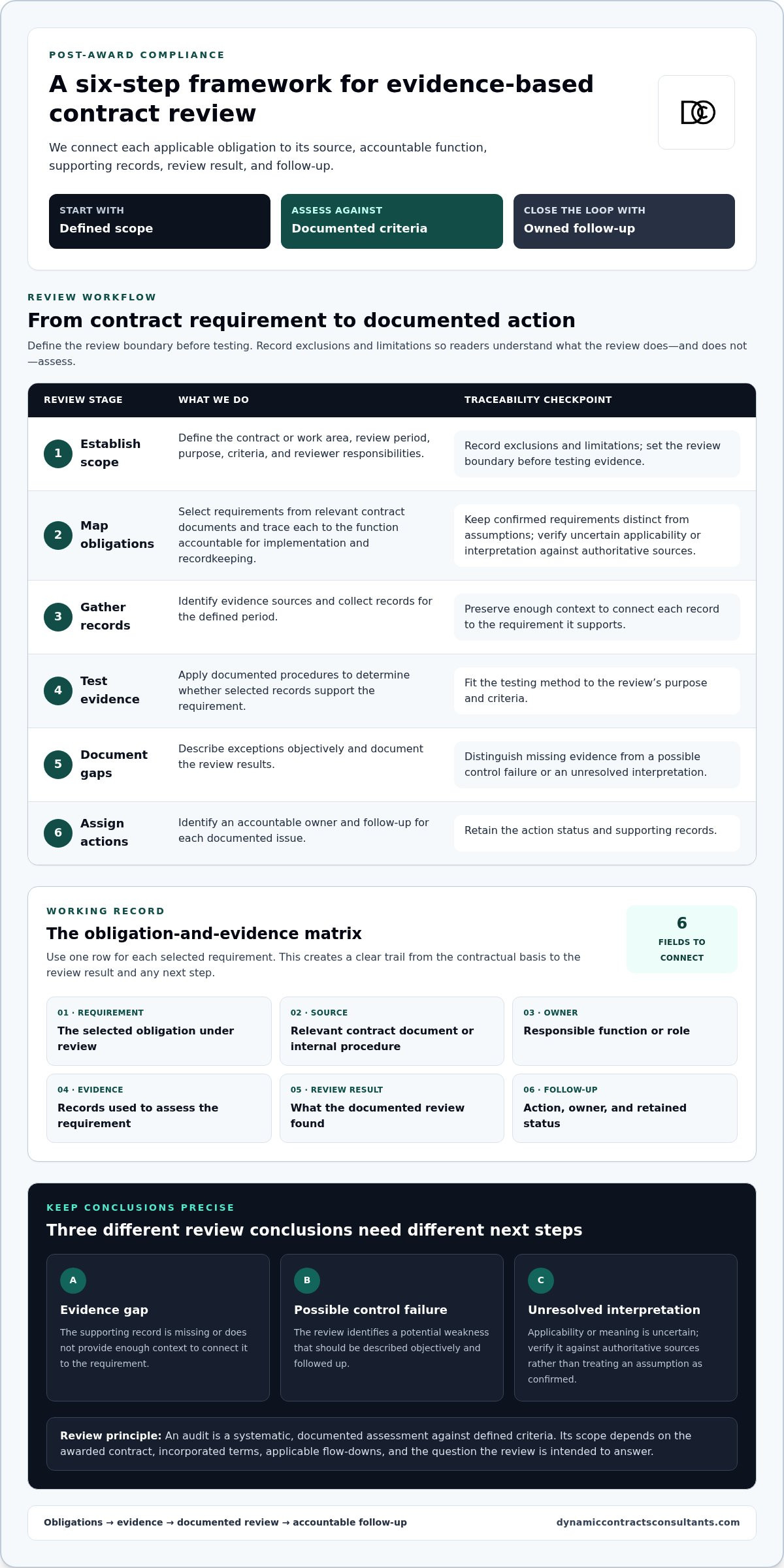
A consistent framework makes results traceable from the requirement to the records examined and any resulting action. Before testing begins, document the review’s purpose and boundaries. The Federal Acquisition Regulation (FAR) on Postaward Audit provides an authoritative reference for its specific subject matter. Use applicable contract terms and current authoritative sources to establish criteria for the review at hand.
- Establish scope. Define the contract or work area, review period, purpose, criteria, and reviewer responsibilities. Record exclusions and limitations so readers know what the review does and does not assess.
- Map obligations. Select requirements from relevant contract documents and trace each to the function accountable for implementation and recordkeeping.
- Gather records. Identify evidence sources and collect records for the defined period. Preserve enough context to connect each item to the requirement.
- Test evidence. Apply documented procedures to determine whether selected records support the requirement. Fit the method to the review’s purpose and criteria.
- Document gaps. Describe exceptions objectively, distinguishing missing evidence from a possible control failure or an unresolved interpretation.
- Assign actions. Identify an accountable owner and follow-up for each documented issue, then retain the status and supporting records.
Create a contract obligation and evidence matrix
Use one row for each selected requirement, with fields for requirement, source, owner, evidence, review result, and follow-up. Identify the relevant contract document or internal procedure as the source. Name the responsible function or role as the owner. Depending on the requirement, evidence might include approvals, deliverables, or administrative records. Record an evidence gap separately from confirmed noncompliance or an unresolved interpretation. These are different review conclusions and can call for different next steps.
Document review procedures and results
For a reproducible review, note the review period, selection rationale, criteria applied, evidence examined, and reviewer. Make sure sampling and testing methods fit the review objective. A sample does not, by itself, establish what happened in records that were not examined. A useful principle is: Every sampled obligation should map to traceable evidence so another reviewer can follow how the conclusion was reached.
Write exceptions as observable facts. Identify the record or item examined, its relevant date, the criterion used, and any limitation. Then state what the evidence did or did not show. Avoid conclusions that go beyond the documentation available. For broader lifecycle context, connect the review framework to post-award compliance support, where contract administration and compliance monitoring work together. If you need to structure a review around your contract records and responsibilities, discuss your post-award compliance needs with our team.
Prioritize Post-Award Audit Risks Across Contract Records and Flow-Downs
Not every exception represents the same type or level of risk. In a post-award compliance audit, classify what the evidence shows before deciding what to address first. A missing document may indicate a recordkeeping gap, while other evidence may point to a process that did not operate as intended. Keep these conclusions distinct and apply consistent criteria so your team can explain its priorities.
| Finding category | What the review identifies | Practical distinction |
|---|---|---|
| Evidence gap | A requested record is absent or incomplete. | The available file does not establish whether the activity occurred. |
| Control weakness | A process intended to support compliance is inconsistently documented or applied. | Assess the process and its operation, not only the missing record. |
| Missed obligation | Evidence indicates that an applicable requirement was not fulfilled. | Relate the conclusion to the specific requirement and evidence reviewed. |
| Documentation inconsistency | Records conflict, such as differing dates or status descriptions. | Resolve the discrepancy before drawing a broader conclusion. |
A missing record shows that performance is not documented; it does not, by itself, prove that the underlying obligation was not performed. State this distinction in your findings so decision-makers can determine whether to locate additional evidence, examine a control, or assess a potential performance issue.
Assess contract records and performance evidence
Compare deliverable and milestone records with the applicable contract terms and approved modifications. Check whether approvals, correspondence, and status documentation relate to the relevant work and period. For example, if a status entry conflicts with a deliverable record, reconcile the discrepancy before drawing a conclusion. Do not automatically classify it as a missed obligation. Tailor evidence requests to the contract rather than applying a universal checklist. The post-award compliance framework connects records review with contract administration and compliance monitoring.
Set transparent prioritization criteria. Consider the contractual significance of the requirement, whether a concern recurs, its operational impact, and how promptly it needs attention. Document how you apply the criteria, including when evidence is incomplete or interpretation remains unresolved. A recurring weakness affecting a key deliverable may warrant prompt follow-up, while an isolated filing inconsistency may call for clarification and improved record organization. Base the classification on evidence, not assumptions.
Review subcontract flow-down administration
For applicable flow-downs, trace the relevant requirement from prime contract terms into subcontract documentation. Then examine evidence of ownership, communication, and monitoring. Identify who is responsible and whether the available records show how the requirement was administered. The Grants.gov Post-Award Phase Overview concerns federal grants, not contract requirements, so use it only as context for the distinct grant lifecycle.
Cost-accounting questions may require separate or coordinated DCAA-focused attention, depending on the review scope and records involved. Keep those matters distinct from flow-down or deliverable findings unless the defined criteria connect them. Clear classification and prioritization give owners a practical basis for follow-up without overstating what the evidence establishes.
Prepare for Findings With Corrective Actions and Audit-Ready Records
A review finding needs more than a label. It needs a documented basis, an accountable owner, and a path to resolution. A finding log helps you track the work consistently and preserve the rationale behind decisions, particularly when several teams contribute evidence or corrective actions.
For each finding, record the criteria used, the evidence reviewed, an impact assessment, the responsible owner, a due date, and current status. Keep the description factual and distinguish established facts from matters still under review. Link supporting records with clear references so a reviewer can trace the finding to its evidence without relying on informal explanations.
Convert findings into assigned corrective actions
Use separate stages so an immediate response is not mistaken for lasting resolution. First, contain an active issue where appropriate. Then analyze its root cause, decide on corrective action, and define how you will review its effectiveness. The owner should know what completion evidence to provide, who will assess it, and what criteria will show whether the action addressed the issue.
Root-cause analysis helps determine whether a finding reflects a systemic process weakness or an isolated records gap. For example, one missing approval record may call for targeted evidence retrieval, while repeated gaps across a process may warrant examining how approvals are created, retained, and monitored. Document the reasoning, action decisions, and any management acceptance of residual concerns.
Maintain records that support reviewability
Organize source documents, review workpapers, evidence references, finding logs, and management decisions under your applicable document-control practices. Consistent naming, version control, and access practices help preserve context and show which materials informed a conclusion. Retain the rationale for changes to findings or action status instead of overwriting earlier decisions without an audit trail.
AI-supported document workflows may help organize materials, but they should not replace professional judgment. Apply human review and appropriate validation to generated or organized documents before relying on them in a compliance record. Our post-award compliance support connects monitoring and audit-ready record preparation with disciplined follow-up across contract administration.
Escalate findings through established management channels when their contractual or operational significance warrants broader oversight. Where a matter raises legal questions, involve qualified counsel; this process guidance is not legal advice. Clear ownership, documented decisions, and evidence-based follow-up make corrective actions more reviewable without implying any guaranteed audit result.
Discuss post-award compliance support with our team to strengthen your finding response and records process.
How Dynamic Supports Post-Award Compliance and Audit Readiness
Effective support connects contract administration, compliance monitoring, and flow-down clause analysis rather than treating each as a separate records exercise. At Dynamic Contracts Consultants LLC, we align that work with your contract terms, documented obligations, review purpose, and organizational priorities. Our experience as a prime contractor on Department of Defense, Department of State, EPA, and NOAA contracts informs our practical understanding of how requirements and supporting records intersect across the procurement lifecycle.
Align support with the contract and review scope
Start with the applicable contract documents and the questions your team needs to answer. We work with you to define the review boundary, identify the obligations and records in scope, and determine where documentation needs closer examination. Human expertise remains central: our reviewers interpret records in context, distinguish an evidence gap from a potential compliance concern, and document the basis for their assessment.
This approach makes a post-award compliance audit more useful by connecting review findings to accountable functions and follow-up. The objective is a structured, defensible process, not a predetermined conclusion. Our post-award compliance services bring administration, monitoring, flow-down analysis, and audit-ready record preparation into a coordinated framework tailored to the review scope.
Where the defined scope involves cost or accounting matters, our DCAA compliance consulting can support the review. Align that work with the specific questions and records being assessed rather than assuming it belongs in every compliance assessment. Broader contract lifecycle support can also connect obligations identified after award with the processes and records used to administer them over time.
Coordinate compliance, administration, and documentation
Consistent administration supports a clearer record of decisions, responsibilities, and contract activity. We help organize review materials so source documents, evidence, and related contract-administration records can be understood in context. This can help your team maintain continuity as staff, deliverables, or review priorities change, while keeping accountability visible across internal functions and applicable subcontract relationships.
Document workflows can support organization when they include appropriate human review. FARIFY, our affiliate’s AI-powered platform, supports government-contracting document generation. Its outputs still require human review and validation before use. Our team applies professional judgment to the compliance context, helping assess organized records against the defined scope rather than accepting them at face value.
Audit-ready record preparation makes relevant documentation easier to locate, trace, and evaluate for a defined review. It cannot guarantee a particular finding, agency determination, or compliance outcome. Its value lies in a disciplined process that clarifies what was reviewed, how conclusions were reached, and where follow-up belongs.
If your team is assessing contract obligations, flow-downs, or documentation practices, contact our team to discuss your post-award requirements.
Make Audit Readiness Part of Contract Governance
Make evidence ownership part of ordinary contract governance rather than treating preparation as an exercise that begins only when a review is scheduled. As responsibilities or contract conditions change, revisit who maintains each record, how decisions are documented, and where unresolved issues are escalated. This supports continuity across teams and prevents essential knowledge from resting with a single individual.
A post-award compliance audit can also inform how your organization improves its internal routines over time. Use review observations to refine documentation practices, clarify handoffs, and direct management attention to recurring areas of exposure. Keep those adjustments connected to the applicable contract and your operational priorities so improvements remain practical as work progresses.
Putting this discipline into practice requires coordination across contract administration, compliance, and program teams. Discuss your post-award compliance requirements with us to develop a focused path forward. With clear ownership and consistent attention to evidence, your team can strengthen oversight of federal work.
Frequently Asked Questions
Is a post-award compliance audit the same as a DCAA audit?
No. A post-award compliance audit can be an internal review scoped to selected contract obligations, while a DCAA audit is a distinct review conducted by the Defense Contract Audit Agency. Their subject matter may overlap, particularly when cost or accounting matters are involved, but their objectives and criteria are not automatically identical. Define the review by its purpose and the applicable records rather than treating the labels as interchangeable.
How often should a federal contractor conduct a post-award compliance audit?
There is no single review interval that fits every contract or organization. Set a cadence based on your documented risk assessment, the contract’s complexity, and how frequently relevant processes or responsibilities change. Consider scheduling a review after a material contract modification, a significant process change, or recurring documentation issues. Periodic reviews can then help monitor areas that remain important. Record why the timing and scope fit your operation.
Can a small federal contractor conduct its own post-award compliance review?
Yes. A small contractor can conduct an internal review by assigning a knowledgeable team member, defining the review boundaries, and maintaining workpapers that show what was examined. For example, a contracts lead might assess selected deliverable records while a colleague familiar with the underlying process validates the supporting documentation. If staffing is limited, disclose review limitations and consider an additional reviewer for areas where the initial reviewer prepared the records.
What should a contractor do after identifying a possible compliance gap?
Preserve the records as they currently exist, verify the relevant requirement, and gather additional evidence before deciding what the gap represents. For example, if a file lacks an approval, check related correspondence or system records before concluding that approval was not obtained. Assign someone to coordinate fact-finding, document decisions, and elevate issues through established management channels. Involve qualified counsel when circumstances raise legal questions; an internal review is not legal advice.
Do subcontractors need to be included in a post-award compliance audit?
Include subcontract-related activity when applicable flow-downs or other requirements within the review scope depend on subcontract records or administration. The review might examine whether relevant terms were communicated and how the prime tracks related subcontract performance. It does not need to cover every subcontract or record by default. Define which relationships and evidence relate to the selected obligations, and document any limits on access or review coverage.
Can AI be used to support post-award compliance documentation?
Yes. AI-supported tools can assist with document generation and organization, provided people validate the output before relying on it. A reviewer should confirm that document references are accurate, context is preserved, and source records support the conclusions being recorded. AI can help structure information, but it cannot replace contract-specific interpretation or human assessment. Treat generated material as a workflow aid, not independent proof of compliance.
What is the difference between an evidence gap and a compliance finding?
An evidence gap means the review record is insufficient to establish what happened. A compliance finding is a conclusion that documented evidence does not meet a defined criterion. For instance, a missing approval in one folder may call for further evidence gathering. Records showing that a required approval step was bypassed could support a finding if that step is an applicable criterion. Classifying the issue accurately helps determine whether to investigate, improve recordkeeping, or address a process failure.
Have a question this article didn’t answer?
Talk it through with a certified contracting professional. The first 30 minutes are free.