
Master the procurement lifecycle with our guide to understanding small business set-asides. We help you evaluate eligibility and bid strategically for growth.
A set-aside label can open a door, but it doesn’t prove your business is eligible or make the opportunity a sound use of proposal resources. Understanding small business set-asides starts with separating the procurement’s competition restrictions from your company’s qualifications, capabilities, and capacity to perform.
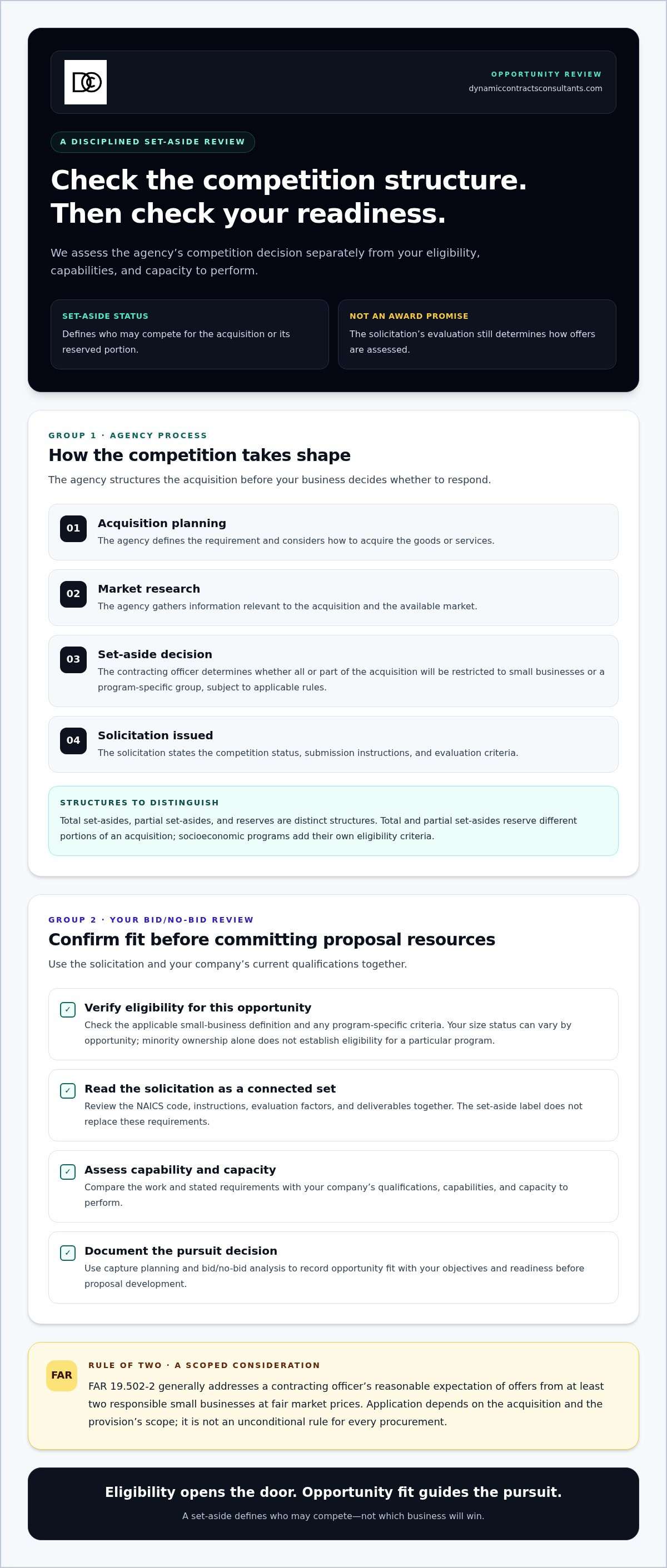
That distinction matters because total and partial set-asides reserve different portions of an acquisition, while socioeconomic programs add their own eligibility criteria. A business’s size status can vary by opportunity, and minority ownership alone doesn’t establish eligibility for a particular program. Review the solicitation and your company’s current qualifications together before deciding to pursue.
This guide explains how federal set-asides work, what eligibility means in practice, and which solicitation and business details to assess before committing time and resources. We’ll also cover how bid/no-bid analysis, capture management, and proposal support can help you align an opportunity with your objectives and readiness. The goal is a disciplined decision across the procurement lifecycle, not an assumption that every eligible opportunity is the right one to pursue.
Key Takeaways
- Understanding small business set-asides means distinguishing who may compete from whether your business meets the opportunity’s specific eligibility requirements.
- Learn how acquisition planning, market research, and the FAR’s Rule of Two relate to a set-aside decision.
- Compare total set-asides, partial set-asides, and reserves, then consider how socioeconomic categories add distinct eligibility criteria.
- Review the NAICS code, solicitation instructions, evaluation factors, deliverables, and your business’s capacity as connected parts of the bid decision.
- Use capture planning and bid/no-bid analysis to document opportunity fit before committing resources to proposal development.
Understanding Small Business Set-Asides: What They Reserve and Why
A federal opportunity may be open to eligible businesses across the market, or competition may be restricted to a defined group of small businesses. That distinction determines who may submit an offer, but it doesn’t identify which firm will win. In our opportunity reviews, we consider the competition’s boundaries, your company’s qualifications, and the government’s evaluation as separate factors.
Under FAR Part 19, a small-business set-aside is a federal acquisition, or a portion of one, reserved for competition among eligible small businesses. The restriction defines who may compete for the reserved work. It does not override the solicitation’s evaluation process or promise an award to any individual bidder.
What does a set-aside change for a prospective contractor?
A set-aside changes the pool of businesses eligible to compete for an acquisition or its reserved portion. An unrestricted competition, by contrast, is not limited to small businesses on that basis. The distinction can shape your pursuit strategy, but the set-aside label is only one part of the opportunity. The solicitation establishes the requirements, evaluation factors, deliverables, and submission instructions.
Small-business status and eligibility for a particular socioeconomic program are related but distinct. Your company may meet the applicable definition of small business yet not qualify for a program-specific competition. Ownership characteristics alone don’t establish eligibility or certification. The opportunity’s terms and applicable program criteria determine whether your business can compete. The later sections explain how to assess those details for a specific solicitation.
Why do federal agencies use small-business set-asides?
Set-asides are one way to expand small-business participation in federal contracting. When an acquisition is structured this way, competition is reserved for eligible small firms, giving qualified businesses access to opportunities on different terms than an unrestricted competition. This policy purpose informs the procurement, but it does not replace the agency’s evaluation of offers against the solicitation.
The Small Business Administration provides government-wide small-business procurement guidance, establishes size standards, and administers small-business certification programs. Contracting agencies make acquisition decisions and evaluate offers under the applicable procurement framework. SBA’s broader role should not be mistaken for a decision on an individual award. Government-wide contracting goals are policy measures, not guarantees about a particular agency’s procurement or a bidder’s result.
Some acquisitions use Simplified Acquisition Procedures, a separate procurement framework with its own processes. The Simplified Acquisition Procedures overview provides background on that framework; it is not a definition of set-aside eligibility. In our analysis, the distinction is straightforward: set-aside status establishes who may compete, while the solicitation and applicable eligibility criteria define what your business must be ready to meet.
How Small Business Set-Asides Work Under FAR and SBA Guidance
A set-aside decision develops through the procurement lifecycle. The agency plans its acquisition and conducts market research before deciding how to structure the competition. The resulting solicitation tells prospective offerors how the requirement will be competed and what a response must include. Understanding small business set-asides means recognizing that the agency’s acquisition decision and your eligibility assessment are separate: the agency determines the competition structure, while your business must assess whether it qualifies and can meet the stated requirements.
- Acquisition planning: The agency defines the requirement and considers how to acquire the goods or services.
- Market research: The agency gathers information relevant to the acquisition and available market.
- Set-aside decision: The contracting officer determines whether the acquisition, or a portion of it, will be restricted to small businesses or a program-specific group, subject to applicable rules.
- Solicitation: The agency issues the solicitation, including competition status, instructions, and evaluation criteria.
- Contractor response: You assess the solicitation, determine whether your business meets the applicable criteria, and decide whether to submit an offer.
This sequence is a practical overview, not a substitute for the governing text. FAR Part 19 and relevant SBA rules frame small-business contracting, while the solicitation and current authoritative requirements control the specific opportunity. Acquisition planning and bid/no-bid analysis can organize your review, but neither replaces the agency’s decision nor establishes eligibility.
What is the Rule of Two in small-business contracting?
The Rule of Two is a FAR concept concerning whether an acquisition should be set aside for small businesses. In general, FAR 19.502-2 addresses a contracting officer’s reasonable expectation of receiving offers from at least two responsible small businesses at fair market prices. Its application depends on the acquisition and the provision’s scope; it is not an unconditional rule for every procurement. For a live opportunity, review the current FAR text and solicitation rather than relying on a shorthand summary.
How do NAICS codes and size standards affect eligibility?
The solicitation’s assigned North American Industry Classification System (NAICS) code informs which SBA size standard applies. Size standards vary by industry and may be based on average annual receipts or employee count, so your business’s status can differ across opportunities. Use the current SBA Size Standards guidance to assess the relevant standard. Don’t assume a prior determination automatically applies to a different NAICS code.
Size is one part of the analysis. Ownership, affiliation, representations, and any program-specific criteria may require separate review. Keep the solicitation’s assigned code and relevant representations together in your opportunity file, then compare them with current SBA guidance before investing in proposal development. We provide acquisition planning and opportunity analysis to help structure this review. Discuss your federal contracting objectives with our team.
Total, Partial, and Socioeconomic Set-Asides: Key Differences
Set-aside terminology describes different dimensions of a procurement. “Total” and “partial” indicate how much of an acquisition is reserved, while a “reserve” describes a structure used in certain multiple-award contract strategies. Socioeconomic categories add another dimension by limiting competition to firms that meet program-specific criteria. We keep these distinctions separate when reviewing an opportunity so its structure is not confused with a contractor’s eligibility.
Total set-aside: The relevant acquisition is reserved for competition among eligible small businesses. A business must still meet the solicitation’s requirements and compete under its evaluation criteria.
Partial set-aside: A portion of a larger acquisition is reserved for small businesses, while other portions may be competed separately. The solicitation defines the reserved portion and how offerors should respond.
Reserve: In certain multiple-award contract structures, the agency may reserve part of the competition or contract for small-business participation. Its operation depends on the acquisition strategy and applicable provisions.
These are high-level distinctions, not interchangeable labels. The exact structure, scope, and response requirements depend on the solicitation and applicable provisions of the Federal Acquisition Regulation (FAR) Part 19. For example, a partial set-aside identifies a portion of an acquisition for small-business competition; it does not, by itself, explain how that portion will be evaluated or awarded. We focus on the solicitation’s terms to identify the work included and what an offer must address.
How do total set-asides, partial set-asides, and reserves differ?
The practical question is what work is reserved and how the solicitation organizes competition for it. A total set-aside applies the restriction to the relevant acquisition; a partial set-aside applies it to a defined portion. A reserve is a distinct approach associated with certain multiple-award contracts, not simply another name for a partial set-aside. The solicitation and governing FAR provisions determine the details for each opportunity.
How do socioeconomic set-asides relate to small-business status?
Small-business size status and socioeconomic program eligibility are separate assessments. A firm may meet the size standard for an opportunity yet not meet the requirements for a program-specific competition. Program categories include 8(a), HUBZone, Women-Owned Small Business (WOSB), and Service-Disabled Veteran-Owned Small Business (SDVOSB). These are distinct programs, not interchangeable designations, and each has its own eligibility and certification requirements.
Minority ownership alone does not automatically qualify a company for a particular socioeconomic set-aside or certification. This distinction matters when a solicitation combines small-business restrictions with a program-specific category. We assess the acquisition structure and a contractor’s status separately, rather than inferring qualification from a business label.
An acquisition’s set-aside structure defines the competition; a contractor’s socioeconomic status determines whether it meets the applicable category-specific criteria. Before making a bid decision, identify what portion is reserved, which firms may compete, and what the solicitation requires from an offeror.
How to Assess a Small Business Set-Aside Before You Bid
A disciplined pursuit review separates threshold eligibility from competitive fit. A set-aside designation may define who can compete, but it doesn’t establish that your business can perform the work or submit a competitive offer. In practice, understanding small business set-asides means reviewing the opportunity in a consistent sequence before committing proposal resources.
- Identify the opportunity type. Confirm whether the solicitation is unrestricted, a total or partial set-aside, or limited to a specific socioeconomic program.
- Check the NAICS code. Compare the solicitation’s assigned code with your business’s applicable size-standard analysis.
- Assess eligibility. Review required representations and any program-specific criteria against your company’s current status.
- Map the requirements. Extract deliverables, performance obligations, evaluation factors, clauses, and submission instructions.
- Test operational capacity. Assess technical capability, staffing, relevant past performance, schedule, and other available resources.
- Document the bid decision. Record the opportunity’s fit, material gaps, proposal effort, and rationale for pursuing or declining.
Read the solicitation as an integrated set of instructions. Eligibility representations, evaluation criteria, deliverables, and submission rules inform one another. A capability that appears relevant may not address a scored factor, while a delivery requirement may affect staffing and schedule assumptions. Compare solicitation language with current authoritative FAR or SBA guidance where needed, and track amendments so your review reflects the active requirements.
Which solicitation details should a small business examine first?
Start with the set-aside designation, assigned NAICS code, eligibility representations, and applicable clauses. Then map each deliverable and performance obligation to the evaluation factors and required response content. Include formatting, submission method, and timing instructions in the same review. This structured read helps reveal whether your offer can demonstrate compliance as well as technical merit.
How can a contractor decide whether to pursue the opportunity?
Compare the requirement with your technical approach, staffing, relevant past performance, strategic priorities, and proposal resources. Distinguish a documented capability gap from a manageable planning issue, and assess whether your team can produce a complete response within the solicitation’s schedule. A bid/no-bid analysis makes the rationale explicit; it supports a decision, not a prediction or guarantee of award.
Once you decide to pursue, solicitation-aligned proposal writing support can help translate requirements and evaluation factors into a coherent response. We connect capture planning and bid/no-bid analysis with proposal development so you can approach the procurement lifecycle with clearer priorities and strategic compliance.
Discuss your federal contracting objectives with our team to bring structure to your opportunity assessment and pursuit planning.
From Set-Aside Opportunity to Proposal: Building a Disciplined Next Step
After reviewing eligibility and solicitation requirements, convert your findings into a documented pursuit decision. A structured plan gives your team shared assumptions, defined responsibilities, and a clear basis for moving from opportunity analysis to proposal development. It also separates facts established by the solicitation from assumptions that need attention before you commit resources.
What should a set-aside pursuit plan document?
Build a concise record connecting the opportunity’s eligibility basis to the work your team would need to deliver. Capture the solicitation version reviewed, applicable set-aside category, relevant representations, evaluation criteria, and key assumptions. Record unresolved questions and dependencies so they can be assessed rather than becoming untracked proposal risks.
- Requirements and evidence: Map solicitation instructions, deliverables, and evaluation factors to the information or substantiation your response will need.
- Responsibilities: Assign owners for requirement analysis, technical content, pricing inputs, approvals, and submission tasks.
- Priorities and risks: Set development priorities, identify material capability gaps, and record assumptions that could affect performance or response quality.
- Pursuit rationale: Document why the team will bid or decline, based on eligibility, strategic fit, capacity, and the resources required to prepare a responsive offer.
This record supports a decision; it is not an award forecast. Base the rationale on the information available, including evidence supporting the pursuit and risks that remain. If the solicitation changes or new information emerges, update assumptions and responsibilities so the plan continues to guide the team’s work.
When can proposal and capture support add value?
Capture planning can help your team assess opportunity alignment and readiness before proposal production begins. A documented bid/no-bid analysis makes tradeoffs visible, including where requirements align with business priorities and where additional planning or evidence may be needed. Once you decide to pursue, proposal development can organize the response around solicitation requirements, evaluation criteria, and submission instructions.
We work with contractors to structure this transition, connecting pursuit decisions with response planning. A clear review process can also support proposal readiness by identifying gaps for attention before final review. The published guide The Strategic Necessity of Government Proposal Review Services in Federal Acquisitions discusses review readiness as part of a disciplined response process.
A documented plan gives your team a practical basis for moving forward, revising the pursuit, or declining it. Discuss proposal and capture support with our team.
Turn Opportunity Insight Into a Deliberate Pursuit
Federal contracting growth depends not only on recognizing an opportunity, but also on building a repeatable process for deciding what your business is prepared to pursue. Make each decision an input to your next capture plan: record what aligned, where evidence was needed, and which capacity or compliance gaps deserve attention before the next solicitation arrives. This turns understanding small business set-asides into a foundation for stronger planning across your procurement lifecycle.
Our proposal writing, capture management, acquisition planning, and bid/no-bid analysis support contractors as they evaluate opportunities and prepare responses. We’ve also served as a prime contractor on Department of Defense, Department of State, EPA, and NOAA contracts. That experience informs our approach, while each opportunity and award decision remains specific to its solicitation and competition.
Bring your next opportunity into focus with a disciplined review of fit, readiness, and response priorities. Discuss your federal contracting objectives with our team and take a considered next step toward sustainable growth.
Frequently Asked Questions
How do I know whether my business qualifies as small for a federal set-aside?
Start with the NAICS code assigned in the solicitation and the corresponding current SBA size standard. Then assess your business against that standard and review any applicable ownership, affiliation, representation, and program-specific requirements. A general company profile or a prior size determination may not answer the question for a different opportunity. For an accurate understanding of small business set-asides, use current SBA guidance alongside the solicitation’s criteria and representations.
Does minority-owned status automatically qualify a company for a federal set-aside?
No. Minority ownership alone doesn’t automatically qualify a company for a specific socioeconomic program or set-aside. General small-business size status is separate from program-specific eligibility and certification. For example, a solicitation restricted to a particular program requires the business to meet that program’s applicable criteria, not simply to be small or minority-owned. Review the solicitation and current SBA program rules before making eligibility representations or deciding to submit an offer.
Can a small business pursue a set-aside as a subcontractor?
Yes, a small business may pursue subcontracting work under a prime contract, subject to the prime contract’s terms and applicable requirements. That role is distinct from submitting an offer as the prime contractor. A subcontracting opportunity doesn’t by itself establish that your company is eligible to compete for the prime acquisition. Clarify whether your pursuit is a prime bid or a teaming arrangement, then review the solicitation, proposed subcontract terms, and relevant contract requirements.
What happens if a small-business set-aside receives no responsive offers?
There isn’t one automatic outcome that applies to every acquisition. The contracting agency must address the situation under applicable procurement procedures, the solicitation’s circumstances, and the contracting officer’s actions. Don’t assume the opportunity will be cancelled, reopened to unrestricted competition, or handled in a particular way. If you’re tracking a procurement, distinguish confirmed agency notices from expectations, and rely on current governing provisions for any specific procedural explanation.
Are federal small-business set-asides the same as state or local small-business programs?
No. This guide addresses federal contracting and FAR-related concepts; state and local procurement programs may define eligibility differently and use distinct terminology or processes. Don’t assume a federal representation or certification transfers automatically to another jurisdiction. For a nonfederal opportunity, review that entity’s current procurement guidance and solicitation, including its definitions, required documentation, and submission instructions. Treat each jurisdiction’s criteria as a separate eligibility assessment.
Do small-business set-asides guarantee that an eligible company will win the contract?
No. Set-aside status determines the competition structure, not the outcome for an individual firm. Eligible offerors must still address the solicitation’s requirements and be evaluated under its stated process. Eligibility, ability to perform, proposal quality, and the government’s assessment are separate considerations. A careful pursuit decision can help you determine whether an opportunity merits proposal resources, but neither set-aside status nor eligibility predicts an award.
Have a question this article didn’t answer?
Talk it through with a certified contracting professional. The first 30 minutes are free.