
Master the procurement lifecycle with our guide to understanding government contract types, pricing structures, and strategic risk allocation for your growth.
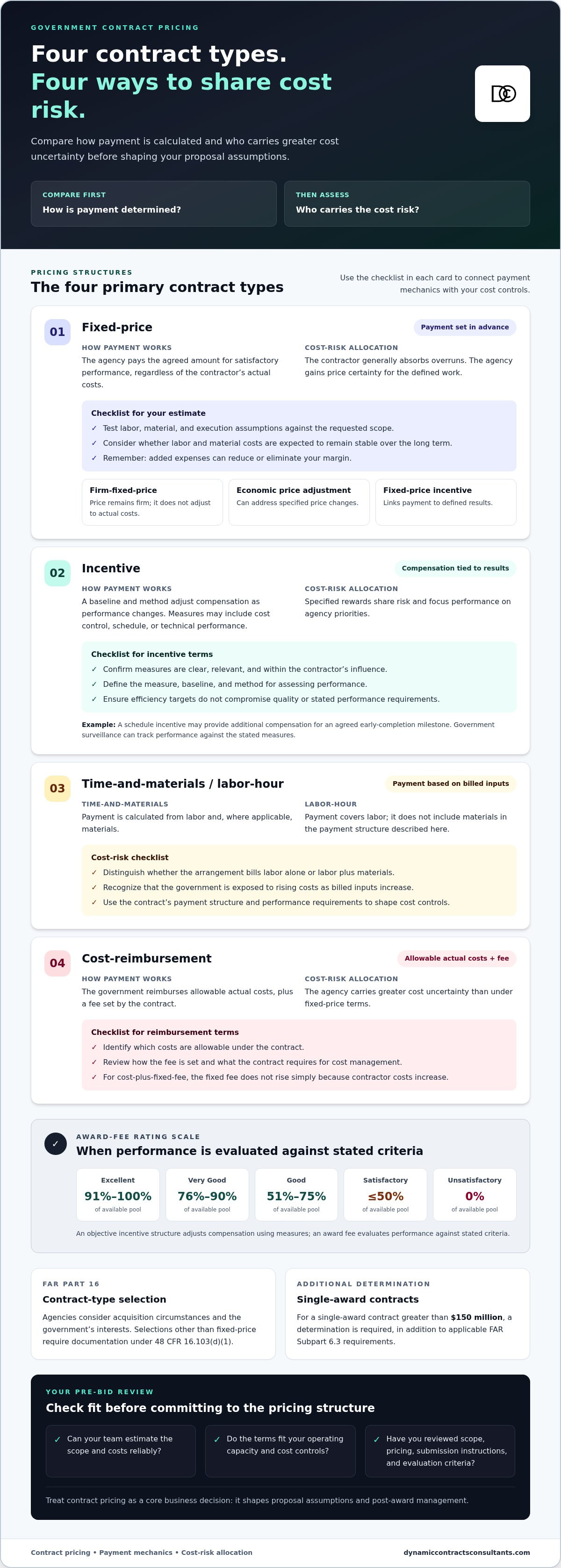
Understanding government contract types starts with four primary pricing approaches: fixed-price, incentive, time-and-materials or labor-hour, and cost-reimbursement. The key differences are how each determines payment and allocates cost risk. Fixed-price contracts set payment in advance; incentive contracts tie compensation to defined performance; time-and-materials and labor-hour contracts calculate payment from labor and, where applicable, materials; and cost-reimbursement contracts pay allowable actual costs plus a fee.
The pricing structure determines how costs, performance expectations, and financial risk are shared between the government and contractor. Treat it as a core business decision: it shapes proposal assumptions and post-award management. Use the contract terms to assess whether an opportunity fits your operating capacity and cost controls.
This article explains how each approach works, what determines payment, and where the key distinctions lie. Understanding the effects on cost control and risk can help you evaluate federal opportunities and prepare for the requirements that follow award.
Key Takeaways
- Compare contract types by how they calculate payment and allocate cost risk, not by their labels alone.
- Assess whether the work’s scope and costs can be estimated reliably before weighing a fixed-price arrangement.
- Understand how incentive terms connect compensation to defined performance measures and outcomes.
- Distinguish time-and-materials contracts, which include labor and materials, from labor-hour contracts, which cover labor.
- Use the contract’s payment structure and performance requirements to shape proposal assumptions and post-award cost controls.
Fixed-price contracts
Under FAR Part 16, fixed-price contracts establish payment in advance for satisfactory performance, regardless of the contractor’s actual costs. The contract type matters most when estimating costs and assigning responsibility for overruns.
To compare fixed-price terms with other pricing arrangements, watch this overview:
Risk varies by contract type. Under fixed-price terms, the contractor generally bears the risk that actual costs exceed the agreed price, while the agency pays that price for satisfactory completion. Incentive arrangements share risk through specified performance rewards. Time-and-materials and labor-hour contracts expose the government to rising costs as billed inputs increase. Cost-reimbursement contracts cover allowable actual costs plus a fee, leaving the agency with greater cost uncertainty.
A small business can find federal opportunities by reviewing agency solicitations and matching them to its capabilities, requirements, and available capacity. Before bidding, analyze the scope, pricing structure, submission instructions, and evaluation criteria, then prepare a proposal that addresses each requirement. For example, when estimating a defined deliverable, test labor and material assumptions against the requested work before proposing a fixed price.
Cost-reimbursement arrangements work differently: the government reimburses allowable actual costs, plus a fee set by the contract. Cost-plus-fixed-fee is one such arrangement; the fixed fee does not rise simply because the contractor’s costs increase. This distinction matters when project costs are uncertain: fixed-price terms leave the contractor to absorb overruns, while reimbursement shifts more cost risk to the agency.
Firm-Fixed-Price Pricing and Risk
A firm-fixed-price contract sets a firm amount for required supplies or services, and payment does not adjust to the contractor’s actual costs. This gives the agency price certainty, while the contractor must estimate labor, materials, and execution costs accurately. Price the defined scope carefully: cost increases can reduce or eliminate your margin.
Fixed-Price Cost-Overrun Risks
A cost overrun occurs when actual expenses exceed the fixed amount established in the contract. If labor takes longer than estimated, for example, the contractor generally absorbs the added expense rather than billing the agency more. When labor or material costs are not expected to remain stable over the long term, federal contracting officers should consider economic price adjustment provisions. These terms can address specified price changes, but do not replace the need for a sound estimate.
Fixed-Price Contract Subtypes
Fixed-price subtypes adjust how the price responds to performance or changing costs. A firm-fixed-price arrangement holds the price firm; an economic price adjustment provision can address specified cost changes; and a fixed-price incentive arrangement links payment to defined results. The appropriate subtype depends on scope certainty and cost volatility. Under FAR Part 16, according to the Federal Acquisition Regulatory Council, a determination is required for a single-award contract greater than $150 million, in addition to any applicable requirements under FAR Subpart 6.3.
Incentive contracts
An incentive contract links some compensation to defined results, such as cost control, schedule, or technical performance. Its value depends on whether the measures are clear, relevant, and within the contractor’s influence.
Under the FAR, agencies select a contract type by considering the acquisition’s circumstances and the government’s interests. FAR Part 16 permits negotiated contracts under FAR Part 15 to use a contract type or combination that promotes the Government’s interest, subject to restrictions; selections other than fixed-price require documentation under 48 CFR 16.103(d)(1).
Incentive contracts set a baseline and a method for adjusting compensation as performance changes. An arrangement might reward a contractor for finishing ahead of schedule or below an established cost target. The contractor can earn more by meeting the defined objective, while the agency uses the incentive to focus performance on its priorities.
Performance-based contracts link payment to results rather than inputs such as labor hours. An incentive can reward outcomes, while government surveillance tracks performance against the contract’s stated measures. This monitoring helps agencies determine whether results qualify for an incentive payment, rather than relying only on reported activity.
Contractor Incentives for Efficiency
Efficiency incentives reward contractors for achieving defined results with less time or cost while meeting performance requirements. A schedule incentive, for example, may provide additional compensation for an agreed early-completion milestone. The contractor benefits by improving execution; the agency benefits when the measured result supports its mission needs.
Incentives work best when the contractor can influence the measured outcome. A labor-hour target, for instance, should distinguish productive efficiency from reductions that could compromise quality. During acquisition planning, agencies define the measure, baseline, and method for assessing performance. Clear terms help both parties interpret results consistently.
Choosing Incentive and Award-Fee Structures
An incentive structure adjusts compensation using objective measures, while an award fee evaluates performance against stated criteria. Under the FAR award-fee rating table, Excellent earns 91%-100% of the available award-fee pool; Very Good earns 76%-90%; Good earns 51%-75%; Satisfactory earns no greater than 50%; and Unsatisfactory earns 0%.
Cost-plus contracts combine cost reimbursement with a fee structure. A cost-plus-fixed-fee contract provides a fixed fee, while a cost-plus-award-fee structure ties an award-fee portion to assessed performance. The distinction matters: fixed-fee compensation does not use an award-fee rating scale, whereas award-fee payments depend on the rating and available pool.
For an agency, selection depends on the work’s uncertainty, government objectives, and whether performance can be meaningfully measured. Contractors should review the solicitation’s baseline, evaluation criteria, and incentive formula before proposing. Those terms determine how the acquisition rewards results and how performance evidence affects payment.
Time-and-materials and labor-hour contracts
These arrangements base payment on labor and, where applicable, materials used during performance. For a federal program with changing task quantities, the pricing mechanism affects cost visibility and oversight.
Time-and-Materials Contract Structure
A time-and-materials contract pays for labor at established hourly rates and for material costs as provided under the contract. This structure can suit work whose scope or duration is difficult to define precisely in advance. For example, a technical support project may require varying labor categories and materials as tasks emerge.
The contract’s hourly labor rates provide a basis for calculating labor charges, while materials are accounted for separately. More hours can raise labor charges, and required materials affect the amount payable. Unlike a fixed-price arrangement, payment follows the inputs used rather than a single price for completing the full scope.
Because time-and-materials terms do not inherently encourage cost control, federal contracts require close government surveillance. Agencies need to monitor labor use and material costs against the work being performed. Reviewing reported hours alongside completed tasks, for example, helps assess whether billed effort supports program requirements, rather than treating hours alone as proof of progress.
Labor-Hour Contracts
A labor-hour contract is a time-and-materials variant in which the contractor supplies labor but not materials, as defined in 48 CFR 16.602. Payment is calculated using the contractor’s hourly labor rate and hours worked. The distinction matters when the government needs labor services but handles or provides project materials separately.
If a federal agency orders analysis services under a labor-hour arrangement, for example, the labor charge reflects the applicable hourly rate and recorded hours. The contractor does not supply materials under this contract type. Agencies monitor hours and deliverables, while contractors need records connecting billed labor to assigned tasks.
When comparing these contracts, identify whether the government pays for labor alone or labor plus materials. Review how the contract defines labor rates, records hours, and accounts for material costs. These distinctions clarify what the contractor provides, what the agency pays for, and which performance details require oversight.
Neither structure is simply an indefinite-quantity commitment: the payment basis concerns labor and materials, while the contract defines the work and ordering terms. If task quantities change during a program, agency surveillance and contractor records help track how each order uses labor and materials. These controls make the pricing mechanism visible throughout performance.
Cost-reimbursement contracts
These contracts can tie payment to costs incurred, rather than a single price set in advance. This structure can provide flexibility when project costs are difficult to estimate before work begins.
FAR Part 16 provides policies, procedures, and guidance for selecting contract types. For cost accounting, contractors should maintain records connecting claimed actual costs to incurred expenses and contract work; the contract terms shape the accounting detail.
Cost-Reimbursement Types and Cost Limits
Cost-reimbursement subtypes differ in how the fee is set and whether performance can affect it. Under a cost-plus-fixed-fee arrangement, the contractor receives reimbursement for actual costs plus a fixed fee. A cost-plus-award-fee structure can tie an award-fee portion to assessed performance, while incentive-fee terms link compensation to defined outcomes.
Cost limits matter because reimbursement does not mean every expense is covered without limit. A contract may set a cost ceiling or funding limit, making it essential to track incurred costs as work progresses. For example, monitoring labor, materials, and remaining authorized funds can help a contractor identify when spending approaches the contract’s stated limit.
Before accepting a cost-reimbursement arrangement, examine which expenses the contract permits, how the fee is calculated, and what limits apply. These terms affect the contractor’s potential profit and the agency’s exposure to costs above its estimate. Accurate forecasts and records help both parties compare spending with the approved work.
Pricing, Payment Terms, and Cash Flow
Contract type, pricing, and payment terms affect cash flow by determining when costs are incurred, how reimbursement is calculated, and when payment is requested. A cost-reimbursement contractor may need to pay labor and supply expenses before receiving reimbursement, so the timing of costs and claims matters.
A fixed-price arrangement ties payment to the agreed price and contract performance, while cost reimbursement tracks actual costs plus a fee. A contractor paying labor costs before submitting a claim, for example, should forecast the gap between payroll obligations and expected reimbursement. Post-award administration helps organize cost tracking, payment documentation, and compliance throughout performance.
For sound financial planning, align the work schedule with expected expenses and contract payment terms. Separate actual costs from fee amounts in internal reporting, and monitor spending against any established limit. These practices can flag cash-flow pressure early and support clear records when the agency reviews a reimbursement request.
Four primary government contract types
Federal contract pricing can be understood through four primary approaches: fixed-price, incentive, time-and-materials or labor-hour, and cost-reimbursement. FAR Part 16 provides policies and guidance for selecting among contract types, while negotiated contracts may combine types when that serves the Government’s interest, subject to restrictions.
Firm-fixed-price and cost-reimbursement contracts differ mainly in how payment responds to actual costs. A firm-fixed-price agreement sets payment in advance for satisfactory performance, so the contractor generally bears overruns. A cost-reimbursement agreement covers actual costs plus a fee, shifting more cost uncertainty to the government. For teams focused on understanding government contract types, this distinction clarifies where cost risk falls.
- Fixed-price: The contractor agrees to complete the defined work for an established price. This structure suits work whose requirements and costs can be estimated with reasonable certainty. If actual costs exceed the price, the contractor’s margin absorbs the difference.
- Incentive: Compensation changes according to defined performance measures, such as cost, schedule, or technical results. An incentive can reward a contractor for meeting an agency’s priorities, with the payment effect determined by the contract’s terms.
- Time-and-materials or labor-hour: Payment follows labor hours and, for time-and-materials, applicable material costs. Labor-hour contracts cover labor without contractor-supplied materials. Because expenses can grow as hours or material needs increase, agencies monitor performance and costs closely.
- Cost-reimbursement: The contractor receives reimbursement for actual costs plus a fee. This approach can accommodate uncertain work, but contract limits, cost records, and payment terms remain central to managing exposure.
The four labels describe different payment and risk mechanisms, not a universal ranking from best to worst. A defined supply requirement may support a fixed-price approach, while evolving technical work can make costs harder to predict. Incentive structures can focus contractor performance on specific outcomes, and labor-hour pricing can accommodate changing service requirements.
A useful way of understanding government contract types is to compare scope certainty, cost predictability, measurable outcomes, and the ability to monitor performance. Then examine the price basis, payment triggers, and responsibility for overruns. A contract’s maximum value or ceiling does not by itself determine the work ordered or the contractor’s eventual payment; the ordering and payment terms control.
For your procurement lifecycle, align the contract type with the work’s uncertainty and the agency’s ability to oversee results. Discuss contract structure and post-award controls to support informed administration.
Dynamic Contracts Consultants: Proposal Writing
Dynamic Contracts Consultants LLC helps businesses turn contract requirements into clear, responsive proposals through its Proposal Writing services. When preparing a bid, consider how the selected contract type affects pricing assumptions, cost explanations, performance commitments, and risk disclosures. Aligning these elements with the solicitation helps present a coherent approach for agency evaluation.
For organizations pursuing federal opportunities, Capture Management supports opportunity positioning, while DCAA Compliance Consulting addresses relevant government contracting compliance needs. Grant Writing supports organizations pursuing grant opportunities. The appropriate support depends on your procurement lifecycle stage and the work your team needs to advance.
Clarify your opportunity’s requirements and proposal objectives with support tailored to your needs. Contact Dynamic Contracts Consultants LLC to discuss your government contracting goals.
Turn Contract Insight Into Your Next Strategic Move
A stronger understanding of government contract types informs more than how you evaluate payment terms. Apply it to opportunity selection, proposal assumptions, internal cost planning, and the controls your team will need after award. Before committing proposal resources, connect the solicitation’s requirements with your organization’s capacity, compliance processes, and growth priorities.
Dynamic Contracts Consultants LLC offers Proposal Writing, Grant Writing, and DCAA Compliance Consulting. These services address distinct procurement lifecycle needs, from developing an opportunity response to preparing grant materials or strengthening compliance practices. The right focus depends on the work your organization is pursuing and the support needed to move it forward.
Bring your contracting goals and current priorities into a focused discussion. Contact Dynamic Contracts Consultants LLC to explore a practical next step for your business. A deliberate approach can help your team pursue federal opportunities with greater clarity and readiness.
Frequently Asked Questions
What are the 4 types of contracts?
The four primary federal pricing types are fixed-price, incentive, time-and-materials or labor-hour, and cost-reimbursement. To compare a solicitation efficiently, record its payment basis, performance measures, and cost-reporting requirements in separate columns. Then check whether the proposed deliverables and your organization’s cost assumptions align with those terms. This comparison helps identify pricing and administration implications before committing proposal resources.
What is an indefinite delivery contract?
An indefinite-delivery contract lets an agency place orders during a defined performance period when exact delivery timing or quantities cannot be set at award. Under an indefinite-quantity arrangement, the contract establishes minimum and maximum order limits, and the agency must order at least the stated minimum. Ordering terms can vary, so assess them rather than assuming a workload.
What are the main types of U.S. government contracts?
U.S. federal contracts include pricing types and ordering structures. Beyond the four principal pricing approaches, FAR Part 16 includes definite-quantity, requirements, and indefinite-quantity arrangements; federal supply schedules are another purchasing vehicle. A definite-quantity contract identifies a set quantity for delivery when ordered, while a requirements contract covers an agency’s actual needs during a stated period. Identify which structure the solicitation uses before developing your bid assumptions.
What are time-and-materials and labor-hour government contracts?
Both calculate payment using contracted labor rates and hours worked. Time-and-materials arrangements also address materials, whereas labor-hour contracts do not include contractor-supplied materials. For proposal review, compare each labor category and rate with the work plan, then identify how material costs are treated. During administration, organize supporting records by task and billing period so invoices can be reconciled with the contract’s pricing terms.
Which government contract types are best for uncertain or evolving project requirements?
The appropriate structure depends on what is uncertain. If requirements may change as tasks emerge, time-and-materials or labor-hour terms can account for actual labor inputs; if allowable project costs are difficult to forecast, cost-reimbursement may be considered. Where the agency can define measurable outcomes, incentive terms can focus performance on those results. Compare uncertainty, available cost controls, and the ability to measure work before selecting a pricing approach.
Have a question this article didn’t answer?
Talk it through with a certified contracting professional. The first 30 minutes are free.